
Your Money, Decoded: What Personal Savings Really Means
What are personal savings is one of the most important financial questions you can ask yourself — and the answer is simpler than you might think.
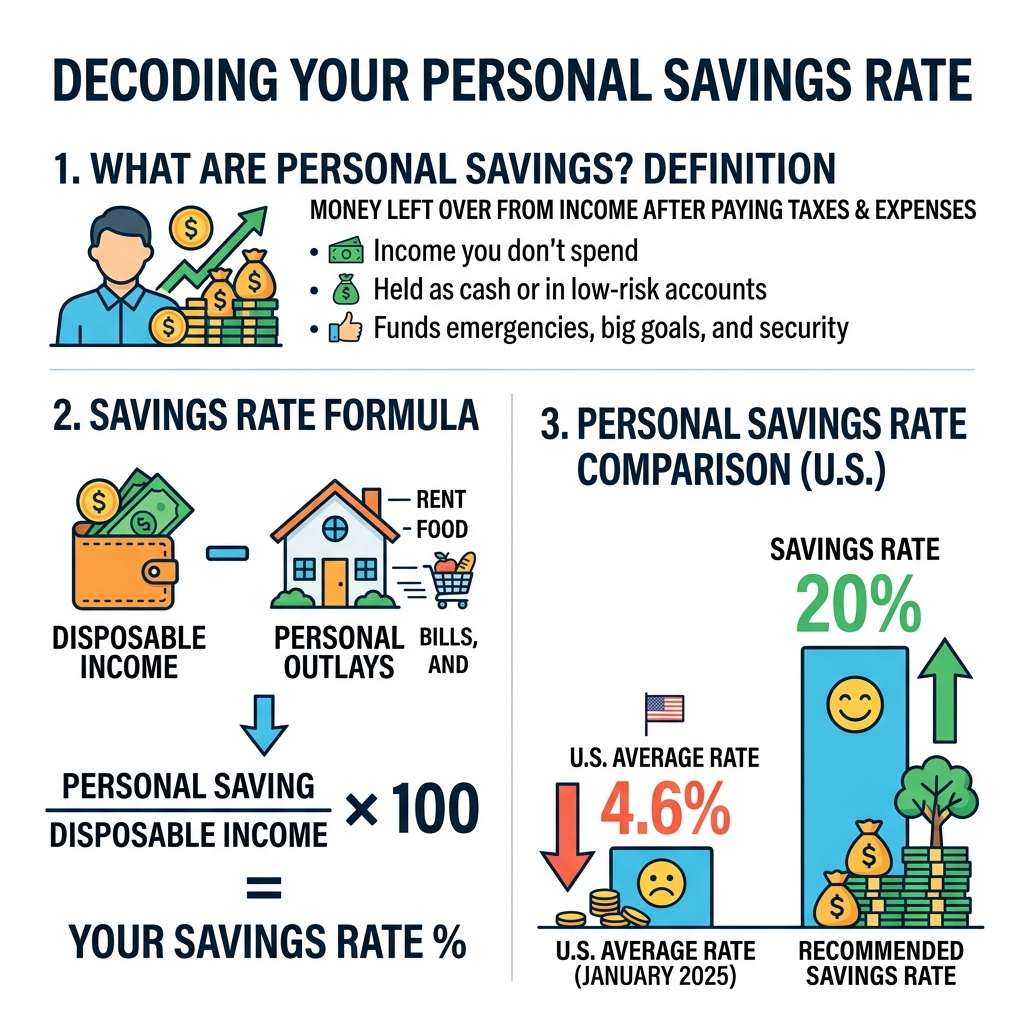
Personal savings is the money left over from your income after you’ve paid taxes and covered your expenses. It’s the portion you set aside rather than spend — kept somewhere safe, like a bank account, for future needs or goals.
Here’s a quick breakdown:
- What it is: Income you don’t spend — held as cash or in a low-risk account
- How it’s calculated: Income minus taxes minus spending = savings
- Why it matters: It funds emergencies, big goals, and long-term security
- Where it lives: Savings accounts, money market accounts, CDs — not the stock market
- How it’s measured: Your personal savings rate is your savings as a percentage of your disposable (after-tax) income
Think of your savings rate like a GPS for your financial life. Without it, you’re moving — but you don’t really know where you’re headed or how far you’ve come.
The numbers tell a sobering story. The U.S. personal savings rate sat at just 4.6% in January 2025, well below the 20% that most financial experts recommend. Even more striking: 27% of U.S. adults have zero emergency savings, and nearly 3 in 10 don’t have enough saved to cover three months of expenses.
If you’re in your 20s juggling rent, groceries, student loans, and a social life — this guide is for you. We’ll walk through everything: what personal savings actually are, how to calculate your rate, where to keep your money, and how to grow your savings even when it feels impossible.
What are Personal Savings and Why Do They Matter?
When we talk about what are personal savings, we are looking at two different things: a “flow” and a “stock.” In economic terms, Saving is the act of not spending your income (the flow), while “savings” refers to the pile of money you’ve accumulated over time (the stock).
The U.S. Bureau of Economic Analysis (BEA) defines personal saving as the amount of disposable personal income that is not spent on personal outlays. This includes your wages, salaries, and government benefits minus the taxes you pay and the money you spend on rent, food, and Netflix.
But why does this matter for us? Beyond the technical Personal saving definitions, having a healthy savings habit is the ultimate form of self-care. It’s about “deferred consumption”—choosing to skip a fancy dinner today so you can afford a home tomorrow. It provides a buffer against the world’s unpredictability and gives you the freedom to make choices without being held hostage by a paycheck. If you’re just starting out, checking out our guide on Learning the Ropes of Personal Finance: A Beginner’s Guide can help you set the foundation, or you can dive deeper into the basics with our Enter the World of Personal Savings: A Beginner’s Guide.
What are personal savings goals for young adults?
Setting goals makes the act of “not spending” feel less like a chore and more like a mission. For most of us, what are personal savings goals usually fall into three buckets:
- The Emergency Fund (The “Oh No” Fund): This is your most critical goal. Experts recommend having three to six months of living expenses tucked away. This covers car repairs, unexpected vet visits, or a sudden job loss. If you’re starting from zero, don’t panic—check out Simple Ways to Build an Emergency Fund.
- Short-Term Goals (The “Rainy Day” and Fun Funds): This is money for things you want in the next 1-3 years. Think of a dream vacation, a new laptop, or a wedding.
- Long-Term Goals (The “Big Dreams”): This includes a home down payment or starting your retirement journey. Even though retirement feels light-years away, starting early is the best way to let compound interest do the heavy lifting. We have a great resource on How to Start a Retirement Fund to get you moving.
How what are personal savings different from investing?
It’s common to use the terms “saving” and “investing” interchangeably, but they are actually very different animals.
- Savings are about capital preservation and liquidity. You put money in a safe place (like an FDIC-insured bank account) where you know exactly how much will be there when you need it. The risk is extremely low, but so is the return.
- Investing is about growth. You use your money to buy assets like stocks or bonds. There is a risk that you could lose money if the market dips, but there is also the potential for much higher returns over a long time horizon.
In personal finance, we generally recommend building a solid savings foundation before you start heavy investing. You don’t want to be forced to sell your stocks during a market crash just because your car broke down. For more on how to balance these, see our Short-Term vs. Long-Term Savings Tips.

Calculating Your Personal Savings Rate: The Financial GPS
If you don’t know your savings rate, you’re essentially flying blind. Your personal savings rate is the percentage of your disposable income that you actually save. According to Personal Saving Rate data, this is a key indicator of financial health.
To calculate your rate, follow this simple formula:
- Find your Monthly Disposable Income: This is your “take-home pay” after taxes are taken out.
- Calculate your Total Savings: Subtract all your monthly expenses (rent, food, insurance, entertainment) from your take-home pay.
- The Formula: (Total Monthly Savings / Disposable Income) x 100 = Your Savings Rate.
Example: Let’s say your take-home pay is $4,000. Your rent, groceries, and other bills total $3,200. This leaves you with $800 in savings. ($800 / $4,000) x 100 = 20% Savings Rate.
Knowing this number helps you adjust your habits. If your rate is 2%, you know you need to cut costs or find a side hustle. If it’s 25%, you’re doing fantastic! For more help on setting these numbers up, our Beginner Guide to Financial Planning and Budgeting for Savings: Where to Begin are perfect starting points.
Benchmarking what are personal savings in the U.S.
How do you stack up against the rest of the country? The data from the U.S. Bureau of Economic Analysis (BEA) gives us a clear picture of the national average.
- The Average: In January 2025, the average U.S. savings rate was 4.6%. By January 2026, it held steady at 4.5%, though it dipped as low as 3.6% in December 2025.
- The Expert Rule: Most financial pros suggest the 50/30/20 rule: 50% of income for needs, 30% for wants, and 20% for savings.
- The High-Achievers: Those in the FIRE movement (Financial Independence, Retire Early) often strive for a savings rate of 50% or more.
While 20% is a great goal, don’t get discouraged if you’re starting smaller. Even a 5% savings rate is better than 0%. The Personal Income statistics show that while income levels vary, the habit of saving is what truly builds wealth over time.
Where to Stash Your Cash: Types of Savings Accounts
Once you’ve decided to save, where should the money go? You want a place that is safe, accessible, and hopefully earns a bit of interest.
| Account Type | Best For | Pros | Cons |
|---|---|---|---|
| Traditional Savings | Everyday emergencies | Easy access, low minimums | Very low interest rates |
| High-Yield Savings (HYSA) | Emergency funds/Short-term goals | Much higher interest (APY) | May be at an online-only bank |
| Certificates of Deposit (CDs) | Money you won’t need for 1-5 years | Guaranteed higher rate | Penalty for early withdrawal |
| Money Market Accounts | Large balances | Higher rates + check-writing | Often requires high minimum balance |
When choosing an account, look for the Annual Percentage Yield (APY). This represents the total amount of interest you earn in a year, including the effect of compounding interest (where you earn interest on your interest!).
Also, ensure your bank is a member of the Federal Deposit Insurance Corporation (FDIC). This protects your money up to $250,000 per depositor, per account category. For a deeper dive into these options, check out Making Your First Steps into the World of Savings and our Personal Finance 101: Stress-Free Saving Tips.
Understanding the distinction between personal and business savings
If you’re a freelancer or a small business owner, it’s tempting to keep all your money in one bucket. However, separating your personal and business savings is crucial for several reasons:
- Legal Separation: If you have a limited company, keeping separate accounts protects your personal assets from business liabilities.
- Tax Reporting: Come tax season, you’ll thank yourself for not having to sift through personal grocery receipts to find business expenses.
- Professionalism: Paying a vendor from a business account looks much more professional than using your personal account.
- Asset Protection: Even for sole traders, separation helps you clearly see how much profit the business is actually making versus how much you are “saving” for your personal life.
Strategies to Boost Your Savings Rate
If your current savings rate is lower than you’d like, don’t worry. There are several actionable steps we can take together to move the needle.
- Automate Everything: This is the “gold standard” of saving. Set up a split in your direct deposit so a portion of your paycheck goes directly into your savings account before you ever see it. You can’t spend what you don’t “have.” Learn more about Automatic Savings: Making Your Money Work for You.
- Pay Yourself First: Treat your savings like a non-negotiable bill. Pay your “future self” before you pay for subscriptions or dining out.
- Audit Your Subscriptions: We’ve all been there—paying for a streaming service we haven’t watched in six months. Cancel the “zombie” subscriptions and move that exact dollar amount into your savings.
- Increase Your Income: Sometimes you’ve cut as much as you can. In that case, look for side hustles or cash-back rewards programs to boost the “income” side of your savings equation. For more monthly ideas, see How to Save Money Every Month.
Frequently Asked Questions about Personal Savings
How much should I have in my emergency fund?
The general recommendation is three to six months of living expenses. If your monthly bills are $3,000, you should aim for $9,000 to $18,000. However, if you are a freelancer or have an unstable income, aiming for closer to nine or twelve months might provide better peace of mind.
Is my money safe in a savings account?
Yes, provided the institution is FDIC-insured (for banks) or NCUA-insured (for credit unions). Your deposits are protected up to $250,000. This makes savings accounts one of the safest places on earth for your money, unlike the stock market where your balance can fluctuate daily.
Can I use a personal savings account for my small business?
While you can (especially if you are a sole trader), it is generally not recommended. It complicates your taxes, reduces your legal protections, and makes it harder to track the actual growth of your business. It’s almost always better to open a dedicated business savings account.
Conclusion
At QuickFinHub, we believe that understanding what are personal savings is the first step toward true financial empowerment. It’s not about how much you make; it’s about how much you keep. By calculating your savings rate, choosing the right accounts, and automating your habits, you are building a bridge to your future self.
The average U.S. savings rate might be 4.6%, but you don’t have to be average. Whether you’re aiming for the expert-recommended 20% or the FIRE-level 50%, the best time to start is today. Consistent, small habits lead to massive results over time.
Ready to take the next step? Explore more Saving Strategies or Start your journey today with our community of young adults navigating finance together. Your future self will thank you!
