
Your Money Is Losing Value While You Read This
The best investments for beginners don’t require a finance degree, a big salary, or years of experience. Here’s a quick overview of the top options to get you started:
| Investment | Minimum to Start | Best For |
|---|---|---|
| 401(k) / Workplace Plan | $0 (paycheck deduction) | Retirement + free employer match |
| Index Funds / ETFs | As little as $1 | Long-term growth, low fees |
| Target-Date Funds | Varies by provider | Hands-off, set-and-forget investing |
| Robo-Advisors / Apps | As little as $5 | Automated, beginner-friendly |
| High-Yield Savings Account | Varies (often $0-$500) | Short-term goals, emergency fund |
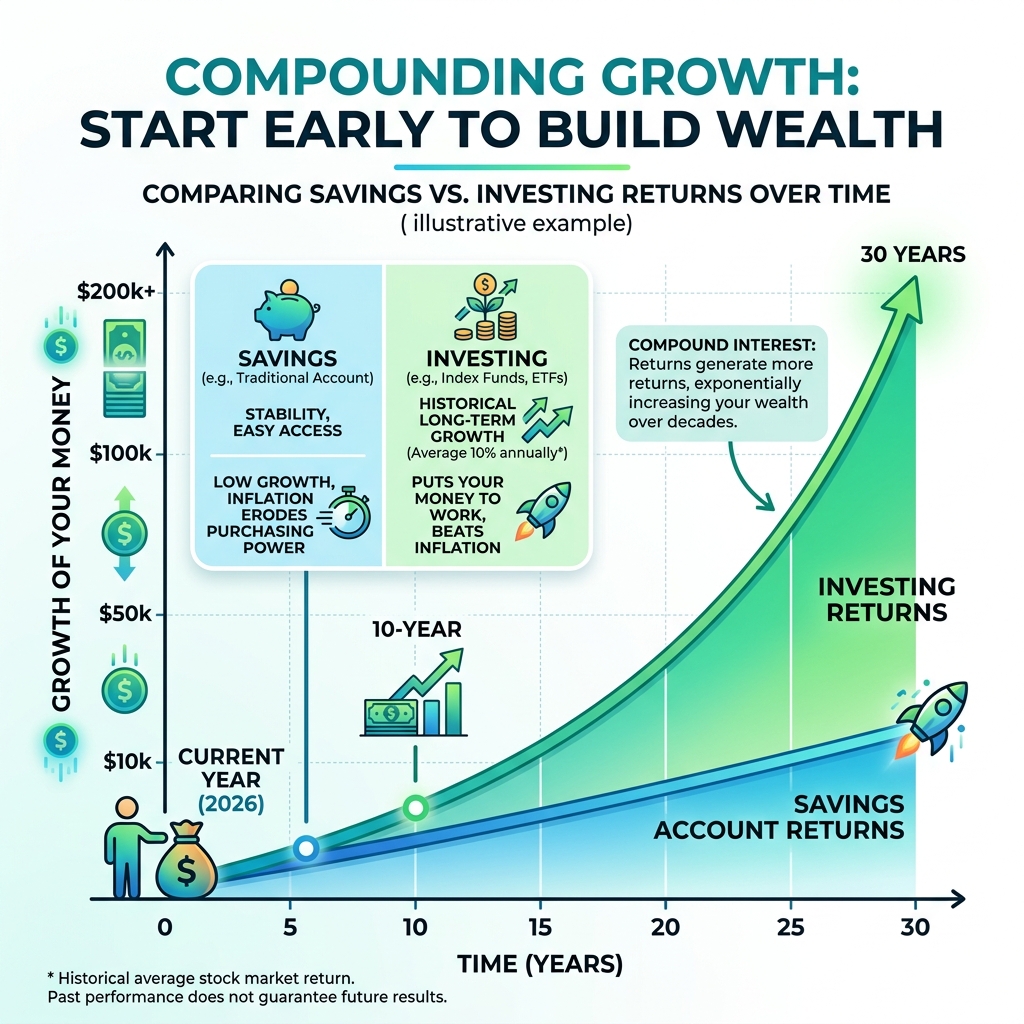
Here’s a hard truth: if your money is sitting in a traditional savings account, it’s likely earning around 0.01% interest. Meanwhile, inflation is quietly eroding its purchasing power every single year.
That gap matters more than most people realize.
The stock market has historically returned an average of around 10% per year over the long run. That’s not a guarantee — but it’s a powerful reminder of what’s possible when you put your money to work instead of letting it sit still.
The best time to start investing was yesterday. The second-best time is today.
You don’t need thousands of dollars. Some apps let you start with as little as $5. What you do need is a basic understanding of your options — and that’s exactly what this guide covers.
Why Investing is the Best Investments for Beginners Strategy
When we talk about the best investments for beginners, we aren’t just talking about picking the next “hot” stock. We’re talking about a fundamental shift in how you handle your wealth. At QuickFinHub, we believe that understanding the difference between saving and investing is the first step toward true financial independence.
Saving is like putting your money in a safe. It’s there when you need it, but it’s essentially “sleeping.” Investing, on the other hand, is putting your money to work. When you invest, you purchase assets—like stocks, bonds, or real estate—with the expectation that they will grow in value over time.
Beating the Inflation Monster
Inflation is the silent thief that makes your morning latte more expensive every year. If inflation is 3% and your savings account pays 0.01%, you are technically losing money every day. Investing is one of the few ways to consistently outpace inflation and maintain your purchasing power. For a deeper dive into these fundamentals, check out our article on Learning the Ropes of Personal Finance: A Beginner’s Guide.
The Magic of Compounding
Compound interest is often called the eighth wonder of the world. It’s the process where your investment returns earn their own returns. Imagine you invest $1,000 and it earns 10%. Now you have $1,100. The next year, that 10% return is calculated on $1,100, not just your original thousand. Over 20 or 30 years, this “snowball effect” can turn small monthly contributions into a massive nest egg.
Risk vs. Reward
We’ll be honest: investing involves risk. Markets go up and down. However, the biggest risk for young adults is often not investing at all. Over long time horizons—think 10, 20, or 40 years—the market has historically trended upward. By starting early, you give yourself the luxury of time to ride out the temporary dips.

Top 5 Beginner-Friendly Investment Options
Choosing where to put your first dollar can feel like staring at a 50-page restaurant menu. To keep it simple, we focus on options that offer diversification (not putting all your eggs in one basket) and low expense ratios (the fees you pay to own a fund).
Here is a quick look at how the three main asset classes stack up:
| Asset Type | Risk Level | Potential Return | Best For… |
|---|---|---|---|
| Stocks | High | High | Long-term growth (10+ years) |
| Bonds | Low to Medium | Low to Medium | Income and stability |
| Mutual Funds | Varies | Varies | Instant diversification |
Diversification is your best friend. Instead of betting on one company, you bet on hundreds. This reduces the chance that one bad apple will ruin your whole portfolio. For more on this, see our Simple Portfolio Diversification Tips.
1. Workplace Retirement Plans and 401(k)s
If your employer offers a 401(k) or a similar workplace retirement plan, this is almost always the best investments for beginners starting point. Why? Two words: Employer Match.
Many companies will match your contributions up to a certain percentage (e.g., they put in $1 for every $1 you contribute, up to 6% of your salary). This is literally free money. If you aren’t contributing enough to get the full match, you’re leaving money on the table.
Tax Advantages
401(k)s come in two main flavors:
- Traditional: Contributions are taken out of your paycheck before taxes. This lowers your taxable income today.
- Roth: You contribute after-tax money, but your withdrawals in retirement are tax-free.
Because the money is deducted automatically from your paycheck, you never “see” it, which makes building an investing habit incredibly easy. If you’re ready to set one up, read our guide on How to Start a Retirement Fund.
2. Low-Cost Index Funds and ETFs
Index funds and Exchange-Traded Funds (ETFs) are like “baskets” of stocks or bonds. Instead of trying to pick the best individual company, you buy a tiny piece of hundreds of companies at once.
The Power of the S&P 500
A popular choice for beginners is an S&P 500 index fund. This fund tracks the performance of the 500 largest companies in the U.S. When you buy one share, you’re essentially betting on the American economy as a whole.
Why Low Fees Matter
Fees, known as “expense ratios,” can eat your profits over time. An expense ratio of 0.10% means you pay $10 for every $10,000 invested. Some low-cost fund providers have average expense ratios as low as 0.07%, which is significantly lower than the industry average of 0.44%. Every dollar you save in fees is a dollar that stays in your pocket to compound.
Check out our Beginner Guide to ETFs for more details, or explore the SEC’s guide on mutual funds and ETFs.
3. Target-Date Mutual Funds
If you want a truly “set-and-forget” strategy, target-date funds are a fantastic choice. These funds are named after the year you plan to retire (e.g., “Target Retirement 2060”).
The fund starts out aggressive (mostly stocks) while you are young and have time to grow. As you get closer to your retirement date, the fund automatically rebalances itself to become more conservative (adding more bonds) to protect your savings. It’s like having a professional manager adjust your portfolio for you, without the high fees of a personal advisor. You can find more Beginner-friendly mutual fund tips on our site.
4. Robo-Advisors and Investing Apps
For those who prefer a digital-first approach, robo-advisors use computer algorithms to manage your investments. You answer a few questions about your goals and risk tolerance, and the “robo” builds a diversified portfolio of ETFs for you.
Fractional Shares
One of the coolest features of modern Investing apps for beginners is fractional shares. If a single share of a popular tech company costs $3,000, you don’t need $3,000 to invest. You can buy $5 worth of that share. This lowers the barrier to entry significantly, allowing anyone to start with the spare change in their pocket.
Robo-advisors typically charge a small fee—usually between 0.25% and 0.50% of your account balance per year—which is quite affordable for the level of automation they provide.
5. High-Yield Savings Accounts (HYSA)
While we’ve spent a lot of time talking about the stock market, every beginner needs a safe place for their “right now” money. This is where the High-Yield Savings Account (HYSA) comes in.
Traditional banks might pay 0.01%, but HYSAs (often found at online-only banks) can offer rates ranging from 1% to over 4%, depending on the current economy. They are FDIC-insured, meaning your money is safe up to $250,000, and you can withdraw your cash whenever you need it.
HYSAs are perfect for:
- Your emergency fund (3-6 months of expenses).
- Short-term goals, like a vacation or a house down payment in two years.
Explore more Safe Investing Options for Beginners to see how these fit into your plan.
How to Start Your Journey with Small Amounts
Many people think you need a suitcase full of cash to start investing. In reality, you can start with the price of a burrito. Micro-investing platforms allow you to begin with as little as $1 to $5.
The secret to success isn’t starting big; it’s starting consistently. This is called Dollar-Cost Averaging. By investing a set amount (say $50) every month, you buy more shares when prices are low and fewer shares when prices are high. Over time, this averages out the cost of your investments and takes the stress out of trying to “time the market.”
If you’re working with a tight budget, check out our tips on Investing with Small Amounts.
Determining Your Risk Tolerance for the Best Investments for Beginners
Before you dive in, we need to talk about your “stomach” for risk. Risk tolerance is a mix of two things:
- Risk Capacity: How much can you afford to lose? If you’re 22, your capacity is high because you have decades to recover.
- Risk Tolerance: How will you feel if your account drops 10% in a week? If you’ll lose sleep or panic-sell, you might need a more conservative portfolio.
Understanding this balance is crucial to staying invested for the long haul. Learn more at Understanding Risk in Investing.
Step-by-Step Guide to Choosing the Best Investments for Beginners
Ready to pull the trigger? Follow these steps:
- Set SMART Goals: Be Specific, Measurable, Achievable, Relevant, and Timely. (e.g., “I want to save $5,000 for a house down payment in 3 years.”)
- Build an Emergency Fund: Don’t invest money you’ll need for rent next month.
- Choose Your Account: Use a 401(k) for the match, an IRA for tax perks, or a brokerage account for flexibility.
- Pick Your Assets: Start with a simple total market index fund or a target-date fund.
- Automate It: Set up a recurring transfer so you don’t have to remember to invest.
For a complete roadmap, see our Beginner Guide to Financial Planning and Easy Ways to Start Investing.
Common Pitfalls and How to Avoid Them
Even the best investments for beginners can go south if you fall into common psychological traps. Here is what we see most often:
1. Timing the Market
Trying to predict when the market will hit its lowest point is a fool’s errand. Even the pros get it wrong. The “time in the market” is much more important than “timing the market.” Stay consistent, regardless of the headlines.
2. Lack of Diversification
Investing all your money in one “meme stock” or your uncle’s “sure-thing” startup is gambling, not investing. Stick to broad funds that cover hundreds of companies.
3. Emotional Selling
When the market dips (and it will), your instinct will be to sell to “save” what’s left. This is how people lose money. You only lock in a loss if you sell. If you have a long-term horizon, a market dip is actually a “sale” where stocks are cheaper.
4. Ignoring Fees
A 1% fee might not sound like much, but over 30 years, it can cost you hundreds of thousands of dollars in lost growth. Always check the expense ratio!
To learn how to keep your cool, read How to Invest Without Stress and our Long-Term vs. Short-Term Investing Tips.
Frequently Asked Questions about Beginner Investing
How much money do I need to start?
You can start with as little as $1 to $5. Many modern brokerages have $0 account minimums and offer fractional shares. You don’t need to be rich to start; you just need to start. For those on a shoestring, we have a guide on Simple Investment Options for Low Budget.
What is the difference between an ETF and a Mutual Fund?
The main difference is how they are traded. ETFs trade like stocks—their price fluctuates throughout the day, and you can buy them anytime the market is open. Mutual funds are only priced once at the end of the day. For most beginners, ETFs are more accessible because they often have lower minimum investment requirements.
Should I pay off debt before investing?
This depends on the interest rate. If you have high-interest credit card debt (usually 20%+), pay that off first! No investment consistently returns 20%. However, if you have low-interest student loans (3-4%), you might be better off investing while making your regular payments. Always prioritize your emergency fund first. Get more Investing tips for young adults to help you decide.
Conclusion
At QuickFinHub, we know that starting your investment journey can feel overwhelming, especially when you’re navigating major life transitions like starting a first job or moving to a new city. But remember: the goal isn’t to become a millionaire overnight. The goal is to build a foundation of financial independence that gives you options in the future.
Whether you start with a 401(k) match or a $5-a-week habit in an investing app, the most important thing is that you stop stashing cash under the mattress and start letting the power of the global economy work for you.
You’ve got the tools. You’ve got the knowledge. Now, it’s time to take that first step.
** Start your journey at QuickFinHub Investing Basics and let’s grow that wealth together!**
