
Why You Should Automate Credit Card Debt Payments Right Now
Automating credit card debt payments means setting up a recurring withdrawal from your bank account to pay your credit card bill every month — automatically, without you having to lift a finger.
Here’s how to do it in 4 simple steps:
- Log in to your credit card issuer’s website or app
- Navigate to the Payments section and select “Automatic Payments” or “AutoPay”
- Link your checking account and choose your payment amount (minimum, fixed, or full balance)
- Confirm your payment date and accept the terms
That’s it. Your payments run on schedule every month.
Life in your early 20s is a lot. New job, new city, new bills — and somehow you’re supposed to remember to pay your credit card every single month without missing a due date.
Most people don’t. And it costs them.
A single missed payment can trigger a late fee of up to $28. If it goes past 30 days, it shows up on your credit report. Payment history makes up 35% of your FICO score — it’s the single biggest factor in whether lenders see you as trustworthy or risky.
The good news? There’s a simple fix: schedule recurring credit card payments so the bill pays itself.
But here’s what most guides won’t tell you — autopay isn’t a “set it and forget it” magic button. Research shows that people who automate only the minimum payment often stay stuck in debt for months or even years, paying mostly interest while their balance barely budges. The tool works. The strategy matters.
This guide walks you through exactly how to set up autopay, which payment option actually helps you get out of debt, and the pitfalls to avoid along the way.

Understanding Credit Card Autopay for Debt Management
At its core, autopay is a financial “nudge.” It’s designed to make the right choice—paying your bills on time—the easiest choice. When we automate credit card debt payments, we are giving the credit card company permission to “pull” a specific amount of money from our checking account on a specific date every month.
This process involves a few moving parts:
- Statement Date: This is when your billing cycle ends and the company calculates what you owe.
- Payment Authorization: This is the legal “green light” you give the bank to take your money.
- Recurring Withdrawals: Unlike a one-time payment, this happens every month until you tell it to stop.
If you are just starting out, check out our beginners-guide-to-tackling-credit-card-debt to see how automation fits into a larger plan. Understanding the mechanics is the first step toward mastery. You aren’t just paying a bill; you’re building a system that protects your future self from forgetfulness.
How to automate credit card debt payments
The enrollment process is generally uniform across major banks, though the buttons might look a little different. Most of us live on our phones, so using the issuer’s mobile app is usually the fastest route.
- Link Your Accounts: You’ll need your checking account number and routing number. Don’t use a debit card number; use the actual bank account details to ensure the connection is stable.
- Choose Your Amount: You will typically see three options: Minimum Payment, Statement Balance, or Fixed Amount. (We’ll dive into which one is best for debt in a moment!)
- Pick a Date: Most people choose the actual due date, but we recommend picking a date 2–3 days before the due date. This acts as a buffer in case there’s a banking holiday or a processing delay.
- Verification: Some banks will send a small “test” deposit or ask for a multi-factor authentication code to prove you own the account.
If tech isn’t your thing, you can always call the customer service number on the back of your card. A representative can walk you through the setup over the phone, though they will still need those bank routing numbers.
Autopay vs. Bank Bill-Pay Services
It’s easy to confuse autopay with your bank’s “Bill-Pay” service, but they work in opposite directions.
- Autopay (Pull Payment): The credit card company reaches into your bank account and pulls the money. This is usually better for variable bills (like credit cards) because the company knows exactly how much you owe each month and adjusts the withdrawal automatically.
- Bank Bill-Pay (Push Payment): Your bank sends money to the credit card company. This is great for fixed bills like rent or a car loan. However, for credit cards, you have to manually update the amount every month, or you might accidentally pay too little.
Processing times also differ. Autopay is usually credited the same day the withdrawal happens. Bank Bill-Pay might involve the bank mailing a physical check, which can take 5–7 business days. For the sake of speed and accuracy, setting up autopay directly with the card issuer is usually the safer bet.
Why Automating Your Payments is a Credit Score Game-Changer
If you want a high credit score, you need a perfect payment history. Period. According to FICO, payment history accounts for 35% of your score calculation. A single 30-day late mark can tank a good score by 100 points or more.
By choosing to automate credit card debt payments, you are essentially buying “credit score insurance.” Even if you’re traveling, sick, or just busy, the system ensures you never hit that 30-day late threshold.
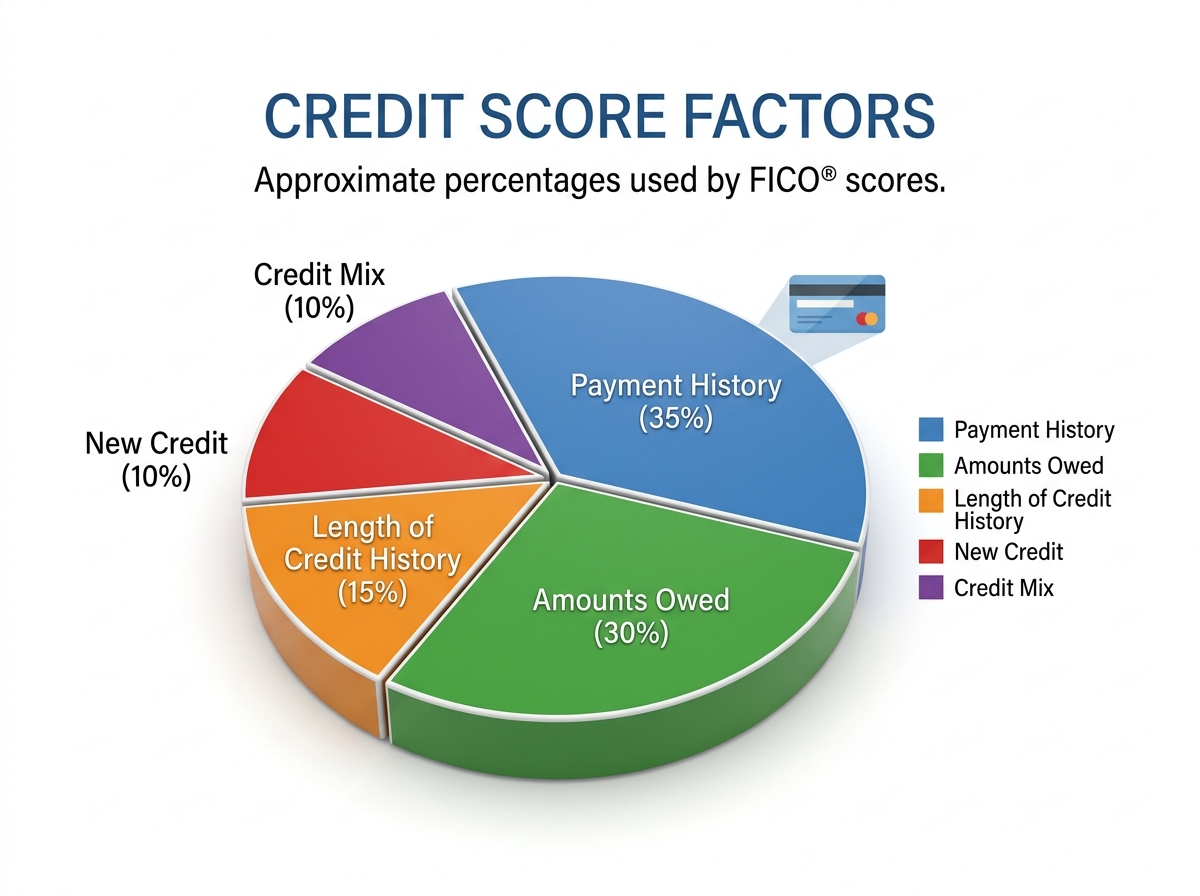
Beyond just being “on time,” automation helps with credit utilization (which is another 30% of your score). This is the ratio of how much debt you have compared to your total limit. Consistent, automated payments keep your balances trending downward, which lowers your utilization and makes your score climb. For more tips on this, read our guide on helping-your-credit-score-climb-a-guide-for-newbies.
The Best Way to Automate Credit Card Debt Payments for Maximum Impact
If your goal is to get out of debt — not just stay current — the “Minimum Payment” option is your enemy. While it protects your credit score, it keeps you in debt longer.
The “Full Balance” option is the gold standard because it avoids interest entirely. But if you have a $5,000 balance and only $1,000 in your bank account, “Full Balance” will cause an overdraft.
The “Fixed Amount” strategy is often the “sweet spot” for debt reduction. By picking a number higher than the minimum — say, $200 every month regardless of the statement — you create a consistent downward pressure on your debt. This helps you hit your “debt-free date” much faster and saves you hundreds, if not thousands, in interest.
[TABLE] comparing Minimum, Fixed, and Full Balance options
| Feature | Minimum Payment | Fixed Amount (e.g., $200) | Full Statement Balance |
|---|---|---|---|
| Interest Costs | Highest (Very expensive) | Moderate (Declines over time) | Zero (Best for your wallet) |
| Payoff Speed | Extremely Slow (Years) | Faster (Predictable) | Immediate (Monthly) |
| Cash Flow Risk | Low (Smallest withdrawal) | Medium (Consistent) | High (Varies by spending) |
| Credit Score Impact | Positive (On-time) | Very Positive (Lowering debt) | Excellent (Low utilization) |
Avoiding the “Minimum Payment Trap” and Other Autopay Risks
Automation is a tool, but like any tool, it can be misused. There is a psychological phenomenon where once we set up autopay, we stop looking at our statements. We call this “financial ghosting,” and it can lead to the “Minimum Payment Trap.”
A study in the UK found that when people signed up for autopay, many chose the minimum payment as a safety net. However, they stayed at that minimum level for an average of 10 months. Because credit card interest rates are so high (often 20% or more), paying only the minimum barely covers the interest. Your actual debt stays the same, or even grows, while you feel like you’re making progress.
Don’t let your “nudge” backfire. If you’re struggling with this, our article on sidestepping-the-pitfalls-avoiding-common-debt-mistakes offers deeper insights into how to break the cycle.
Why Minimum Autopay Can Lead to More Debt
When you only pay the minimum, you are essentially treading water in a pool of high-interest debt.
- Interest Accrual: The unpaid balance gathers interest every single day.
- 10-Month Plateau: Statistics show that autopay users often “set it and forget it” for nearly a year before realizing their balance hasn’t dropped.
- Negative Nudges: Sometimes, knowing the bill is “taken care of” makes us feel more comfortable spending more on the card, leading to a growing mountain of debt.
Preventing Overdraft Fees and Insufficient Funds
The biggest fear of autopay is the dreaded “Insufficient Funds” notification. In 2024, the average overdraft fee hit $27.08. If your autopay fails, the credit card issuer might also hit you with a “returned payment fee” of $25 to $40. Suddenly, your attempt to be responsible has cost you $60 in fees.
To prevent this:
- Align with Your Paycheck: If you get paid on the 15th, set your autopay for the 17th.
- Low-Balance Alerts: Set your banking app to text you if your balance drops below $100.
- The “Safety Buffer”: Try to keep a small “buffer” of cash in your checking account that you never touch, specifically to cover automated bills.
How to Automate Credit Card Debt Payments with Major Issuers
Most major issuers like Chase, American Express, and Capital One have made the autopay process very user-friendly.
- Chase: You can set this up in the “Payments” tab of the mobile app. They even allow you to choose to pay the “Statement Balance” or a “Fixed Amount.”
- American Express: Known for their “Manage Autopay” feature, Amex allows you to set a ceiling. For example, “Pay the full balance, but never more than $500.”
- Capital One: Their app, Eno, can actually send you reminders that an automatic payment is coming up, giving you a chance to check your bank balance.
Setting Up Your Recurring Payment Plan
When you finalize your setup, the bank will ask you to “Accept Terms and Conditions.” Read the fine print. Specifically, look for how long it takes for the first payment to start. Many issuers take 1–2 billing cycles to activate autopay. This means you might still need to make a manual payment this month to avoid a late fee.
Always wait for a confirmation email or a “Success” screen. We recommend taking a screenshot of that confirmation for your records.
Monitoring and Adjusting Your Automation Strategy
Autopay is not an excuse to stop reading your mail. You should still log in once a month to:
- Check for Fraud: Autopay will faithfully pay for a $100 fraudulent charge if you don’t catch it.
- Verify the Amount: Ensure the bank pulled the correct amount.
- The “Subscription Purge”: Look for recurring charges you don’t use anymore. If you see a $15 gym membership you haven’t used since January, cancel it and add that $15 to your automated debt payment instead.
Frequently Asked Questions about Automating Debt
Can I cancel or change my autopay settings?
Yes, but timing is everything. Most issuers require at least 3 business days’ notice to stop a scheduled payment. If your payment is due on Monday and you try to cancel it on Sunday night, the money will likely still leave your account. Always check your “Processing Window” in the app.
Does autopay protect me from all late fees?
Not necessarily. If your bank account doesn’t have enough money, the payment will fail. A failed payment is treated the same as a missed payment. You’ll get hit with a late fee from the credit card company and an overdraft fee from your bank. Automation only works if the “fuel” (money) is in the tank.
What are the best alternatives to autopay?
If you have an irregular income (like freelance work) and can’t predict your bank balance, autopay might be too risky. In that case:
- Calendar Reminders: Set three alarms on your phone for 5 days, 2 days, and 1 day before the due date.
- Manual Bill-Pay: Log in every payday and pay whatever you can afford at that moment.
- Debt Snowball: Focus on paying off the smallest balance first while making minimums on the rest. You can automate the minimums and manually pay the “extra” toward your target card.
Conclusion: Taking Control of Your Financial Future
At QuickFinHub, we believe that financial freedom isn’t about how much you make; it’s about the systems you build. Choosing to automate credit card debt payments is one of the most powerful systems a young adult can implement. It removes the “human error” from your credit score and ensures that you are constantly moving toward a debt-free life.
The goal isn’t just to be “on time”—it’s to be “done.” Use autopay as your safety net, but keep your eyes on the prize by paying more than the minimum whenever possible.
Ready to see how fast you can actually become debt-free? Start your journey to debt freedom today and take the first step toward a life without interest charges. Consistent habits today lead to total freedom tomorrow.
