
Why Most People Struggle With Money (And What Actually Fixes It)
A monthly budget for beginners is a written plan that tells your money where to go before the month starts — covering your income, fixed bills, variable spending, and savings goals.
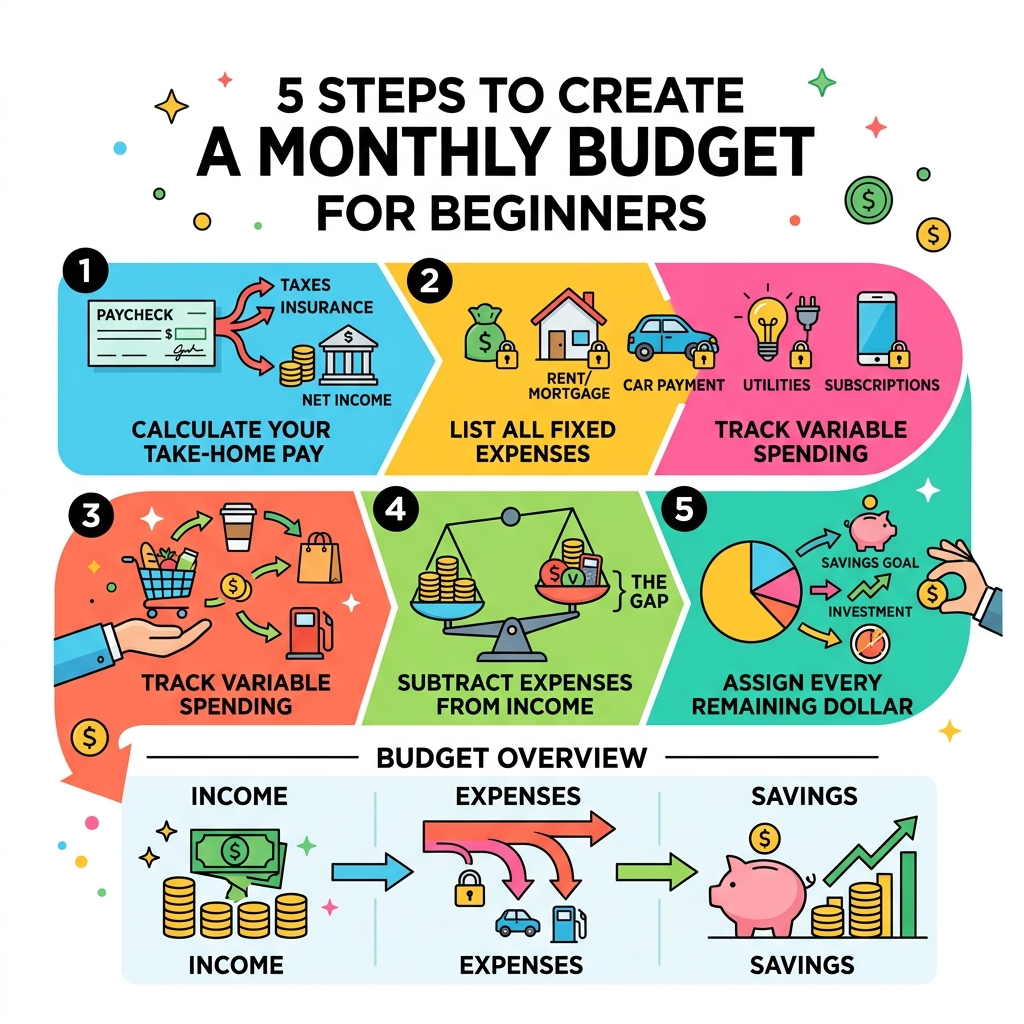
Here’s how to start one in 5 steps:
- Calculate your take-home pay (after taxes, not your gross salary)
- List all fixed expenses (rent, subscriptions, minimum debt payments)
- Track variable spending (food, transport, entertainment)
- Subtract expenses from income and spot the gap
- Assign every remaining dollar to a category or savings goal
Nearly 78% of Americans live paycheck to paycheck. And it’s not always because they don’t earn enough. More often, it’s because no one ever showed them how to plan their spending on purpose.
The good news? A budget isn’t about restriction. It’s about clarity. When you know exactly where your money is going, you stop wondering why it disappears.
Think of it like a GPS for your finances. You wouldn’t drive to a new city without directions. Your money works the same way — without a plan, you’re just guessing.
This guide walks you through everything: how to build your first budget, which method fits your life, how to actually stick to it, and what to do when things go sideways.
Why a Monthly Budget for Beginners is Your Financial Superpower
We’ve all been there: staring at a bank balance on a Tuesday morning, wondering how $200 vanished since Friday. For many of us, the word “budget” sounds like a financial diet — bland, restrictive, and zero fun. But at QuickFinHub, we see it differently. A monthly budget for beginners isn’t a cage; it’s a roadmap to freedom.
When you have a plan, you aren’t just “not spending money.” You are choosing exactly what your money does for you. This clarity is the ultimate stress-reducer. In fact, research on the link between financial planning and mental well-being shows that having a plan significantly lowers anxiety.
Budgeting allows you to:
- Manage Debt: Instead of just paying the minimums and hoping for the best, you can strategically target high-interest balances.
- Reach Savings Goals: Whether it’s a trip to Japan or a down payment on a house, a budget makes “someday” a specific date on the calendar.
- Empower Your Choices: You can spend $50 on a nice dinner guilt-free because you know the rent is already covered.
If you’re just starting out, check out our guide on learning the ropes of personal finance: a beginner’s guide to get the foundational mindset right. Nearly 9 in 10 Americans report using a budget in some form, yet fewer than 1 in 4 follow it consistently. The goal isn’t perfection; it’s progress.
Step-by-Step: Creating Your First Monthly Budget
Creating a monthly budget for beginners doesn’t require a degree in accounting. It just requires about 60 to 90 minutes of your time and a little bit of honesty. Most people underestimate their monthly spending by $200 to $400 because small, frequent purchases — like that $6 latte or a $12 streaming service — are “psychologically invisible.”

To start, you need to look at your “Real” numbers. Don’t guess. Pull up your bank and credit card statements from the last three months. This will give you an average of what you actually spend, not what you wish you spent.
The Foundation: Fixed vs. Variable Expenses
Every budget is built on two pillars: things that stay the same and things that change.
| Expense Type | Definition | Examples |
|---|---|---|
| Fixed Expenses | Costs that remain the same every month. | Rent/Mortgage, Car Payment, Insurance, Subscriptions. |
| Variable Expenses | Costs that fluctuate based on your habits. | Groceries, Dining Out, Gas, Entertainment. |
To dive deeper into the mechanics of daily tracking, read our article on how to track expenses at home.
Calculating Your Real Take-Home Income
The biggest mistake beginners make is budgeting based on their gross salary. If you earn $55,000 a year, you don’t actually have $4,583 to spend every month. Between taxes, health insurance, and 401(k) contributions, your take-home pay (net income) is likely closer to $3,800.
Always budget using your net income. This is the money that actually hits your bank account.
If you have irregular income — perhaps you’re a freelancer or work on commission — we recommend using your lowest-earning month from the past year as your baseline. Anything you earn above that “floor” can be treated as a bonus for your savings or debt repayment. For more granular advice, see our weekly budgeting tips for beginners.
Essential Categories for a Monthly Budget for Beginners
Once you know your income, it’s time to categorize. While everyone’s life is different, most successful budgets include these core categories:
- Housing & Utilities: Rent, electricity, water, and internet.
- Transportation: Car payments, gas, public transit, and maintenance.
- Food: Groceries and dining out (yes, keep these separate!).
- Debt Payments: Student loans, credit cards, or personal loans.
- Sinking Funds: These are for irregular but predictable expenses. Think of car registration, annual insurance premiums, or holiday gifts. Divide the annual cost by 12 and save that amount every month.
- Miscellaneous Buffer: Life happens. A $50–$100 buffer prevents a surprise birthday gift or a flat tire from blowing your entire plan.
If your total expenses are creeping too close to your income, check out these easy ways to reduce monthly expenses to find some breathing room.
Choosing the Right Budgeting Method for Your Lifestyle
There is no “one size fits all” in personal finance. The best monthly budget for beginners is the one you will actually stick to. About 70% of people find line-by-line budgeting too tedious, so if spreadsheets make your eyes glaze over, don’t use them!
Here are the most popular frameworks:
- Zero-Based Budgeting: Every single dollar gets a “job.” If you have $3,000 in income, your expenses + savings + debt payments must equal exactly $3,000. It’s highly effective for those who want total control. Learn more about zero-based budgeting for beginners.
- The Envelope System: A classic for a reason. You put cash into physical envelopes for categories like “Groceries” or “Fun.” When the envelope is empty, you’re done spending for the month.
- The Daily Budget Method: Take your flexible spending money (income minus fixed bills) and divide it by the days in the month. This gives you one simple number to stay under every day.
Implementing the 50/30/20 Rule as a Monthly Budget for Beginners
If you want a simple, balanced approach, the 50/30/20 rule is a fantastic starting point. It divides your take-home pay into three buckets:
- 50% for Needs: This covers the “must-haves” like housing, groceries, and minimum debt payments.
- 30% for Wants: This is your “fun money” — dining out, hobbies, and Netflix.
- 20% for Savings and Extra Debt Repayment: This goes toward your emergency fund, retirement, or aggressive debt payoff.
Using this rule helps you prioritize your future without feeling like you’re living in a cave. If you’re wondering how to allocate that 20%, our guide on budgeting for savings: where to begin has you covered.
How to Stick to Your Plan and Avoid Common Pitfalls
The first month of a monthly budget for beginners is always a “test run.” You will likely forget an expense or overspend in one category. That’s okay! The goal is to be 80% accurate, not perfect.
One of the biggest reasons budgets fail is “yo-yo budgeting” — being so strict for two weeks that you end up on a spending binge by week three. To avoid this, always include a small “fun money” allowance. It’s a sustainability mechanism, not a failure.
Key habits for success:
- Automate Everything: Set up automatic transfers to your savings account the day after payday. This is “Easy Mode” for budgeting.
- Check-In Weekly: Spend 10 minutes every Sunday reviewing your transactions. It prevents end-of-the-month surprises.
- Build an Emergency Fund: Aim for $1,000 initially. This acts as a shield for your budget when the “unexpected” happens.
For more tips on staying the course, read about beginner budgeting mistakes to avoid and how to prepare for budgeting for unexpected expenses.
Handling Irregular Income and Surprises
If your income fluctuates, budgeting can feel like hitting a moving target. The secret is to build a “buffer account.” During high-earning months, keep the extra money in a separate savings account. During low-earning months, you can “pay yourself” from that buffer to keep your lifestyle steady.
Even if you’re budgeting on a low income, the principle remains: control what you can, and prepare for what you can’t.
Frequently Asked Questions about Beginner Budgeting
How much should I save each month as a beginner?
We recommend aiming for 10-20% of your take-home pay. However, if you are currently living paycheck to paycheck, even $25 a month is a win. The habit of saving is more important than the amount when you’re starting. As your income grows or you cut unnecessary costs, you can increase that percentage. For a stress-free approach, check out personal finance 101: stress-free saving tips.
What should I do if my expenses exceed my income?
First, don’t panic. A budget that shows a deficit isn’t a failure — it’s the budget doing its job by making a problem visible. You have two levers: Decrease Expenses or Increase Income. Start by cutting “psychologically invisible” costs like unused subscriptions or excessive food delivery. If that’s not enough, look into side hustles or career growth. Our guide on how to save money every month offers practical tactics to close the gap.
Which tools are best for tracking my spending?
The best tool is the one you’ll use.
- Apps: There are several highly-rated budgeting apps available that offer automatic syncing and categorization to help you stay on track.
- Spreadsheets: Google Sheets or Excel offer total customization.
- Old School: A simple notebook and pen works wonders for some. Explore our list of simple tools for budget management to find your perfect match.
Conclusion
Mastering a monthly budget for beginners is the single most important step you can take toward long-term stability. It’s not about saying “no” to everything you love; it’s about saying “yes” to your future self.
At QuickFinHub, we believe that personal finance should be accessible and tailored to your life’s transitions. By taking control of your money today, you’re building a foundation for a life defined by choices, not constraints. Ready to make it permanent? Start creating a sustainable budget plan today and watch your financial confidence grow!
