
Why Money Saving Tips for Young Adults Matter More Than Ever
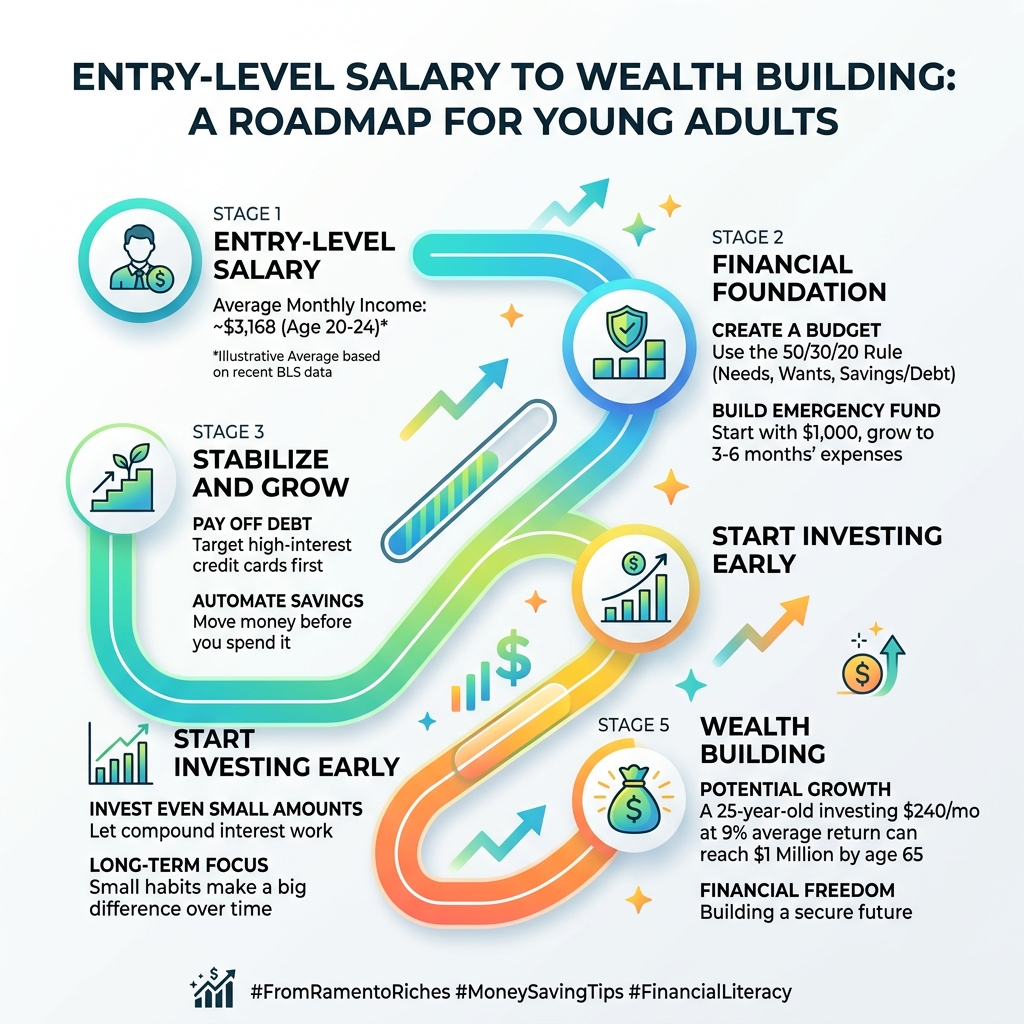
The best money saving tips for young adults come down to a handful of core habits you can start today:
- Create a budget using a simple method like the 50/30/20 rule
- Build an emergency fund covering at least $1,000 to start, then 3-6 months of expenses
- Pay off high-interest debt first, especially credit cards
- Automate your savings so money moves before you can spend it
- Start investing early, even small amounts, to let compound interest do the heavy lifting
Here’s the reality: young adults ages 20 to 24 earn around $3,168 a month on average — significantly less than the $5,328 a month earned by adults ages 35 to 44, according to the U.S. Bureau of Labor Statistics. That gap makes every dollar count more right now.
And yet, over 45% of people say they aren’t confident they could cover an unexpected expense. More than half of adults aged 18 to 29 name surprise costs as their biggest budgeting challenge.
That’s not a personal failure. It’s a system gap. Most high schools and colleges don’t teach personal finance — so most young adults figure it out the hard way, mid-crisis.
The good news? You don’t need a finance degree to get ahead. Small, consistent habits — started now — can make an enormous difference over time. A 25-year-old who invests just $240 a month at a 9% average return will have $1 million by age 65. That’s the power of starting early.
This guide breaks it all down in plain language, step by step.
Mastering the Art of Budgeting for Young Adults
Budgeting often gets a bad rap. Many of us view it as a financial “diet” that keeps us from having fun. But at QuickFinHub, we like to think of a budget as a tool that gives you power. It’s a plan for your money so you can control it, rather than letting your money control you.
When you’re starting out, the income gap is real. Since young adults typically earn about $2,000 less per month than those in their prime earning years, efficiency is everything. You can’t afford to “mental budget” and hope for the best. In fact, about a quarter of adults aged 18 to 29 don’t have a formal budget, which often leads to “leaky” spending—money disappearing on subscriptions, takeout, and impulse buys.
To stop the leak, you need a system. Check out these Personal Finance Budgeting Tips for Young Adults to see how a structured plan can change your outlook.
Comparing Popular Budgeting Methods
There isn’t a one-size-fits-all approach. Some people love tracking every penny, while others prefer a “set it and forget it” style. Here is a breakdown of the most effective strategies:
| Method | Best For | How it Works |
|---|---|---|
| 50/30/20 Rule | Beginners | 50% Needs, 30% Wants, 20% Savings/Debt. |
| Zero-Based Budget | Detail-oriented people | Every single dollar is assigned a job until you hit zero. |
| Envelope System | Over-spenders | Use cash (or digital “envelopes”) for specific categories. |
The 50/30/20 rule is arguably the most famous. It’s flexible and ensures you’re covering the basics while still allowing room for a life. On the other hand, Zero-Based Budgeting is fantastic if you find yourself wondering where your money went at the end of the month. It forces you to account for every cent, whether it’s going to rent, a burrito, or your Roth IRA.

Differentiating Needs vs. Wants
One of the hardest parts of implementing money saving tips for young adults is being honest about what is a “need” and what is a “want.”
- Needs are the non-negotiables: shelter, basic groceries, utilities, health insurance, and minimum debt payments.
- Wants are the extras: that third streaming service, upgraded gym memberships, designer clothes, or dining out.
The secret to mastering this is delayed gratification. Do you really want to pay interest on a pair of jeans or a box of cereal because you put it on a credit card? Probably not. By separating these categories, you can ensure your “fixed expenses” are covered first. If you’re struggling to find the balance, reading about Beginner Budgeting Mistakes to Avoid can help you sidestep common traps.
Choosing Your Money Saving Tips for Young Adults Strategy
Once you have your categories, it’s time to pick a strategy. We highly recommend the Pay-Yourself-First method. This means as soon as your paycheck hits, you immediately move money into savings or retirement accounts before you pay a single bill or buy groceries. This treats your future self like a mandatory bill that must be paid.
If you find manual tracking tedious, use technology. There are dozens of Budgeting Apps for Beginners that sync with your bank account to categorize spending automatically. According to the U.S. Bureau of Labor Statistics on consumer expenditures, housing, transportation, and food are the biggest expenses for most households. Monitoring these big three via an app can reveal exactly where you can trim the fat.
Building Your Financial Safety Net: The Emergency Fund
Life happens. Pipes burst, cars break down, and sometimes, jobs disappear. Without a safety net, these “spending shocks” often end up on high-interest credit cards, creating a cycle of debt that’s hard to break. This is why an emergency fund is your most important financial asset.
Experts suggest aiming for 3 to 6 months of living expenses. However, for many young adults, that number feels impossible. Don’t let the big goal scare you off. The most important thing is to start. Even a small fund provides peace of mind. Check out these Simple Ways to Build an Emergency Fund to get the ball rolling.
Steps to Your First $1,000
Your first milestone should be $1,000. This amount covers most common emergencies, like a new set of tires or an unexpected trip to the urgent care.
- Open a High-Yield Savings Account (HYSA): Don’t keep your emergency fund in your everyday checking account. It’s too easy to spend. An HYSA earns more interest and keeps the money out of sight.
- Set Up Automatic Transfers: Use Automatic Savings: Making Your Money Work for You strategies. Even $25 a week adds up to $1,300 in a year.
- Treat it as Non-Negotiable: When you’re Budgeting for Unexpected Expenses, treat your emergency fund contribution like your rent—it has to be paid.
Crushing Debt and Daily Money Saving Tips for Young Adults
Debt is a major hurdle for our generation. The average young borrower carries about $29,702 in non-mortgage debt, much of which is student loans and credit cards. High-interest debt is a wealth-killer because you aren’t just paying for what you bought; you’re paying the bank for the privilege of borrowing.
To get ahead, you need to reduce your monthly overhead. We’ve compiled Easy Ways to Reduce Monthly Expenses that can help you find extra cash to throw at your balances. For a deeper look at the numbers, the Experian study on young borrower debt shows just how common this struggle is—you are definitely not alone.
Strategies for Debt Repayment
There are two main ways to attack debt:
- The Debt Snowball: Pay off the smallest balance first. This gives you a quick “win” and psychological momentum.
- The Debt Avalanche: Pay off the debt with the highest interest rate first. This saves you the most money in the long run.
For most young adults, the Avalanche method is mathematically superior, especially for credit cards with 20%+ APR. However, if you need motivation, the Snowball works wonders. Whichever you choose, consistency is key. For more guidance, see Personal Finance 101: Stress-Free Saving Tips.
Developing Frugal Daily Habits
Saving money isn’t just about the big wins; it’s about the daily choices.
- Loud Budgeting: This is a new social trend where you are vocal about your financial limits. Instead of saying “I can’t go to dinner,” say “That’s not in my budget this month, but let’s go for a hike instead.” It removes the stigma of saving.
- Meal Prepping: The “morning java habit” and daily takeout can cost hundreds a month. Cooking at home is the single most effective way to save. Learn more with Save More on Groceries: A Novice’s Approach.
- Thrifting and Repairing: Before buying new, check thrift stores or try to repair what you have. We have plenty of Creative Ways to Save Money at Home to help you live a high-quality life on a low budget.
Investing Early: Why Time is Your Greatest Asset
If there is one thing we want you to take away from this guide, it’s this: Time is more valuable than money.
Because of compound interest, the dollars you invest at 22 are worth significantly more than the dollars you invest at 42. Compound interest is essentially “interest on interest.” Your money grows, and then the growth grows.
If you’re feeling overwhelmed by the jargon, don’t worry. Learning the Ropes of Personal Finance: A Beginner’s Guide can help you understand the basics of how markets work.
Retirement Accounts and Wealth Building
You don’t need to be “rich” to start. Many platforms allow you to invest with as little as $5. Here is where you should look first:
- The 401(k) Match: If your employer offers a 401(k) match, that is free money. If they match up to 3%, and you don’t contribute 3%, you are literally leaving part of your salary on the table.
- Roth IRA: This is a retirement account where you contribute after-tax money, but your withdrawals in retirement are tax-free. It’s a massive advantage for young adults who expect to be in a higher tax bracket later in life.
- Diversification: Don’t put all your eggs in one basket. Use low-cost index funds or ETFs to spread your risk across many different companies.
For a structured approach to your future, our Beginner Guide to Financial Planning is a great next step.
Frequently Asked Questions about Money Saving Tips for Young Adults
How much should a young adult save each month?
A solid rule of thumb is to aim for 15% to 20% of your gross income. If that feels like too much right now, start with 1% or 5% and increase it by 1% every time you get a raise or a “windfall” (like a tax refund). The goal is to build the habit. Check our guide on How to Save Money Every Month for more tips on finding that extra percentage.
Should I pay off debt or save for an emergency first?
This is the classic financial dilemma. We recommend building a “starter” emergency fund of $1,000 to $2,000 first. This prevents you from going deeper into debt when a car tire blows out. Once that starter fund is set, pivot aggressively to high-interest debt (anything over 7-8% interest). For more nuance, read about Short-Term vs. Long-Term Savings Tips.
What are the best tools for tracking daily spending?
While we love a good spreadsheet, budgeting apps are the most practical for young adults on the go. Look for apps that offer “envelope” features or automatic categorization. If you prefer a manual touch to stay accountable, Tracking Daily Spending Effectively can show you how to use a simple ledger or notes app to stay on top of your cash flow.
Conclusion
At QuickFinHub, we know that navigating your 20s is a wild ride. Between entry-level salaries and the rising cost of living, it can feel like you’re constantly playing catch-up. But by applying these money saving tips for young adults, you aren’t just surviving—you’re building a foundation for a life of freedom.
Financial literacy isn’t a destination; it’s a practice. It requires persistence and the willingness to learn from your mistakes. Whether you’re starting with $5 or $500, the most important step is the one you take today.
Start Making Your First Steps into the World of Savings and watch how quickly “Ramen to Riches” becomes your reality.
