
Why Building an Emergency Fund Fast Is One of the Best Financial Moves You Can Make
Knowing how to save emergency fund quickly can be the difference between a stressful financial setback and a minor inconvenience. Life has a habit of throwing expensive surprises at you — a car breakdown, an unexpected medical bill, or suddenly losing a job. Without a cash cushion, any one of these can push you straight into debt.
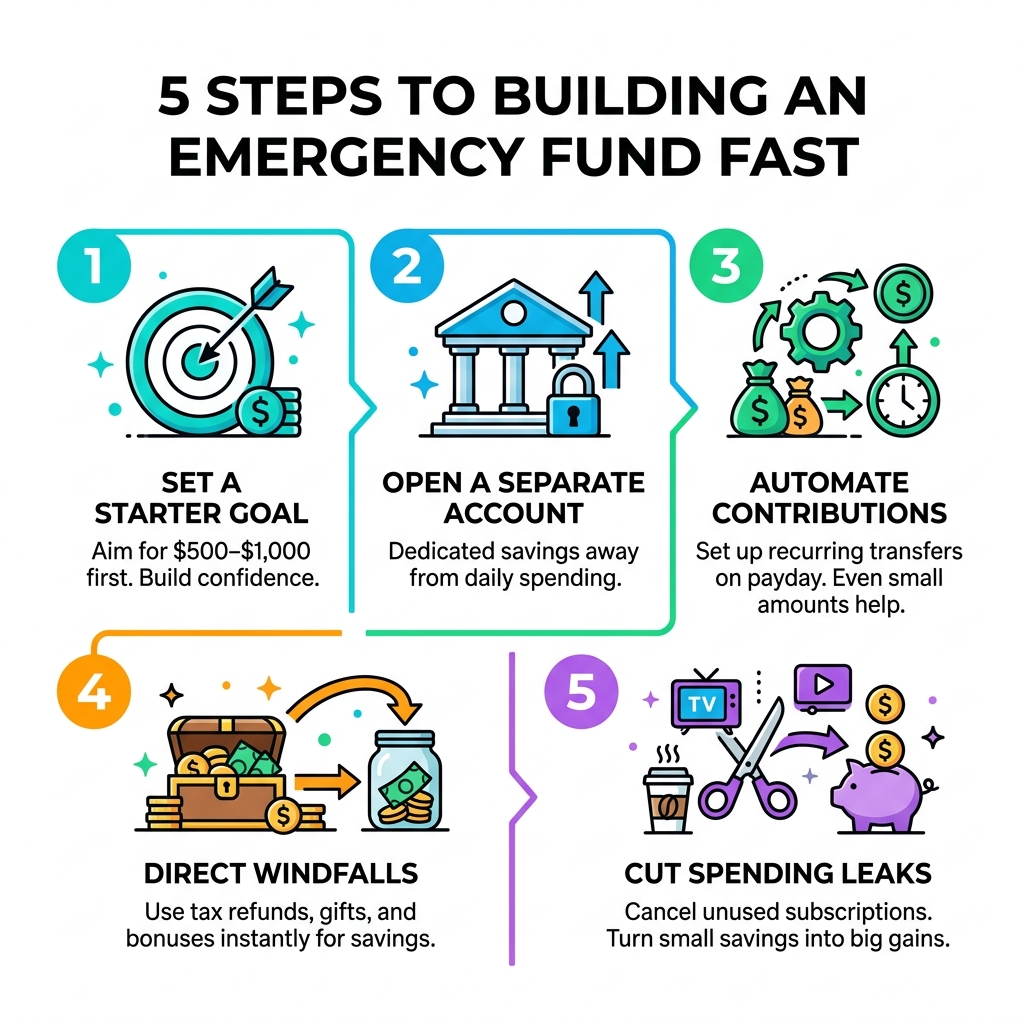
Here is a quick overview of the fastest ways to build your emergency fund:
- Set a small starter goal — Aim for $500 to $1,000 first, not the full amount
- Open a separate savings account — Keep it away from your spending money
- Automate your contributions — Set up a recurring transfer on payday, even $10 to $25 a week
- Direct windfalls straight to savings — Tax refunds, cash gifts, and bonuses add up fast
- Cut small spending leaks — Cancel unused subscriptions and redirect that money
The truth is, most people have less saved than they think they need. Research shows that many households would struggle to cover even a $1,000 emergency without borrowing. That is a fragile place to be — especially when you are just starting out on your own.
The good news? You do not need to be wealthy to fix this. You just need a clear plan and a few consistent habits.
What is an Emergency Fund and Why is it Essential?
At its core, an emergency fund is a dedicated cash reserve set aside for unplanned expenses or financial disruptions. Think of it as a “peace of mind” account. We often call it a financial cushion because it softens the blow when life gets bumpy.
In personal finance, we generally look at two types of surprises: “spending shocks” and “income shocks.” A spending shock is a sudden, large bill you didn’t see coming—like your laptop screen cracking or a sudden root canal. An income shock is more serious, such as having your work hours cut or losing your job entirely.
The primary goal of this fund is liquidity. This means the money is sitting in cash or a very safe account where you can grab it the moment you need it. It isn’t tied up in the stock market or a long-term investment that might be down in value when you need to sell. Having this cash ready helps you avoid high-interest credit card debt, which is one of the most simple ways to build an emergency fund that actually lasts.
By prioritizing this fund, we are practicing personal-finance-101-stress-free-saving-tips. It turns a potential disaster into a mere “hiccup.” Instead of panicking about how to pay for a new tire, you simply transfer the money from your “Safety Net” account and move on with your day.
Defining a True Emergency
One of the biggest hurdles in learning how to save emergency fund quickly is actually keeping the money in the account. To do that, we need to define what counts as a “true emergency.” If we dip into the fund for a weekend getaway or a new pair of shoes, it won’t be there when the car breaks down.
A true emergency is usually:
- Unforeseen: You didn’t know it was coming.
- Necessary: It is essential for your health, safety, or ability to work.
- Urgent: It needs to be handled right now.
Common examples include sudden medical bills, emergency car repairs, or a job loss. On the flip side, a holiday sale or a friend’s birthday party is not an emergency. Those are “predictable” expenses. By budgeting for unexpected expenses separately, we protect our emergency fund for the big stuff.
How Much Should You Aim to Save?
The “gold standard” recommendation from financial experts is to save three to six months’ worth of your essential living expenses. However, we know that for many young adults, seeing a target of $10,000 or $20,000 can feel so intimidating that they never even start.
That is why we recommend a staged approach:
- The Starter Goal: $500 to $1,000. This covers most common “spending shocks” like a flat tire or a broken appliance.
- The One-Month Milestone: Enough to cover one full month of rent, food, and bills.
- The Full Safety Net: Three to six months of expenses.
According to the Federal Reserve report on economic well-being, a significant portion of adults could not cover a $400 emergency with cash. By hitting just that first $1,000 milestone, you are already ahead of the curve and significantly more secure than the average household.
Calculating Your Personal Target
Your target isn’t based on your salary; it’s based on your essential expenses. If you lose your job, you probably won’t be spending $200 a month on fancy cocktails or new video games.
To find your number, list your:
- Fixed Costs: Rent/mortgage, insurance, utilities, and minimum debt payments.
- Variable Costs: Groceries, transportation, and basic toiletries.
Your “risk profile” also matters. If you are a freelancer with irregular income or you have a family to support, you should aim closer to six or nine months. If you have a very stable W-2 job and low overhead, three months might be plenty. Understanding budgeting-for-savings-where-to-begin is the first step in mapping out these numbers accurately.
How to Save Emergency Fund Quickly
If you want to know how to save emergency fund quickly, you have to look beyond just “saving what’s left over” at the end of the month. You need to be aggressive and creative.
One of the fastest ways to see progress is to use “windfalls.” A windfall is any “extra” money that isn’t part of your regular paycheck. This includes:
- Tax Refunds: The average refund is often enough to fund a starter emergency account instantly.
- Cash Gifts: Birthday money or holiday checks from relatives.
- Work Bonuses: Any performance-based pay or overtime.
Another high-speed strategy is starting a “side hustle.” In today’s gig economy, you can tutor, freelance, or sell unused items online. If you can bring in an extra $100 a week through a side gig and put it all into your fund, you’ll have over $5,000 in a single year. We have plenty of guides on how-to-save-money-every-month that dive deeper into these income-boosting tactics.
How to Save Emergency Fund Quickly with Automation
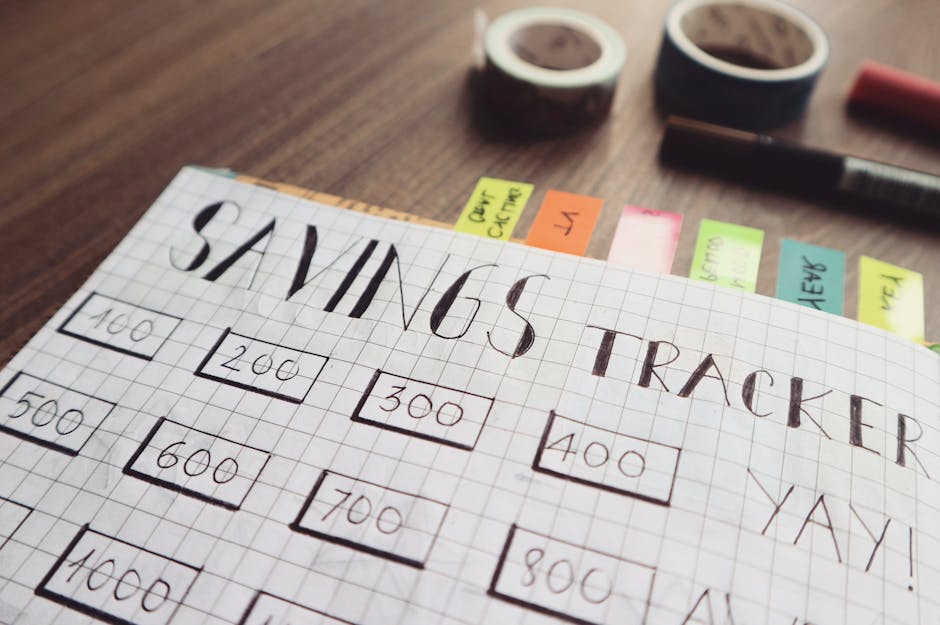
The secret to saving without feeling the “pinch” is automation. If you have to manually move money every month, you are relying on willpower—and willpower is a finite resource.
We recommend “paying yourself first” through these methods:
- Split Paycheck: Many employers allow you to send a percentage of your direct deposit to a separate savings account automatically. You never even see the money in your checking account, so you aren’t tempted to spend it.
- Recurring Transfers: Set up your banking app to move $25 every Friday (or whatever fits your budget) into your emergency fund.
- Round-Ups: Some apps round up your purchases to the nearest dollar and save the change. While small, this “frictionless saving” adds up over time.
For more on this, check out our articles on automatic-savings-strategies-for-beginners and automatic-savings-making-your-money-work-for-you.
How to Save Emergency Fund Quickly by Reducing Expenses
While making more money is great, cutting what you already spend is often the quickest lever you can pull. We suggest a “subscription audit” as your first step. We all have that one streaming service or gym membership we don’t use. Canceling a $15/month subscription is an easy $180 a year back in your pocket.
Other rapid-reduction strategies include:
- Zero-Based Budgeting: This is where every dollar has a “job” before the month begins. If you have $50 left over in your plan, its job is “Emergency Fund.”
- Spending Freezes: Challenge yourself to a “no-spend weekend” once a month where you only pay for essentials.
- Dining Out: Reducing takeout by just two meals a week can save $40–$60 weekly, which is roughly $2,600 a year!
For more tips, see our guide on easy-ways-to-reduce-monthly-expenses or learn the ropes of zero-based-budgeting-for-beginners.
Where to Keep Your Emergency Fund for Maximum Growth
Where you store your money is just as important as how much you save. You want a place that is safe, accessible, and earns a bit of interest to help combat inflation.
The best place for most people is a High-Yield Savings Account (HYSA). These are often found at online-only banks and offer significantly higher interest rates than the “big banks” on the corner. Your money stays liquid, meaning you can transfer it to your checking account in a day or two.
Another great option is a Money Market Account (MMA). These often come with a debit card or check-writing abilities, giving you even faster access during a crisis, while still earning a decent interest rate. Regardless of which you choose, ensure the institution is FDIC-insured (or NCUA-insured for credit unions). This protects your balance up to $250,000 per depositor.
Check out our guides on enter-the-world-of-personal-savings-a-beginners-guide and making-your-first-steps-into-the-world-of-savings to help you choose your first account.
Comparing Account Types for Fast Access
| Account Type | Interest Rate | Accessibility | Safety |
|---|---|---|---|
| Standard Savings | Very Low | High (Instant) | FDIC Insured |
| High-Yield Savings | High | Medium (1-2 days) | FDIC Insured |
| Money Market Account | High | High (Check/Debit) | FDIC Insured |
| Certificate of Deposit (CD) | High | Low (Locked term) | FDIC Insured |
| Checking Account | None | Highest | FDIC Insured |
Note: We generally advise against keeping your emergency fund in a CD because you’ll face penalties if you need the money early, and avoid keeping it in checking because it’s too easy to spend accidentally.
Balancing Rapid Savings with Debt Repayment
One of the most common questions we get is: “Should I save for emergencies or pay off my credit cards first?” It is a tough balance. If you put every extra penny toward debt and then have a car breakdown, you’ll just end up putting that repair back on the credit card, continuing the cycle.
This is why we advocate for the Starter Fund First approach.
- Pay the minimums on all your debts.
- Aggressively build a $1,000 starter emergency fund.
- Once you have that $1,000 “buffer,” go back to attacking your high-interest debt (like credit cards).
This strategy reduces your “financial fragility.” According to Scientific research on the psychology of financial stress, having a small cash buffer significantly lowers the cognitive load and anxiety associated with money, allowing you to make better financial decisions in the long run.
Strategies for Low-Income Savers
If money is tight, don’t get discouraged. Saving is a behavior, not just a math problem. Even small amounts matter.
- Micro-saving: Can you save $1 a day? That is $365 a year.
- Round-ups: Use apps that save your “digital change.”
- Adjust Bill Due Dates: Sometimes moving a bill due date to align with your payday can prevent “cash flow gaps” that lead to overspending.
We have specific resources for budgeting-on-a-low-income and saving-tips-for-college-students to help you find those extra dollars even when the budget feels maxed out.
Frequently Asked Questions about Saving Fast
Is $1,000 enough for an emergency fund?
For a “starter” fund, yes. It covers most minor disasters. However, $1,000 won’t cover your rent and food if you lose your job for three months. Think of $1,000 as your “shield” against small problems while you build your “fortress” (3-6 months of expenses).
Should I invest my emergency fund in the stock market?
Generally, no. The stock market can be volatile. Imagine there is a recession, you lose your job, and the stock market drops 20% all in the same week. If your emergency fund is in stocks, you’d be forced to sell at a loss right when you need the money most. Keep it in a safe, liquid savings account.
How do I replenish my fund after using it?
Treat your emergency fund like a mandatory bill. As soon as the emergency is handled, adjust your budget to prioritize refilling that account before you go back to “fun” spending or aggressive debt payoff. Automate a temporary increase in your savings transfers until you’re back to your target balance.
Conclusion
Building a safety net is the foundation of financial independence. At QuickFinHub, we believe that every young adult deserves the peace of mind that comes with being prepared. It doesn’t matter if you start with $5 a week or $500 a month—the most important step is simply starting.
Remember to celebrate your milestones! When you hit that first $500 or $1,000, take a moment to acknowledge your hard work. Consistency is the key to turning a fragile financial situation into a stable one. By following these steps on how to save emergency fund quickly, you are taking control of your future and ensuring that life’s little surprises don’t hold you back.
Ready to take the next step in your financial journey? Start your savings journey today and explore more of our tailored advice for navigating life’s transitions with confidence.
