
Why Getting Your Apartment Budget Right Changes Everything
Apartment budget young adults need to nail before signing a lease comes down to a few core numbers:
| Budget Category | Recommended % of Take-Home Pay |
|---|---|
| Rent | 30% or less |
| Utilities + Insurance | ~10% |
| Groceries | 10-15% |
| Savings + Emergency Fund | 15-20% |
| Transportation | ~10% |
| Lifestyle + Misc | 10-15% |
So for a $3,000/month take-home pay, that means targeting no more than $900/month in rent and building from there.
Moving into your first apartment feels like freedom. Keys in hand, your own space, your own rules.
Then the bills arrive.
The reality? Most young adults massively underestimate what independent living actually costs. The average 22-year-old carries $37,000 in student debt while earning just $35,000 a year. That math is tight before you even add rent, utilities, and groceries.
Here’s another number that stings: a $50,000 annual salary doesn’t give you $4,167 a month to spend. After taxes and deductions, it’s closer to $3,200. That gap between what you think you earn and what actually hits your bank account is where most first-apartment budgets fall apart.
The good news? Adults who budget in their twenties accumulate 40% more wealth by age 40 compared to those who don’t. Getting this right early isn’t just about surviving month to month. It’s about building a foundation that actually works for you long-term.
This guide walks you through everything — from calculating your real income to handling upfront costs, monthly expenses, and common mistakes — so your first apartment is a win, not a financial scare.
Calculating Your Real Income for an Apartment Budget for Young Adults
Before we even look at Zillow or walk through a studio, we need to know exactly how much money is “ours.” Many of us make the mistake of looking at our gross salary — the big number on the job offer — and dividing it by 12. As we mentioned, a $50,000 salary sounds great until the government takes its share.
Net Pay: The Only Number That Matters
Your “take-home pay” or net income is what actually hits your bank account after federal and state taxes, Social Security, and health insurance premiums are deducted. If you’re already working, look at your most recent pay stub. Multiply that net amount by the number of paychecks you receive per month. That is your baseline for an apartment budget young adults can actually live by.
If you have a side hustle, like freelancing or dog walking, be conservative. We recommend only including side income if it’s consistent. If it fluctuates, treat it as “bonus” money for your savings or debt repayment rather than a way to afford higher rent. For more help on managing these early career finances, check out our personal finance budgeting tips for young adults.
The 14-Day Tracking Method
One of the best ways to find your “real” income is to see where it’s currently going. We suggest tracking every single dollar you spend for 14 days. Use your bank statements or a simple notes app. At the end of two weeks, multiply that total by 2.17 to get a monthly estimate.
This helps you see if you’re a “zero-based” spender. In zero-based budgeting for beginners, every dollar has a job, whether it’s paying for Netflix or going into your “moving out” fund.

Upfront Costs and the “Moving Out” Fund
The monthly rent is just the tip of the iceberg. Moving in requires a mountain of cash upfront. If your rent is $1,200, you might need over $3,000 just to get the keys.
Here is what we need to save for:
- Security Deposit: Usually 1 to 1.5 times the monthly rent. This protects the landlord against damages.
- First and Last Month’s Rent: Many landlords require both upfront to ensure you don’t bail on the final month of your lease.
- Application and Admin Fees: These can range from $75 to $100 per person and are usually non-refundable.
- Pet Deposits: If you’re bringing a furry friend, expect to pay an extra $200 to $500 as a deposit, plus potentially “pet rent” each month.
- Moving Truck Rentals: Even a DIY move with a small truck can cost $50 to $200 depending on the distance and insurance.
According to research on Budgeting for Your First Apartment: Costs, Savings & Tips, it’s always helpful to overestimate these costs to be safe. We recommend aiming for a total “moving out” fund of $5,000 to $8,000 for a typical $1,500 apartment.
The Emergency Fund Buffer
Life happens. A pipe bursts, your car breaks down, or your hours get cut at work. Statistics show that 40% of Americans cannot cover a $400 emergency expense. When you’re living on your own, having an emergency fund is non-negotiable. We suggest saving at least three months of total living expenses before you move. If you’re wondering where to start, see our guide on budgeting for savings: where to begin.
Saving Strategies for Your Apartment Budget for Young Adults
How do we actually get that $5,000 in the bank? It’s about consistency, not intensity.
- Automate Your Savings: Set up an automatic transfer to a high-yield savings account the day after you get paid. If you don’t see the money, you won’t spend it.
- The 15% Rule: Instead of cutting everything fun, try to reduce your spending by just 15% initially. This prevents the “spending binge” that happens when budgets are too restrictive.
- Run a Rent Simulation: This is our favorite trick. If you think you can afford $1,000 in rent, start transferring $1,000 every month into a savings account while you’re still living at home or with roommates. If you can do this for three months without stress, you’re ready. For more student-specific ideas, check out saving tips for college students and how to start saving money in college.
Monthly Recurring Expenses Beyond Rent
Rent is the “big” bill, but the “small” bills are what usually break an apartment budget young adults try to manage.
The Utility Trap
The average U.S. utility bill is about $230 per month. This includes electricity, water, trash, and heating. These costs fluctuate. Your electric bill might be $80 in the spring but $200 in the summer when the AC is cranking. Always ask the landlord what utilities are included in the rent. Sometimes water and trash are covered, which can save you $50+ a month.
The “Hidden” Monthly Costs
- Renter’s Insurance: Most landlords require this. It’s usually cheap ($10 to $25 a month) and covers your stuff if there’s a fire or theft.
- High-Speed Internet: Expect to pay $50 to $100. Look for “new customer” bundles, but remember the price usually jumps after 12 months.
- Laundry: If your unit doesn’t have a washer/dryer, you’ll need to budget $40 to $50 a month for the laundromat.
Solo Living vs. Roommate Cost-Sharing
Living alone is the dream, but roommates are the ultimate “hack” for your budget.
| Expense | Solo Living (Estimated) | Shared with 1 Roommate |
|---|---|---|
| Rent | $1,500 | $850 (for a 2-bedroom) |
| Internet | $70 | $35 |
| Utilities | $200 | $100 |
| Total | $1,770 | $985 |
By having just one roommate, you could save nearly $800 a month. That’s money that can go toward travel, a car, or your future home. To find more ways to trim these numbers, read our easy ways to reduce monthly expenses.
Managing Variable Costs in an Apartment Budget for Young Adults
Variable costs are the ones you can control, but they’re also the ones that “creep” up on you.
- Lifestyle Creep: This is when you start making more money and immediately start spending more on “wants.”
- Subscription Audit: Check your bank statements for apps, streaming services, and gym memberships you don’t use. Cutting three $15 subscriptions saves you $540 a year.
- Meal Prepping: Americans aged 25-34 spend an average of $3,526 annually on food away from home. Cooking at home even three more nights a week can save you $100+ a month. We have plenty of budget-friendly lifestyle tips and simple budgeting tips for students to help you keep these costs down.
Essential Budgeting Frameworks and Tracking Tools
We don’t need a PhD in finance to manage an apartment budget young adults can follow. We just need a framework.
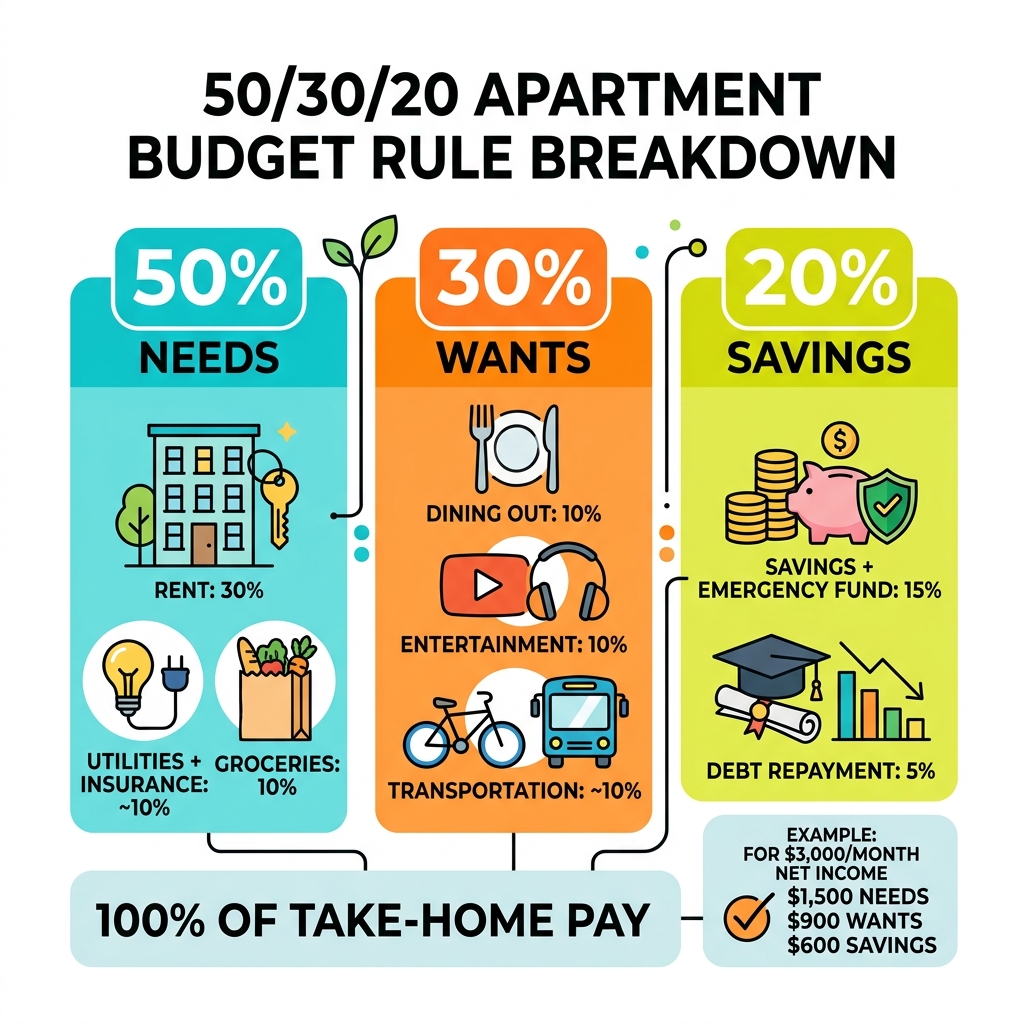
The 50/30/20 Rule
This is the gold standard for simple budgeting:
- 50% Needs: Rent, utilities, groceries, insurance, and minimum debt payments.
- 30% Wants: Dining out, Netflix, hobbies, and travel.
- 20% Savings & Debt: Building your emergency fund or paying down student loans faster.
If your “Needs” are taking up 70% of your income, you either need a cheaper apartment or a roommate. For a deeper dive, see how to create a sustainable budget plan.
The 30% Gross Income Rule
Most landlords require that your gross (pre-tax) monthly income be at least three times the rent. For example, if you want a $1,000 apartment, you need to earn at least $3,000 a month before taxes. While this is a good “ceiling,” we recommend staying closer to 25-30% of your take-home pay for true comfort.
Tracking Your Progress
You can’t manage what you don’t measure. Whether you use a high-tech app or a simple spreadsheet, you need to see where the money goes.
- Digital Apps: Tools like Mint or YNAB (You Need A Budget) connect to your bank and categorize spending for you.
- Manual Tracking: Some people prefer the “envelope method” or a manual log. If you’re just starting, check out our easy budget planner for beginners or learn how to track expenses at home. Consistency is more important than the tool you choose. See our tips on tracking daily spending effectively.
Common Pitfalls and Credit Score Realities
Even with a great plan, there are a few traps that catch young renters off guard.
The Credit Score Hurdle
Your credit score is your financial resume. Most landlords look for a score of 620 or higher.
- If your score is low: You might be asked for a larger security deposit or a “guarantor” (someone, usually a parent, who signs the lease with you and is responsible if you don’t pay).
- Limited History: If you have no credit, bring proof of income (pay stubs) and a solid reference from a previous landlord or even a boss.
Underestimating Your Spending
Remember: Americans underestimate their spending by 23% on average. This usually happens because we forget the “one-off” costs. Cleaning supplies, light bulbs, a shower curtain, and a basic first-aid kit can easily add $200 to your first month’s expenses. Check out our weekly budgeting tips for beginners to stay ahead of these surprises.
Furnishing on a Budget
You do not need a brand-new West Elm sofa the day you move in. Furnishing an apartment can cost between $1,000 and $2,500 if you buy everything new.
- The “Survival Essentials”: Buy a new mattress and pillow for hygiene. Everything else — tables, chairs, dishes — can be found on Facebook Marketplace, at thrift stores, or from family members looking to declutter.
- Wait 30 Days: Live in the space for a month before buying “decor.” You’ll realize you need a lamp more than you need that $60 throw pillow.
Frequently Asked Questions about Apartment Budgeting
How much should I save before moving out?
We recommend having $5,000 to $8,000 in the bank for a typical apartment. This covers your upfront costs (security deposit, first/last month’s rent), basic furniture, and a three-month emergency buffer. If you’re starting from zero, check out budgeting for savings: where to begin 2.
Can I rent an apartment with a low credit score?
Yes, but it’s harder. You may need a co-signer or a guarantor with a high credit score. Some landlords will accept a larger security deposit (like two months’ rent instead of one) to offset the risk. Always have your proof of income and a clean rental history ready to show you are a reliable tenant.
Is it better to live alone or with roommates?
Financially, roommates are almost always the better choice. You split the rent, internet, and utilities, which can save you $500 to $1,000 a month. However, if you value privacy and have the income to stay under the 30% rule, living alone can be great for your mental health. If you’re moving in with a partner or sibling, you might even consider creating a family budget plan to manage shared costs.
Conclusion
Mastering your apartment budget young adults is about more than just paying rent on time. It’s about creating a lifestyle that allows you to enjoy your independence without the crushing weight of debt. By calculating your real take-home pay, saving for those heavy upfront costs, and using frameworks like the 50/30/20 rule, you are setting yourself up for a future of wealth, not just survival.
At QuickFinHub, we believe financial stability is the ultimate freedom. Moving out is a huge milestone, and with a little planning, it can be the start of your most successful chapter yet. Ready to take the next step? Start your financial journey today with our latest resources and tools.
