
Why Most Young Adults Struggle to Know Where Your Money Goes
Track expenses young adult tips are exactly what you need if you’ve ever reached the end of the month wondering where your paycheck disappeared.
Here’s a quick answer to get you started:
How to track expenses as a young adult — the essentials:
- List all income — every job, gig, or transfer coming in
- Record every expense — fixed bills and variable spending
- Separate needs from wants — housing and food vs. subscriptions and dining out
- Pick a method — an app, spreadsheet, or even pen and paper
- Review weekly — a 5-minute Sunday check-in is enough to start
- Automate savings first — move money out before you can spend it
Young adults ages 20 to 24 earn around $3,168 per month on average, according to the U.S. Bureau of Labor Statistics. That’s a tight budget when you factor in rent, food, transportation, and the small daily costs that quietly add up — like that $3 coffee that costs you over $1,000 a year.
The frustrating part? Most people think they’re on top of their spending. But research suggests that even among those who do budget, the majority still overspend and lean on credit cards to fill the gap.
The problem usually isn’t discipline. It’s awareness.
Without a clear picture of where your money actually goes, every financial goal — paying off debt, building savings, or just making rent — becomes harder than it needs to be.
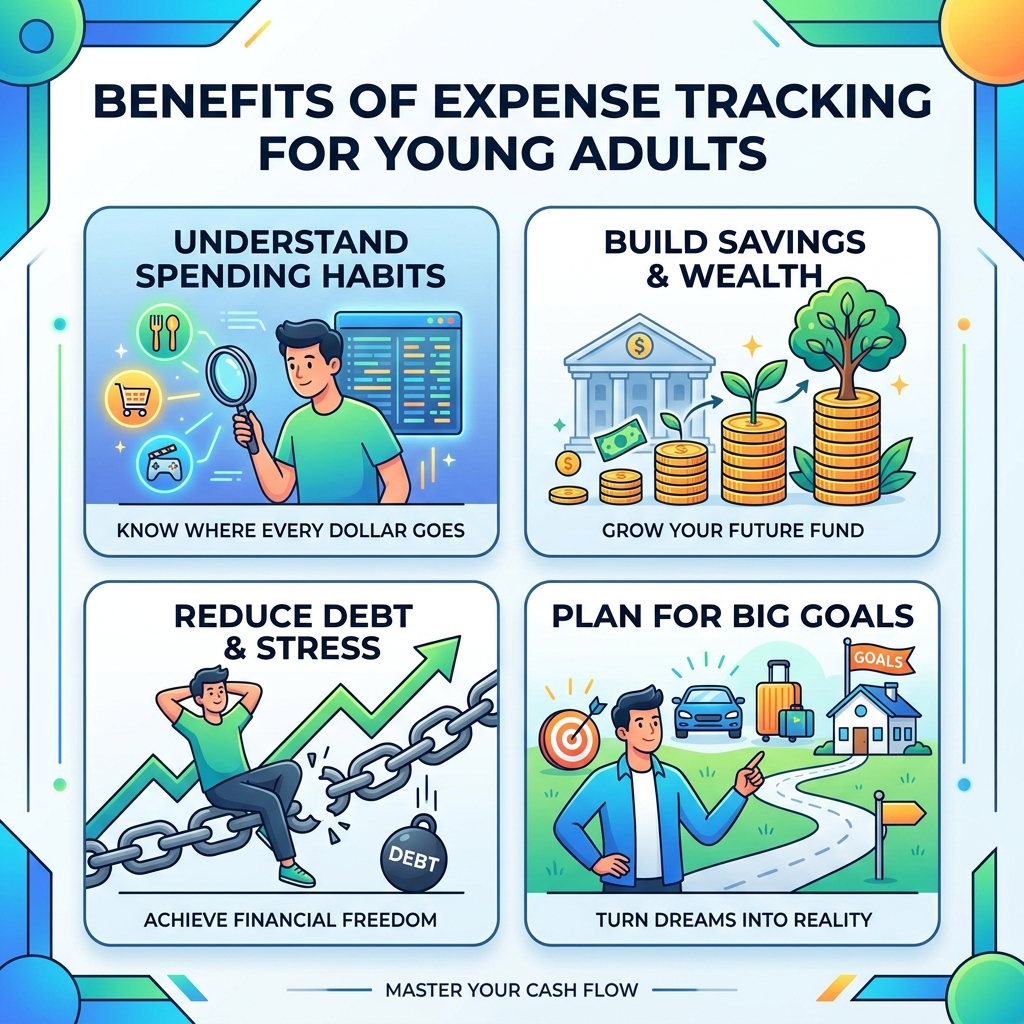
Why Tracking Expenses is Your Financial Superpower
Think of expense tracking not as a chore, but as a GPS for your life. When we understand exactly where our cash is flowing, we gain the power to redirect it toward the things that actually matter to us. For many of us starting out, personal-finance-budgeting-tips-for-young-adults are the difference between living paycheck-to-paycheck and building true stability.
One of the most critical metrics we can monitor is our debt-to-income ratio. Lenders typically like to see this ratio between 30% and 40%. If your monthly debt payments (like student loans or credit cards) are eating up more than that, tracking your spending is the first step to reclaiming your income.
Beyond debt, tracking supports the creation of an emergency fund. Statistics show that 45% of people aren’t confident they could cover an unexpected expense. By keeping a close eye on our outgoings, we can identify small leaks—like those 4 to 6 subscriptions many students carry at $50–$75 a month—and move that money into a high-interest savings account instead.
Finally, tracking early in life lets you harness the magic of compound interest. As we discuss in our investing-tips-for-young-adults, even saving $50 a week starting in your 20s can grow into over $160,000 over 30 years at a 5% return. You can’t invest what you’ve already spent on “mystery” purchases!
According to the U.S. Bureau of Labor Statistics data on young adult earnings, young adults often earn significantly less than those in their 30s and 40s. This makes every dollar more valuable. Tracking ensures that your lower starting salary is working as hard as possible for your short-term goals and long-term wealth.
Overcoming Common Obstacles to Track Expenses Young Adult Tips
We know that “just write it down” is easier said than done. Many of us face genuine hurdles when trying to stay consistent.

The Executive Function Gap
For those of us dealing with ADHD or executive function challenges, traditional spreadsheets can feel like a nightmare. The key here is to move away from “neurotypical” advice that demands rigid perfection. Instead of a complex monthly review, try a weekly cash flow check. Use visual tools like sticky notes or separate bank accounts for different spending categories. If a system takes more than 30 seconds to update, you probably won’t use it—so keep it lightning-fast.
The Myth of Mental Budgeting
About 25% of young adults rely on “mental budgeting.” Here’s the truth: our brains are excellent at lying to us. We tend to remember the $20 we saved on a sale but forget the three $15 DoorDash deliveries we ordered while tired. Having the numbers physically in front of you—whether on a screen or paper—makes it much harder to ignore the reality of your spending. Check out how-to-track-expenses-at-home for simple ways to start recording data without the stress.
Social Pressure and “Loud Budgeting”
One of the biggest triggers for overspending is the fear of missing out (FOMO). We’ve all been there: friends want to go to an expensive dinner, and we don’t want to be the “broke” one. Enter the concept of Loud Budgeting. This is the practice of being vocal and honest about your financial boundaries. Instead of saying “I can’t go,” try saying, “That’s not in my budget this month, but I’d love to do a potluck or a movie night instead.” It turns financial restriction into an empowered choice.
How to Manage Irregular Income and Shared Costs
Life as a young adult is rarely a straight line of steady paychecks and solo bills. Whether you’re navigating college life or the gig economy, your expenses often come in “lumps.”
The College Spending Cycle
The average college student spends about $2,000 per month on living expenses outside of tuition. However, these costs aren’t spread evenly. You might have massive “spikes” in August and January for textbooks (costing $200–$600) and move-in costs. We recommend creating a semester financial calendar to anticipate these spikes so they don’t wreck your budget.
If you’re looking to travel during breaks, check out the-best-budget-destinations-for-young-adults to ensure your fun doesn’t lead to debt.
Roommate Expense Systems
Living with others is a great way to save, but it can lead to social friction. Don’t rely on “we’ll settle up later.” Choose a system:
- The Shared Fund: Everyone puts a set amount into a jar or shared account for household basics.
- The Rotating Payer: One person buys the groceries this week, the next person the following week.
- Receipt Splitting: Using an app to log every shared cost and balance the sheets instantly.
Navigating the Gig Economy
If you have irregular income from freelancing or side hustles, budgeting-on-a-low-income requires a different approach. Instead of budgeting based on what you hope to make, budget based on your lowest ever monthly income. Anything you earn above that goes straight into savings or towards next month’s bills. For more frequent updates, our weekly-budgeting-tips-for-beginners can help you stay agile when your income fluctuates.
Proven Strategies to Track Expenses Young Adult Tips for Success
Success in tracking isn’t about the tool you use; it’s about the strategy behind it. Here is a comparison of the two most popular frameworks:
| Feature | 50/30/20 Rule | Zero-Based Budgeting |
|---|---|---|
| Philosophy | Percentage-based allocation | Every dollar has a “job” |
| Best For | Beginners wanting simplicity | People who want total control |
| Needs | 50% of income | Total income minus expenses = $0 |
| Wants | 30% of income | Adjusted based on what’s left |
| Savings | 20% of income | Assigned as a specific category |
Distinguishing Needs vs. Wants
This is the heart of track expenses young adult tips. A “need” is essential for survival or employment (rent, basic groceries, transit). A “want” is anything that improves your lifestyle but isn’t strictly necessary (Netflix, dining out, the latest sneakers).
A great frugal habit is the 24-hour rule: if you see something you want, wait 24 hours before buying it. Often, the impulse fades, and your bank account stays intact. Also, consider a “subscription audit.” Many of us are paying for 4-6 services we rarely use. Cutting just two could save you $300 a year!
Advanced Tracking Methods
If you want to get serious, try these:
- The Pay-Yourself-First Method: Set up an automatic transfer to your savings the moment your paycheck hits. If you don’t see the money, you won’t spend it.
- The Envelope System: Use physical cash for “temptation” categories like dining out. When the cash is gone, you’re done spending in that category for the month.
- Daily Logging: Use tracking-daily-spending-effectively techniques to record every transaction the moment it happens.
Essential Tools to Track Expenses Young Adult Tips and Automate Growth
We don’t have to do all the math ourselves. There are plenty of budgeting-apps-for-beginners that can do the heavy lifting for us.
Automation is Your Best Friend
The most successful budgeters are the ones who automate. Set up Pre-Authorized Contributions (PACs) to move money into your retirement or emergency fund automatically. Similarly, automate your bill payments. This avoids late fees and ensures that your “must-pay” items are handled before you spend money on “wants.”
Simple Tools for the Win
You don’t need a degree in finance to manage your money. Sometimes simple-tools-for-budget-management, like a basic notes app or a dedicated receipt-logging tool, are more effective than a complex suite of software. The best tool is the one you actually open every day.
When to Seek Help
While apps are great, they can’t replace a personalized plan. If you’re feeling overwhelmed by debt or don’t know how to start investing, seeking professional financial advice can be a game-changer. Many credit unions and non-profits offer free financial counseling sessions for young adults.
Frequently Asked Questions about Young Adult Budgeting
How do I distinguish between a need and a want?
A need is an essential cost required for you to live and work safely. This includes housing, basic food (groceries, not takeout), utilities, and minimum debt payments. A want is discretionary spending—things that make life more fun but aren’t required. A good test is to ask: “If my income was cut by 50% tomorrow, would I still pay for this?” If the answer is no, it’s a want. Be wary of lifestyle creep, where you start treating former “wants” (like a premium gym membership) as “needs” as you earn more.
How much should I save for an emergency fund?
The gold standard is three to six months of living expenses. This provides a financial safety net in case of job loss, medical emergencies, or unexpected car repairs. If you’re just starting, don’t feel pressured to hit that goal overnight. Start by aiming for $500, then $1,000. Having that liquidity is the best way to avoid falling back into high-interest credit card debt when life happens.
What are the best tips for tracking expenses with ADHD?
Focus on visual and immediate systems. Use apps with simple interfaces and color-coding (e.g., green for income, red for spending). Try to log expenses immediately at the register rather than waiting until the end of the week. Set phone reminders for “Money Minutes”—short, 2-minute sessions to check your bank balance. Above all, don’t punish yourself for slip-ups; just reset and start again the next day.
Conclusion
At QuickFinHub, we believe that mastering your cash flow is the ultimate act of self-care. It’s about more than just numbers; it’s about giving yourself the freedom to navigate life’s transitions with confidence. By implementing these track expenses young adult tips, you are building a foundation of financial literacy that will serve you for decades.
The goal isn’t perfection—it’s progress. Start small, stay consistent, and watch how much power you gain over your future. Start building your future with these saving strategies and take control of your financial story today!
