
Why So Many People Struggle to Manage Monthly Budget Finances (And What Actually Works)
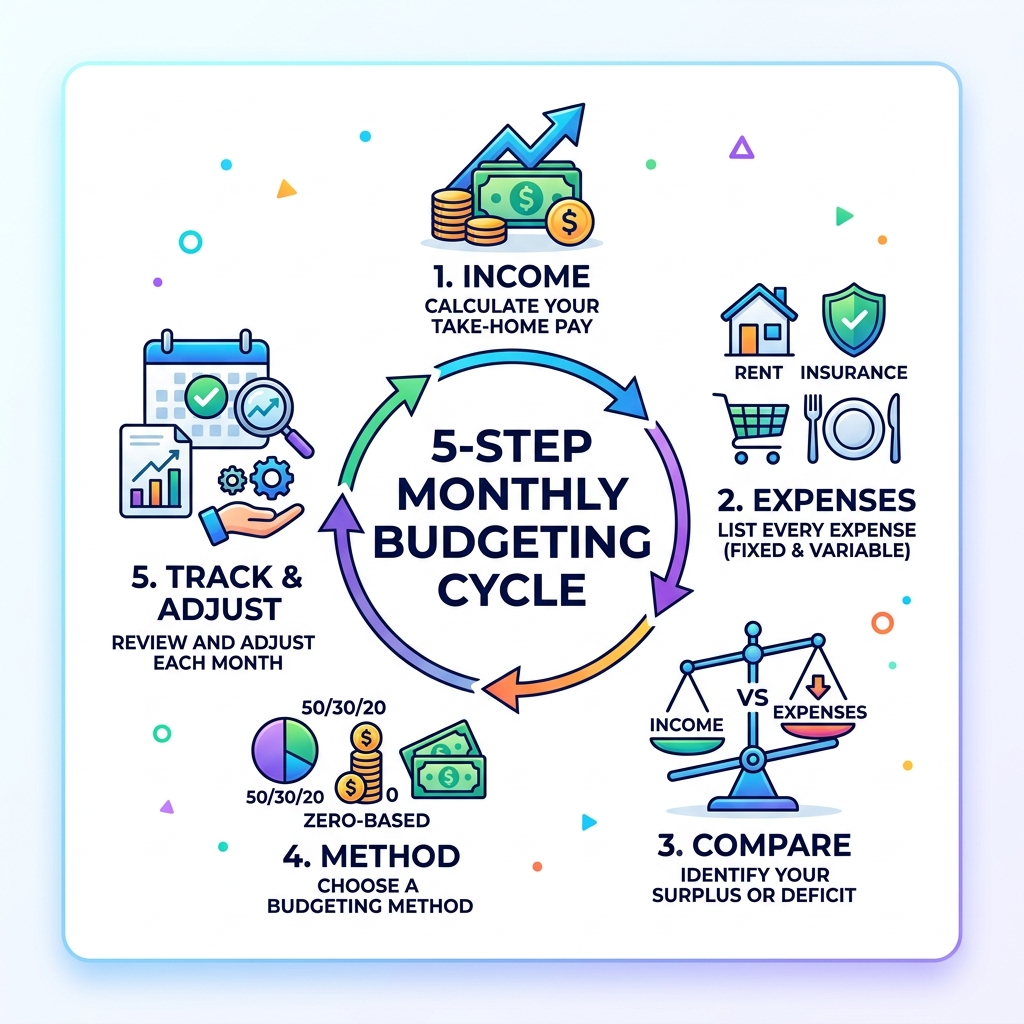
Manage monthly budget effectively comes down to five core steps:
- Calculate your take-home income – Add up all money you actually receive after taxes
- List every expense – Fixed (rent, insurance) and variable (groceries, dining out)
- Compare income vs. expenses – Identify your surplus or deficit
- Choose a budgeting method – Such as 50/30/20, zero-based, or envelope system
- Track, review, and adjust – Every month, without exception
You get your paycheck. You pay your bills. Then somehow, two weeks later, you’re wondering where it all went.
If that sounds familiar, you’re not alone. Most young adults hit their 20s with zero training in personal finance — and it shows. Student loans, first apartments, entry-level salaries, and the constant pull of social spending all collide at once.
But here’s the truth: budgeting isn’t about restricting your life. It’s about directing your money toward what you actually want — whether that’s a trip, a safety net, or just sleeping better at night.
A budget is simply a written plan for how you’ll spend and save your income each month. That’s it. No complicated math. No finance degree required.
The people who master this skill don’t earn more than you. They just know where their money is going — and they make intentional choices about it. That awareness alone changes everything.
The Foundation: How to Create and Manage Monthly Budget Plans
Creating a budget is an empowering process. It shifts you from being a passive observer of your bank account to being the CEO of your own life. To manage monthly budget plans successfully, you need to start with a clear, honest snapshot of your financial reality. This isn’t about being perfect; it’s about being accurate.
The first step is gathering your data. You’ll need your recent pay stubs, bank statements, and utility bills. If you’re just starting out, check out our Easy Budget Planner for Beginners to help organize these documents. Whether you use a high-tech app or a simple paper worksheet, the goal is to see exactly how much is coming in versus how much is going out.
When you manage monthly budget flows, you’ll quickly notice two types of costs: fixed and variable. Fixed expenses are the “must-pays” that stay the same every month, like your rent or car insurance. Variable costs are the “shifters,” like groceries or entertainment, which can change based on your choices. If you’re coordinating finances with a partner or roommates, Creating a Family Budget Plan can help align everyone’s expectations and responsibilities.
Accurately Estimating Your Monthly Income
Before you can decide how to spend, you need to know what you’re working with. This means calculating your net pay—the actual “take-home” amount that hits your bank account after taxes, health insurance, and retirement contributions are deducted.
If you have a steady salary, this is easy: just multiply your paycheck by the number of times you get paid per month. However, for many young adults, income isn’t always a straight line. If you’re working a side hustle, freelancing, or dealing with Budgeting on a Low Income, your totals might fluctuate.
The golden rule for irregular income? Be conservative. Base your budget on your lowest-earning month from the past year. If you earn more than that baseline, treat the extra as a “bonus” for your savings or debt repayment rather than a reason to increase your lifestyle spending. This “worst-case scenario” planning ensures you can always cover your essentials, even during slow months.
Categorizing Expenses to Manage Monthly Budget Flow
Once you know your income, it’s time to tally the “outgo.” We recommend breaking your spending into logical categories to see where the “bleeding” is happening. Common categories include:
- Housing: Rent, mortgage, property taxes, or HOA fees.
- Utilities: Electricity, water, garbage, and the all-important internet and phone bills.
- Transportation: Car payments, gas, maintenance, and public transit passes.
- Food: This includes both groceries and the “oops, I didn’t feel like cooking” restaurant visits.
- Debt: Student loans, credit card minimums, and personal loans.
If your total expenses are higher than your income, don’t panic. This is actually the most valuable moment in budgeting because it highlights exactly where you can make changes. Look for Easy Ways to Reduce Monthly Expenses, such as canceling unused subscriptions or negotiating your cable bill. For those who find themselves overspending mid-month, implementing Weekly Budgeting Tips for Beginners can provide smaller, more manageable checkpoints to keep you on track.
Proven Budgeting Methods for Every Lifestyle
There is no “one size fits all” when you manage monthly budget categories. The best method is the one you will actually stick to. Here is a comparison of the most popular strategies we recommend for young adults:
| Method | Best For | How It Works |
|---|---|---|
| 50/30/20 Rule | Beginners who want simplicity | 50% Needs, 30% Wants, 20% Savings/Debt |
| Zero-Based Budgeting | Detail-oriented planners | Every dollar is assigned a job until you hit zero |
| Envelope System | Chronic overspenders | Uses cash or digital “buckets” to cap spending |
If you want to dive deep into the “every dollar has a job” philosophy, our guide on Zero-Based Budgeting for Beginners explains how to ensure no cent goes unaccounted for. This is particularly helpful for Simple Budgeting Tips for Students who are working with limited funds and need to maximize every penny.
The 50/30/20 Rule for Balanced Spending
The 50/30/20 rule is a fan favorite because it provides a high-level framework without requiring you to track every single pack of gum.
- 50% for Needs: These are non-negotiables. Rent, utilities, basic groceries, and minimum debt payments.
- 30% for Wants: This is your “fun” money. Hobbies, dining out, Netflix, and that new outfit.
- 20% for Savings and Debt Repayment: This goes toward your emergency fund, extra debt payments, or retirement.
This method is excellent for Personal Finance Budgeting Tips for Young Adults because it bakes “fun” into the plan. When you know you have 30% of your income reserved for things you enjoy, you’re much less likely to feel deprived and “rebel” against your budget.
Using the Envelope System to Manage Monthly Budget Limits
If you find that “swiping” makes it too easy to overspend, the Envelope System is your best friend. Traditionally, this involved putting physical cash into paper envelopes labeled “Groceries,” “Entertainment,” etc. Once the cash in the “Entertainment” envelope was gone, you were done for the month—no exceptions.
In our digital world, you can do this with Tracking Daily Spending Effectively using apps that create virtual envelopes or even sub-savings accounts. This method builds incredible impulse control. It forces you to make a conscious choice: “If I buy these concert tickets now, I won’t have money for the movies later this month.” That friction is exactly what helps you manage monthly budget limits successfully.
Tracking Progress and Handling Financial Surpluses
A budget is not a “set it and forget it” document. It’s a living thing. You might plan to spend $400 on groceries, but then a sale happens—or a price hike—and you spend $450. Without tracking, you’d never know you’re $50 over until your card gets declined.

To stay on top of things, you need a system for How to Track Expenses at Home. Whether you prefer a spreadsheet or one of the many Budgeting Apps for Beginners, the key is consistency. We recommend a “two-minute drill” every evening to log your spending, or a weekly “money date” where you review the last seven days.
What happens if you have money left over? That’s a surplus, and it’s a high-class problem to have! Don’t just let it sit in your checking account where it might get spent accidentally. Use Simple Tools for Budget Management to redirect that surplus toward your highest priority goal.
Incorporating Savings and Debt Repayment
When you manage monthly budget priorities, savings and debt shouldn’t be “leftovers.” They should be treated like a bill you owe to your future self.
First, focus on Budgeting for Savings Where to Begin. Your initial goal should be a small emergency fund—think $1,000 or one month of expenses. This acts as a buffer so that when life happens (and it will), you don’t have to reach for a credit card. Once you’re Budgeting for Unexpected Expenses, you can start tackling debt more aggressively.
For debt, many people find success with the “Debt Snowball” (paying off the smallest balance first for a quick win) or the “Debt Avalanche” (paying off the highest interest rate first to save money over time). Whichever you choose, make sure the payment is a line item in your monthly plan.
Frequently Asked Questions about Monthly Budgeting
We get it—budgeting can feel overwhelming at first. Even with a plan, questions pop up. Avoiding Beginner Budgeting Mistakes to Avoid is easier when you have the right answers.
What is the best way to handle irregular income?
If your income changes every month (hello, freelancers and servers!), use the “Reverse Budget” or “Prioritized Spending” list. List your expenses in order of importance: Rent, Utilities, Food, Insurance, then Savings, then Fun. As the money comes in, you fill the buckets from the top down. If you have a low-earning month, you might not get to the “Fun” bucket, but your rent is always covered. Always plan based on your lowest-earning month to stay safe.
How often should I review my budget?
You should manage monthly budget reviews at least once a month, usually a few days before the new month begins. This is when you look at what’s coming up (birthdays, holidays, car registration) and adjust your categories. However, daily tracking is what makes the monthly review easy. If you track as you go, the end-of-month review takes ten minutes instead of two hours.
What should I do if I overspend one month?
First, breathe. It happens to everyone. Don’t throw the whole budget away just because you went overboard on a Saturday night. Treat it as a learning opportunity. Ask yourself: Was the budget unrealistic? Or did I just lose track? Adjust the category for next month, or “steal” from another category (like your “Wants”) to cover the gap. The goal isn’t perfection; it’s persistence.
Conclusion
Managing a monthly budget is one of the most significant “adulting” wins you can achieve. It’s the difference between feeling like your money is disappearing and feeling like you are finally in the driver’s seat. By following these steps—calculating your true income, categorizing your costs, and choosing a method that fits your brain—you’re building a foundation for a life of freedom rather than a life of debt.
At QuickFinHub, we’re here to help you navigate these transitions with ease. Whether you’re just starting your first job or trying to pay down student loans, a budget is a tool for your happiness, not a cage for your spending.
Ready to make it official? Start Creating a Sustainable Budget Plan today and stop the bleeding for good. For more tips tailored specifically for young adults, visit us at QuickFinHub and let’s get your finances on track together.
For an extra boost in your journey, you might also consider using a Monthly Budget Planner — Smart AI-Powered Personal Finance Management to automate the heavy lifting and get even deeper insights into your habits. Your future self will thank you!
