
The Road to Financial Control Starts Here
For anyone looking to gain control of their money, budget planning for beginners is the essential first step. A budget is simply a plan for your money. It shows you how much you earn and how you choose to spend it. Mastering this skill can lead to financial stability, less stress, and the ability to achieve your biggest dreams.
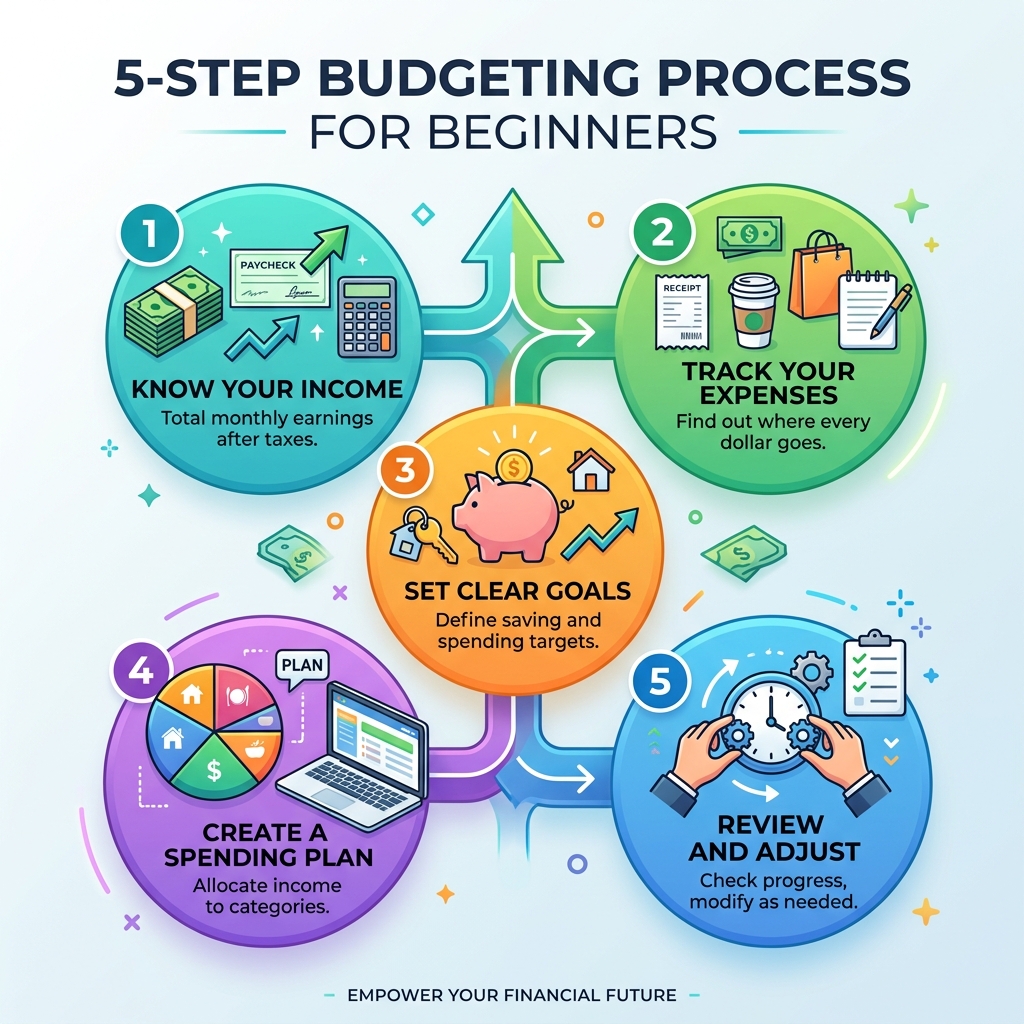
Here’s how to start budget planning for beginners:
- Calculate Your Income: Know exactly how much money you bring in each month after taxes and deductions.
- Track Your Expenses: Find out where every dollar goes by listing all your fixed bills and variable spending.
- Set Clear Goals: Decide what you want your money to accomplish, whether it’s saving for a down payment or paying off debt.
- Create a Spending Plan: Allocate your income to different categories using a method that fits your lifestyle.
- Review and Adjust: Regularly check your budget and make changes as your financial situation or goals evolve.
Many young adults face the challenge of balancing expenses with dreams. You’re navigating new responsibilities, planning for the future, and sometimes just trying to make it to the next paycheck. This guide is designed to help you create a practical budget that works for you, without feeling restrictive or overwhelming. It’s about empowering you to make intentional choices with your money.
Why Budget Planning for Beginners is the Key to Financial Freedom
We often hear the word “budget” and think of restriction—like a financial diet of rice and beans. But in reality, budget planning for beginners is about empowerment. It is a written roadmap that ensures you have enough money for the things you actually need and the things that make you happy.
Without a plan, money has a way of “disappearing.” Have you ever looked at your bank account on a Tuesday and wondered where that $100 went over the weekend? You aren’t alone. Research shows that financial planning is directly linked to better mental well-being. When you know where your money is going, that late-night “can I afford rent?” anxiety starts to fade away.
Budgeting helps us:
- Prevent Overspending: It sets boundaries so we don’t spend money we don’t have.
- Reach Goals Faster: Whether it’s a dream vacation or a new car, a budget carves out the path to get there.
- Build an Emergency Cushion: 46% of Americans plan on saving money for emergencies in 2026. A budget makes this a priority rather than an afterthought.
If you are ready to stop wondering where your money went and start telling it where to go, check out our Budgeting Tips (Category) for more deep dives into specific strategies.

The 3-Step Process to Building Your First Budget
Creating a budget doesn’t require a degree in accounting or a love for complex spreadsheets. It just requires three clear steps.
The first step is knowing your net income. This is your “take-home pay”—the amount that actually hits your bank account after taxes, Social Security, and health insurance are taken out. If you only look at your gross salary (the big number on your contract), you’ll likely overspend because you’re budgeting with money you never actually see.
When calculating your income, don’t forget to include:
- Your primary paycheck.
- Side hustles or freelance gigs.
- Tips or commissions.
- Passive income like dividends or interest.
- Occasional income like child support or tax refunds.
For those of us with side hustles, it’s helpful to look at Personal Finance Budgeting Tips for Young Adults to see how to balance multiple income streams. If your income is irregular, use a conservative estimate based on your lowest-earning month from the past year.
Essential Budget Planning for Beginners: Identifying Needs
Once we know what’s coming in, we have to look at what’s going out. We categorize these into “Needs” (Fixed and Variable) and “Wants.”
Fixed Expenses are the bills that stay the same every month. These are the easiest to budget for because they are predictable. Variable Expenses change based on your usage or habits.
| Expense Type | Examples | Predictability |
|---|---|---|
| Fixed | Rent/Mortgage, Car Payment, Insurance, Subscriptions (Netflix/Gym) | High |
| Variable | Groceries, Utilities (Electricity/Water), Gas, Dining Out | Low |
To get a handle on the variable stuff, like food, you might want to read how to Save More on Groceries: A Novice’s Approach. Small changes in these categories can free up hundreds of dollars a month.
Tracking Expenses for Effective Budget Planning for Beginners
You cannot manage what you do not measure. To build an effective budget, you need to see your “spending leaks.” These are the small, daily purchases that add up. For example, did you know the average cost of cable is more than $1,700 a year? Or that a $4 daily coffee habit totals over $1,000 annually?
We recommend tracking your spending for at least 30 days. You can do this by:
- Reviewing your last three months of bank and credit card statements.
- Using a notebook to record every purchase immediately.
- Checking out our guide on How to Track Expenses at Home.
The goal isn’t to judge yourself; it’s to gather data. For more tips on staying consistent, see our advice on Tracking Daily Spending Effectively.
Choosing the Right Budgeting Method for Your Lifestyle
There is no “one size fits all” in personal finance. The best budget is the one you actually stick to. Here are the three most popular methods for beginners:
- The 50/30/20 Rule: This is the gold standard for simplicity. You allocate 50% of your income to Needs, 30% to Wants, and 20% to Savings and Debt Repayment.
- Zero-Based Budgeting: This method gives every single dollar a “job.” If you earn $3,000, you assign all $3,000 to categories (including savings) until you have $0 left. It’s highly effective for those who want total control. Learn more at Zero-Based Budgeting for Beginners.
- The Envelope System: This is a visual, cash-based system. You put a set amount of cash into physical envelopes labeled “Groceries,” “Entertainment,” etc. When the envelope is empty, you stop spending in that category for the month.
If you prefer a digital approach, there are many Budgeting Apps for Beginners that can automate the tracking process for you.
Finding the Best Budget Planning for Beginners Strategy
Choosing a strategy depends on your personality. Do you love details? Go Zero-Based. Do you want something “set it and forget it”? Try the 50/30/20 rule.
The key is to include “guilt-free spending.” If your budget is too strict, you’ll eventually “binge spend” and quit. We like to think of a budget as a living document. You should check out our Weekly Budgeting Tips for Beginners to see how to make small tweaks that keep your plan realistic. Your goal should be Creating a Sustainable Budget Plan that evolves with your life.
Strategies to Stick to Your Budget and Reach Your Goals
Setting up the budget is the easy part; sticking to it is where the magic happens. We recommend using your financial goals as an “anchor.” When you’re tempted to buy something you don’t need, remind yourself of that vacation or the peace of mind an emergency fund provides.
Speaking of emergencies, your first goal should be an emergency fund. Start with a goal of $500 to $1,000 to cover a surprise car repair or a medical bill. Eventually, work toward 3-6 months of living expenses.
Here are a few more strategies to keep you on track:
- Automate Your Savings: Scientific research on automated savings habits shows that we are much more likely to save when the money is moved before we have a chance to spend it. Set up a recurring transfer on payday. This is the essence of Automatic Savings: Making Your Money Work for You.
- Distinguish Between Goals: Use different strategies for Short-Term vs. Long-Term Savings Tips. A vacation fund might go in a standard savings account, while retirement should go into a tax-advantaged account like a 401(k) or IRA.
- Visual Reminders: Keep a picture of your goal (like a new home) in your wallet or on your fridge.
Frequently Asked Questions about Budgeting
How do I budget with an irregular or low income?
Budgeting on a low income is actually more important, not less. It ensures that every cent is used intentionally. If your income is irregular (like freelance work), budget based on your “baseline” or lowest-earning month. Any “extra” money you make during good months should be funneled into a “slush fund” to cover you during lean months. For more specific help, read our guide on Budgeting on a Low Income.
How often should I review and update my budget?
We recommend a quick weekly check-in (5-10 minutes) to see if you are on track for the month. At the end of every month, do a full review. Did you overspend on dining out? Adjust the number for next month. Life transitions—like a new job, moving, or a raise—require a complete budget overhaul. Our Beginner Guide to Financial Planning covers how to handle these big shifts.
What is the difference between ‘needs’ and ‘wants’?
A “Need” is something required for survival or to keep your job (housing, basic food, utilities, transportation). A “Want” is something that enhances your lifestyle (dining out, the latest iPhone, designer clothes). If you’re struggling to make ends meet, look for Easy Ways to Reduce Monthly Expenses by cutting back on the wants first.
Conclusion
At QuickFinHub, we believe that budget planning for beginners is the foundation of a life well-lived. It isn’t about saying “no” to everything you love; it’s about saying “yes” to your future self. By calculating your income, tracking your spending, and choosing a method that fits your life, you are taking the wheel of your financial ship.
Your first budget will likely be imperfect. You might overspend in your first month, and that’s okay! The goal is progress, not perfection. It usually takes about three months to really get the hang of it. To help you stay on the right path, take a look at these Beginner Budgeting Mistakes to Avoid.
Visit QuickFinHub Homepage for more resources tailored to help you navigate your financial journey with confidence. You’ve got this!
