
The Best Places to Keep Your Emergency Fund (And Why It Matters)
Where is the best place to keep an emergency fund depends on your need for quick access, safety, and growth — but here are the top options most financial experts agree on:
| Account Type | Best For | Typical APY | FDIC Insured? |
|---|---|---|---|
| High-Yield Savings Account | Best overall | Up to ~5% | Yes |
| Money Market Account | Easy access + interest | ~0.59% avg | Yes |
| Certificate of Deposit (CD) | Larger reserves | Varies | Yes |
| Standard Savings Account | Simplicity | ~0.39% avg | Yes |
The short answer: a high-yield savings account wins for most people. It keeps your money safe, earns real interest, and lets you access cash fast when something goes wrong.
Life doesn’t wait for a convenient time to break down. The furnace quits in January. Your car makes a noise that costs $900 to fix. A medical bill shows up out of nowhere.
That’s exactly why an emergency fund exists — and where you keep it matters just as much as having one.
Right now, 60% of U.S. adults say they’re uncomfortable with their emergency savings. One in three Americans carry more credit card debt than emergency savings. For people in their 20s, that number is even worse — 34% of Gen Zers have no emergency savings at all.
Keeping your money in the wrong place — like a sock drawer, a checking account, or tied up in investments — can make a real emergency even worse.
This guide breaks down exactly where to put your money so it’s safe, growing, and ready when you need it.
Why You Need a Financial Safety Net
An emergency fund is more than just a number in a bank account; it is your financial “break glass in case of fire” box. Think of it as a dedicated stash of cash set aside specifically for life’s expensive surprises. Without this cushion, a single “spending shock”—like a root canal or a broken HVAC system—can force you into high-interest credit card debt that takes years to pay off.
We often categorize emergencies into two buckets: spending shocks and income shocks. A spending shock is an unexpected bill that hits your mailbox, like a $500 car repair. An income shock is more significant, such as a sudden job loss or a reduction in hours. Having a plan for budgeting for unexpected expenses ensures that when these shocks happen, you aren’t choosing between fixing your car and buying groceries.
Calculating Your Target Amount
The golden rule in personal finance is to aim for three to six months of essential living expenses. However, this isn’t a one-size-fits-all number. If you are a freelancer with variable income or have a family to support, you might want to lean closer to nine or twelve months. If you are single, renting, and have high job security, three months might suffice.
Don’t let the big numbers scare you off. If you have zero savings today, your first goal should be a “starter” fund of $1,000. Research shows that even a small cushion can prevent most minor emergencies from spiraling into debt. Once you hit that first milestone, you can look into simple ways to build an emergency fund to reach your full three-to-six-month target.
Where is the best place to keep an emergency fund?
When we evaluate where is the best place to keep an emergency fund, we look at three non-negotiable pillars:
- Liquidity: How fast can you get the cash? If your car is at the mechanic, you need that money today or tomorrow, not in thirty days.
- Principal Protection: Your $5,000 needs to stay $5,000. You cannot risk your emergency money in the stock market, where a 10% dip could happen the same week you lose your job.
- Growth Potential: While safety is priority number one, we don’t want inflation (which was 2.6% as of late 2025) to eat away at your purchasing power.
For most of us, the best choice involves an account that is FDIC-insured (for banks) or NCUA-insured (for credit unions). This means the federal government guarantees your deposits up to $250,000.
| Feature | High-Yield Savings (HYSA) | Money Market Account (MMA) | Certificate of Deposit (CD) |
|---|---|---|---|
| Access | Digital Transfer (1-3 days) | Debit Card / Checks | Restricted (Penalties) |
| Interest | High (Up to 5%) | Moderate (~0.64%) | Fixed/High |
| Risk | Zero (FDIC Insured) | Zero (FDIC Insured) | Zero (FDIC Insured) |
| Best For | Maximum Growth | Immediate Spending | Long-term Stash |
High-Yield Savings: Where is the best place to keep an emergency fund for growth?
If you want your money to actually work for you while it sits there, the High-Yield Savings Account (HYSA) is the heavyweight champion. As of late 2025, while typical savings accounts earned a measly 0.39%, many top-tier online HYSAs offered rates up to 5%.
The beauty of an HYSA is compound interest. By keeping your money in an account with a high APY, your interest earns interest. Over a year, a $10,000 fund at 5% earns you $500 just for existing. Online banks can offer these higher rates because they don’t have the overhead costs of physical branches. To make building this fund effortless, consider automatic savings making your money work for you by setting up a recurring transfer every payday.
Money Market Accounts: Where is the best place to keep an emergency fund for access?
Money Market Accounts (MMAs) are like a hybrid between a savings and a checking account. They often come with a debit card or check-writing privileges, which is a massive plus if you need to pay a contractor on the spot for a home repair.
While the national average interest rates for MMAs often hover around 0.64%, many online versions offer much higher rates that rival HYSAs. The trade-off is that MMAs sometimes require a higher minimum balance (like $1,000 or $5,000) to avoid monthly fees. If you value being able to swipe a card in an emergency, this might be your best bet.
Advanced Options for Larger Reserves
Once you’ve saved up more than three months of expenses, you might want to get a bit more strategic. You don’t necessarily need $20,000 sitting in a single liquid account if you only expect a “spending shock” of $2,000 at any given time. This is where a tiered strategy comes in.
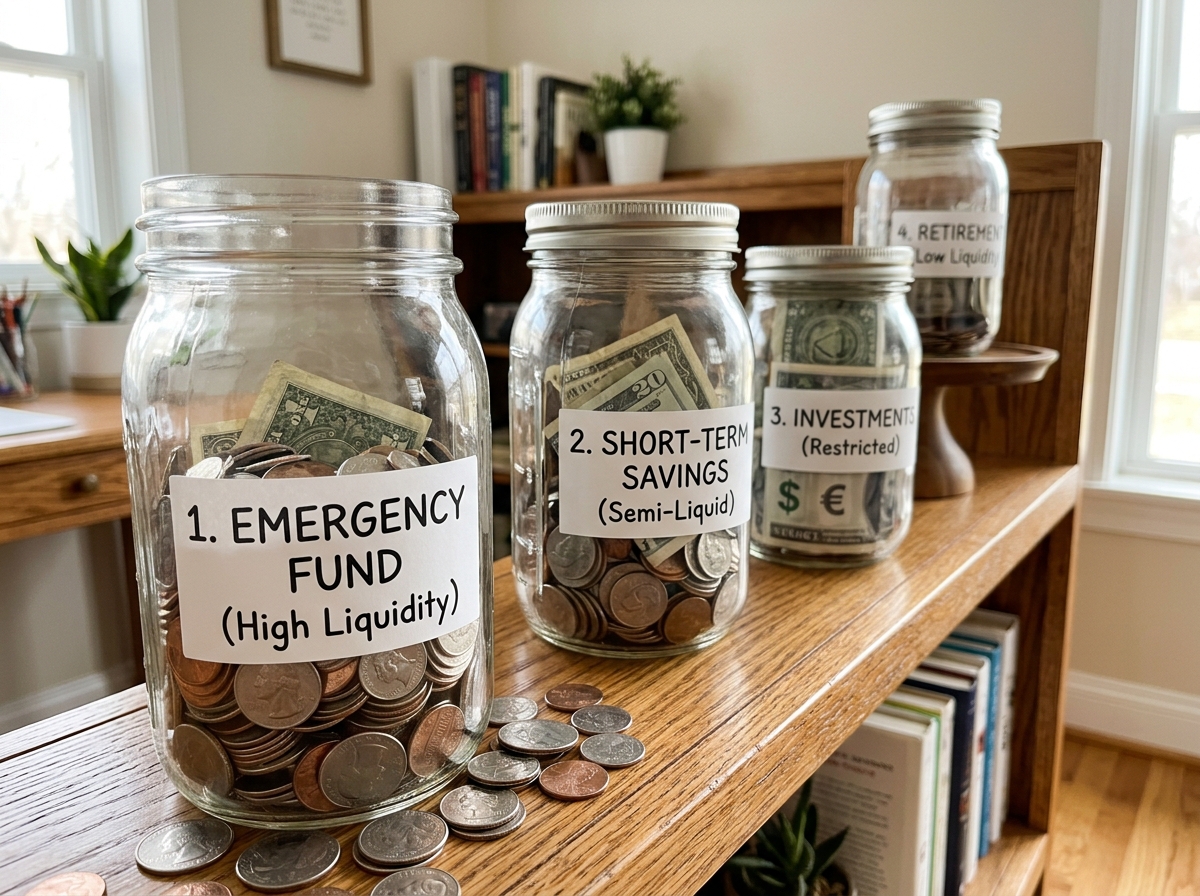
CD Laddering: Staggered Maturity
A Certificate of Deposit (CD) offers a fixed interest rate for a specific term (like 6, 12, or 24 months). The catch? If you take the money out early, you pay a penalty. For an emergency fund, that sounds risky.
However, you can use “CD Laddering.” Instead of putting $10,000 in one 12-month CD, you put $2,500 into four different CDs that mature at different times (e.g., every 3 months). This ensures that a portion of your cash becomes available regularly without penalty. It’s a great way to lock in higher rates for the “back half” of your emergency fund. You can learn more about these automatic savings strategies for beginners to see if laddering fits your style.
Inflation Hedges and Retirement Backups
For those looking to protect their money from rising prices, Series I Savings Bonds are a unique option. Their interest rate is partially tied to the inflation rate. However, they come with a major caveat: you cannot touch the money for the first 12 months. This makes them a poor choice for your first $1,000, but a great place for your sixth month of expenses. You can check the current I Bond rates and terms at TreasuryDirect.
Another “emergency” option is a Roth IRA. Since you contribute to a Roth IRA with after-tax dollars, you can actually withdraw your contributions (but not the earnings) at any time without taxes or penalties. We generally recommend keeping your retirement and emergency funds separate, but in a true “income shock” scenario, a Roth IRA can serve as a final safety net.
Where You Should Never Store Your Emergency Savings
Knowing where not to put your money is just as important as knowing the best spots. Avoid these common traps:
- The Stock Market: It’s tempting to want that 10% average annual return, but the market is volatile. If the market crashes by 20% and you lose your job the same week, your emergency fund has vanished when you need it most.
- A Standard Checking Account: Keeping “extra” money in your checking account is a recipe for accidental spending. When you see a high balance, you’re more likely to treat yourself to a vacation or a new gadget, forgetting that the money was meant for a new transmission.
- Physical Cash at Home: While keeping $100 in your wallet is fine, keeping thousands under a mattress is dangerous. It can be stolen, lost in a fire, or damaged by water—and it earns zero interest.
- Retirement Accounts (401k): Taking a hardship withdrawal from a 401(k) usually results in a 10% penalty plus income taxes. It’s an expensive way to get your own money.
Using simple tools for budget management can help you visualize these different buckets so you don’t accidentally dip into the wrong one.
The Danger of Commingling Funds
“Commingling” is a fancy way of saying “mixing your money together.” If your emergency fund is in the same account you use to pay for Netflix and tacos, the lines get blurry.
Psychologically, we are much less likely to spend money that is moved to a separate bank or a specifically named “Rainy Day” account. Many modern budgeting apps for beginners allow you to create “vaults” or “buckets” within one account, which provides that necessary mental barrier.
How to Build and Replenish Your Fund
Building a fund takes time, but the best way to start is through automation. Treat your emergency fund like a mandatory monthly bill. If you never see the money hit your checking account, you won’t miss it.
- Direct Deposit: Ask your employer to split your paycheck, sending 5-10% directly to your high-yield savings account.
- Tax Refunds and Bonuses: Instead of spending your “windfall” money, commit to putting at least 50% of it into your safety net.
- The “Trim” Method: Use a creating a sustainable budget plan to find one subscription or habit to cut, then redirect that exact amount to your savings.
When to Tap In and How to Bounce Back
An emergency fund is not for a “once-in-a-lifetime” concert or a flash sale on sneakers. Ask yourself: Is it unexpected? Is it necessary? Is it urgent? If the answer to all three is yes, use the money! That is why it’s there.
Once the crisis has passed, your number one financial priority should be replenishing that fund. Don’t feel guilty for using it—feel proud that you were prepared. You can use an easy budget planner for beginners to recalibrate your spending and get back to your target balance as quickly as possible.
Frequently Asked Questions about Emergency Funds
Why should my emergency fund be separate from my checking account?
Separation prevents “lifestyle creep.” If you see $5,000 in your checking account, your brain tells you that you are “rich” and can afford a splurge. Moving that money to a separate account—ideally at a different bank—creates a friction point that makes you think twice before spending it.
Is a Roth IRA a good place for an emergency fund?
It can be a backup, but it shouldn’t be your primary storage. While you can withdraw contributions penalty-free, doing so robs your future self of years of tax-free growth. It’s better to have a dedicated HYSA first.
What is the difference between a money market account and a money market fund?
A Money Market Account (MMA) is a bank deposit account that is FDIC-insured. A Money Market Fund is a type of mutual fund (an investment) that is not FDIC-insured. While funds are generally very safe, they aren’t guaranteed by the government like an account is.
Conclusion
At QuickFinHub, we believe that financial peace of mind shouldn’t be a luxury reserved for the wealthy. It starts with a single step: moving your money out of your “spending” reach and into a place where it can grow safely.
Whether you choose a high-yield savings account for the 5% APY or a money market account for the easy access, the “best” place is ultimately the one you will actually use. Stop hiding money in your sock drawer and start building a sustainable habit today. Your future self—the one facing a flat tire or a surprise bill—will thank you.
