
Why Financial Independence Retire Early Tips Can Change Your Life
Financial independence retire early tips are exactly what you need if you want to stop trading your best years for a paycheck and start building a life on your own terms.
Here are the core strategies at a glance:
- Calculate your FIRE number – multiply your annual expenses by 25 (Rule of 25) or 33 for a more conservative target
- Boost your savings rate – aim for 30-60% of income, or 70%+ for an aggressive 8-10 year timeline
- Invest consistently – low-cost index funds and tax-advantaged accounts (401k, Roth IRA, HSA)
- Cut lifestyle creep – keep expenses steady as income grows
- Build an emergency fund – 3-6 months of expenses before investing aggressively
- Eliminate high-interest debt – especially credit cards before ramping up investments
- Plan for healthcare – this is the biggest gap before Medicare at 65
- Choose your FIRE style – Lean, Fat, Barista, or Coast FIRE depending on your lifestyle goals
The average American retires at 63-65. But a growing movement of people – especially Millennials and Gen Xers – are rejecting that timeline entirely.
FIRE stands for Financial Independence, Retire Early. It’s not just about quitting your job young. It’s about using money as a tool to design the life you actually want, rather than delaying it for decades.
The idea is simple: spend less than you earn, invest the difference aggressively, and reach a point where your portfolio funds your life – permanently.
But simple doesn’t mean easy. The math is straightforward. The discipline is hard.
This guide breaks down everything you need to know – from calculating your target number to the investing strategies and budgeting habits that actually work – so you can figure out what FIRE looks like for you.
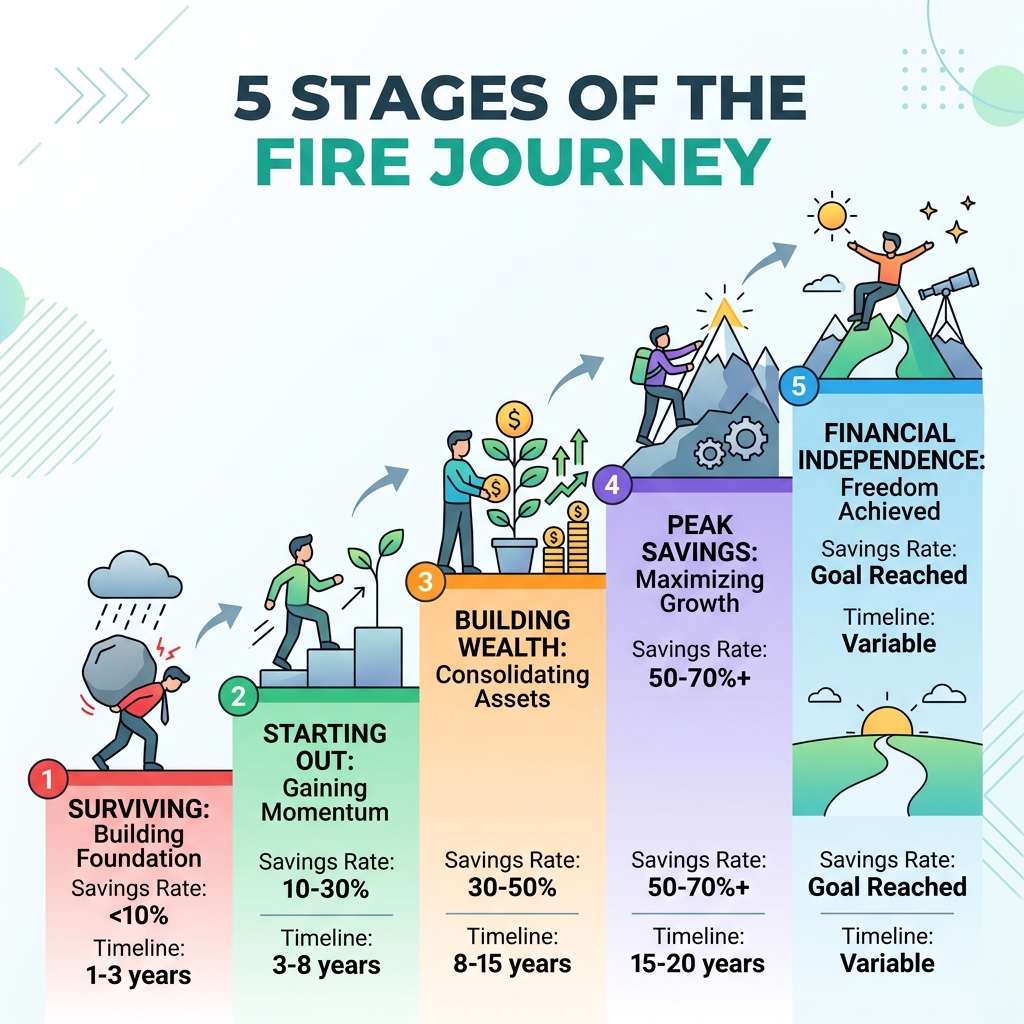
Understanding the FIRE Movement and Its Variations
At its heart, the FIRE movement is about reclaiming your time. While the acronym ends with “Retire Early,” many in the community find that once they reach financial independence, they don’t actually want to sit on a beach forever. Instead, they want the option to work on projects they love without worrying about a mortgage payment.
The movement gained massive traction following the philosophy laid out in the 1992 book Your Money or Your Life by Vicki Robin and Joe Dominguez. The core idea is to look at your expenses not just in dollars, but in “life energy”—the number of hours you had to work to pay for that item.
Because everyone’s version of a “dream life” is different, several variations of FIRE have emerged:
- Lean FIRE: This is for the minimalists. You live on a very lean budget (often under $40,000 a year) to reach independence as fast as possible.
- Fat FIRE: The opposite of Lean FIRE. This is for those who want a luxurious retirement with a high standard of living, requiring a much larger “nest egg.”
- Barista FIRE: You’ve saved enough to cover your core expenses, but you keep a part-time job (perhaps at a coffee shop) for extra “fun money” or to access employer-sponsored healthcare.
- Coast FIRE: You’ve invested enough early in life that even if you never contribute another cent, your portfolio will grow to a full retirement amount by the time you reach standard retirement age. You only need to work enough to cover your current living expenses.

Comparing FIRE Types
| FIRE Type | Lifestyle Focus | Estimated Annual Spend |
|---|---|---|
| Lean FIRE | Frugality & Minimalism | < $40,000 |
| Barista FIRE | Part-time work for perks | $40,000 – $60,000 |
| Coast FIRE | Investing early, working for now | Varies |
| Fat FIRE | Luxury & High spending | $100,000+ |
How to Calculate Your Target Number and the 4% Rule
The most common question we hear is: “How much do I actually need?” To answer this, we use the Rule of 25.
Based on the Trinity Study (a famous piece of financial research), the “4% Rule” suggests that you can safely withdraw 4% of your initial portfolio value in the first year of retirement, adjusted for inflation thereafter, with a high probability of the money lasting 30 years. To find your “FIRE Number,” simply multiply your expected annual expenses by 25.
For example, if you plan to spend $60,000 a year, you need $1.5 million ($60,000 x 25).
However, if you are retiring at age 35 or 45, a 30-year horizon isn’t enough. You might live for another 50 years! In these cases, many experts suggest a more conservative 33x expenses rule, which equates to a 3% withdrawal rate. This provides a larger buffer against market volatility and inflation.
According to Social Security Administration data, the standard retirement age is creeping upward, making these early-exit strategies even more valuable for those who want to reclaim their youth.
When planning your number, you must account for:
- Inflation: Your $50,000 lifestyle today will cost more in 20 years.
- Sequence of Returns Risk: A market crash right after you retire is much more dangerous than one ten years in.
- Taxes: Don’t forget that Uncle Sam will want a cut of your withdrawals.
For more help on setting these goals, check out our Saving Strategies.
Essential Financial Independence Retire Early Tips for Success
Achieving FIRE isn’t a matter of luck; it’s a matter of math and habit. The single most important metric is your savings rate. While a traditional retirement plan suggests saving 15% of your income, FIRE followers often aim for 50% to 70%.
At a 70% savings rate, you can theoretically reach financial independence in just 8 to 10 years, assuming a 7% annual return.
The Foundation
Before you start sprinting toward retirement, you need a solid foundation. This means:
- Emergency Fund: Keep 3-6 months of cash in a high-yield savings account. This prevents you from having to sell investments during a market downturn.
- Kill High-Interest Debt: You cannot out-invest a 25% interest rate on a credit card. Use our guides on Debt to clear the path first.
- Avoid Lifestyle Creep: As your income rises, keep your spending the same. This “gap” is where wealth is built.
Practical Financial Independence Retire Early Tips for Budgeting
Budgeting for FIRE isn’t about deprivation; it’s about value-based spending. We recommend tracking every penny for at least three months to see where your money actually goes.
- Geo-arbitrage: Consider moving to a lower-cost-of-living area. If you can work remotely or find a similar job in a cheaper city, your savings rate will skyrocket.
- The 50/30/20 Rule (Modified): Instead of 50% needs, 30% wants, and 20% savings, try to flip it. Aim for 20% needs, 10% wants, and 70% savings.
- Automation: Set up your accounts so your investments are taken out the moment your paycheck hits. If you don’t see the money, you won’t spend it.
For more detailed help, explore our Budgeting Tips.
Advanced Financial Independence Retire Early Tips for Investing
Once you’ve mastered the budget, you need your money to work as hard as you do. For most of us, this means a heavy focus on Investing Basics like low-cost index funds and ETFs.
Tax-Advantaged Accounts are King:
- 401(k): For 2025, the contribution limit is $23,500. Always contribute enough to get your employer match—that’s a 100% return on your money!
- IRA (Traditional or Roth): A great way to add another $7,000 (for 2025) to your retirement stash.
- HSA (Health Savings Account): Often called the “Super IRA.” It’s triple-tax advantaged: tax-deductible contributions, tax-free growth, and tax-free withdrawals for medical expenses.
Bridging the Gap: One major hurdle for early retirees is accessing funds before age 59½ without paying penalties. Strategies include:
- Roth IRA Conversion Ladder: Converting traditional 401(k) funds to a Roth IRA and waiting five years to withdraw the principal penalty-free.
- Rule of 55: If you leave your job in the year you turn 55 (or later), you may be able to take penalty-free withdrawals from your current employer’s 401(k).
- Section 72(t): Allows you to take “Substantially Equal Periodic Payments” (SEPP) from your IRA at any age without the 10% penalty, though it requires strict adherence to IRS schedules.
Overcoming Challenges and Common FIRE Myths
Pursuing FIRE isn’t without risks. The biggest concerns for early retirees are often healthcare and market volatility.
The Healthcare Hurdle
Since most Americans get health insurance through their jobs, retiring at 40 creates a gap. Options include:
- The Marketplace (ACA): You may qualify for significant subsidies if your taxable income is kept low.
- Health Sharing Ministries: A lower-cost alternative to traditional insurance, though they come with fewer legal protections.
- Part-time Work: Some “Barista FIRE” followers work at companies known for providing health benefits to part-time employees.
Market Volatility and Longevity
What if the market crashes the year you quit? This is why having a “cash buffer” or a flexible spending plan is vital. If the market is down, you might choose to skip your annual vacation or take on a small side hustle to avoid selling stocks at a loss.
Common FIRE Myths
- “You need a six-figure salary”: While a high income helps, FIRE is more about your savings rate than your absolute income. Someone earning $60k who saves $30k is closer to FIRE than someone earning $200k who saves $20k.
- “You have to be a miser”: FIRE is about intentionality. If you love travel, keep it in the budget—just cut the things you don’t care about, like a brand-new car every three years.
- “You’ll never work again”: Most “retired” FIRE followers eventually start businesses, consult, or volunteer. The difference is they work because they want to, not because they have to.
According to the IRS update for 2025, contribution limits are rising, giving you even more room to shield your wealth from taxes as you build your bridge to freedom.
Frequently Asked Questions about FIRE
What is a realistic savings rate for early retirement?
While the average American saves about 5%, a realistic savings rate for FIRE is usually in the 30-60% range. If you can hit 70%, you can reach financial independence in roughly 8-10 years. The key is to optimize your income (ask for that raise!) while keeping your expenses low. Compound interest does the heavy lifting, but your savings rate is the engine that gets the car moving.
Is the 4% rule safe for a 40-year retirement?
The original 4% rule was designed for a 30-year retirement. For a 40 or 50-year horizon, many experts recommend a 3% to 3.5% withdrawal rate. It’s also wise to remain flexible. If the market has a bad year, reducing your spending by just 10% can significantly increase the longevity of your portfolio.
How do I handle health insurance before Medicare?
This is one of the most critical financial independence retire early tips. Most early retirees use the ACA Marketplace, where subsidies are based on income, not assets. By managing your taxable income (using a mix of Roth and brokerage withdrawals), you can often keep premiums very low. Other options include joining a spouse’s plan, using COBRA for the first 18 months, or utilizing HSA funds saved during your working years.
Conclusion
The journey to FIRE is a marathon, not a sprint. It requires a fundamental shift in how you view money—not as something to be spent, but as a tool to buy your freedom. By following these financial independence retire early tips, you can move from a life of financial stress to one of intentional living and total independence.
At QuickFinHub, we believe that financial freedom should be accessible to everyone, especially young adults navigating the complexities of modern life. It takes discipline, but the reward—owning 100% of your time—is worth every sacrifice.
Ready to take the first step? Start your journey to financial freedom today and explore more of our guides to build the life you’ve always dreamed of.
