
Why Every Young Adult Needs an Emergency Fund (And How to Build One Fast)
Knowing how to build an emergency fund is one of the most important money skills you can have — especially when you’re just starting out on your own.
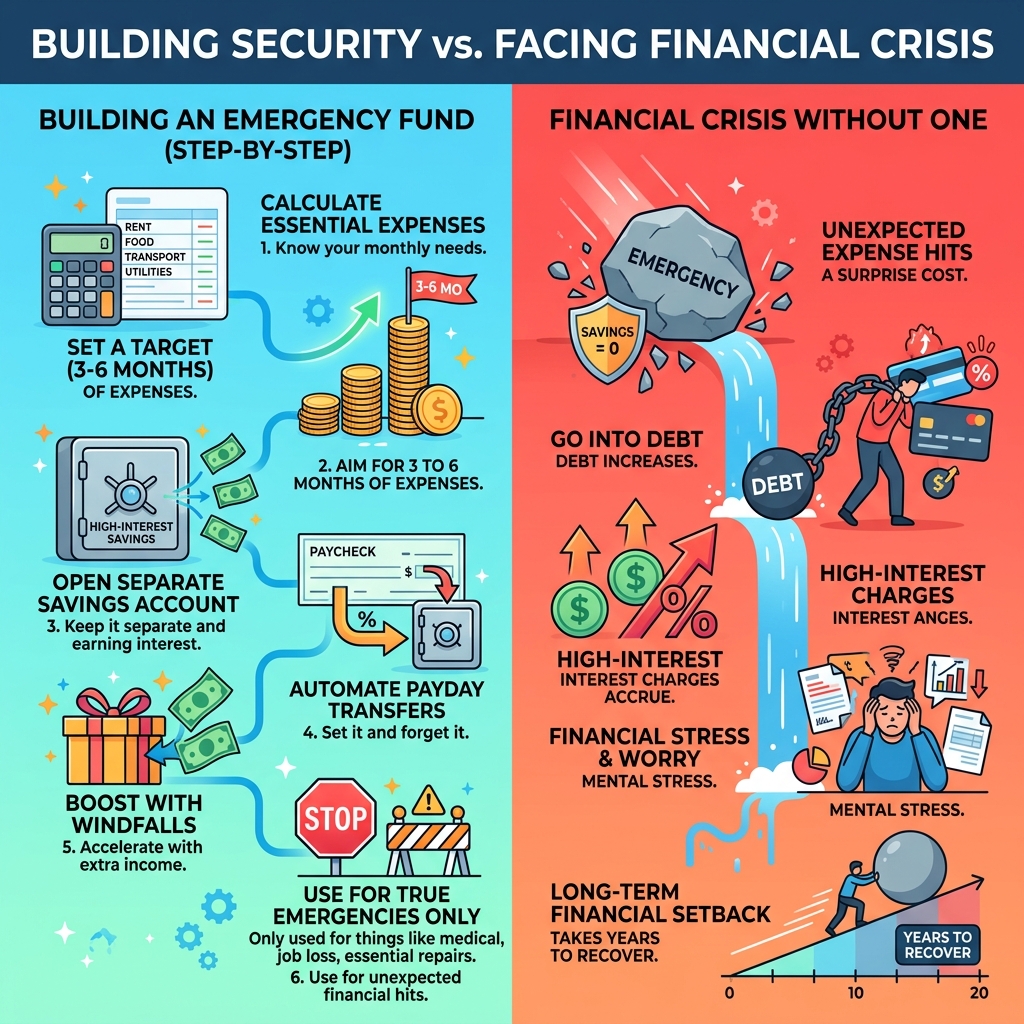
Here’s the quick version:
- Calculate your monthly essential expenses (rent, food, transport, utilities)
- Set a target of 3 to 6 months’ worth of those expenses
- Open a separate high-interest savings account just for this fund
- Automate a fixed transfer into that account every payday
- Boost it with windfalls like tax refunds or bonuses
- Only use it for true emergencies — then replenish it as soon as you can
That’s the core of it. The rest of this guide will walk you through each step in detail.
Life has a way of throwing curveballs at the worst possible times. A car breaks down. A medical bill shows up out of nowhere. You lose a job you thought was stable.
Without a financial cushion, those moments don’t just sting — they can send you into debt that takes years to climb out of.
The numbers tell the story clearly. According to recent data, 55% of Canadians had an emergency fund in 2024 that could cover three months of expenses — down from 64% in 2019. And south of the border, 57% of U.S. adults say they couldn’t cover a $1,000 emergency expense without going into debt.
That’s a lot of people one bad day away from a financial crisis.
The good news? You don’t need to be perfect with money to build a solid safety net. You just need a simple plan and the habit to stick to it — even if you start with just $10 or $20 a week.
What is an Emergency Fund and Why is it Essential?
At its simplest, an emergency fund is a dedicated stash of cash set aside for life’s “unplanned” moments. We like to think of it as a financial shock absorber. Just like the shocks on a car keep you from feeling every single pothole in the road, an emergency fund keeps you from feeling the full impact of a financial bump.
The primary purpose of this fund is to provide a safety net for two main types of financial hits:
- Spending Shocks: These are sudden, unplanned expenses. Think of a root canal that isn’t fully covered by insurance, a broken windshield, or your laptop suddenly deciding it’s done with this world right before a major deadline.
- Income Shocks: These are more serious. This is when your usual income suddenly stops, perhaps due to a layoff, a sudden illness, or a reduction in hours.
Why is this so essential for us as young adults? Because without this cushion, we often turn to high-interest credit cards or personal loans to cover the gap. This creates a cycle of debt that is incredibly hard to break. Research shows that 45% of renters and 29% of mortgage holders say an unexpected expense of just over $250 would break the bank for them. Having a fund helps with budgeting-for-unexpected-expenses so that a flat tire doesn’t become a three-year debt sentence.
Beyond just the math, there is the psychological side. Knowing you have a few thousand dollars in the bank specifically for “worst-case scenarios” provides immense peace of mind. It allows you to navigate transitions — like moving to a new city or switching careers — with confidence. For more on the basics, check out these Tips for Building or Rebuilding Your Emergency Fund.
Differentiating Emergency Funds from Sinking Funds
One of the biggest mistakes we see is people mixing up their emergency fund with other types of savings. To succeed, you need to draw a hard line in the sand.
- The Emergency Fund: This is for “catastrophes.” It’s for when your basement floods or you lose your job. It is not for a “shopping emergency” at your favorite store.
- The Rainy-Day Fund: These are for smaller, irregular expenses that you know will happen eventually, but you don’t know exactly when. For example, your car will eventually need new tires. Your phone might need a screen repair.
- Sinking Funds: These are for planned, specific goals. If you are saving for a wedding, a new PlayStation, or a trip to Europe, that is a sinking fund.
- The ‘Forget You’ Fund: This is a unique term for a fund that gives you the power to walk away from a toxic job or a bad living situation. While it shares some DNA with an emergency fund, it’s more about mobility and life changes.
Understanding these short-term-vs-long-term-savings-tips helps you keep your hands off the emergency cash when you see a flight deal you really want to grab.
Determining Your Target for How to Build an Emergency Fund
So, how much do you actually need? The standard advice is to save 3 to 6 months of non-discretionary expenses.
“Non-discretionary” is a fancy way of saying “the stuff you absolutely have to pay to survive.” This includes:
- Rent or mortgage payments
- Utilities (electricity, water, internet)
- Basic groceries (not fine dining)
- Insurance premiums
- Minimum debt payments
- Transportation costs (gas, transit passes)
If your total “must-pay” bills come to $3,000 a month, your target should be between $9,000 and $18,000. If that number feels terrifying, don’t panic! Most people start with a smaller “Starter Emergency Fund” of $1,000 or one month of expenses before building up to the full amount.
| Life Situation | Recommended Cushion | Why? |
|---|---|---|
| Single / Renting | 3 Months | Lower overhead; generally easier to pivot or find roommates. |
| Homeowner | 6 Months | Houses are expensive; furnaces and roofs don’t fix themselves. |
| Single Income Family | 6-9 Months | Higher risk; more people depending on that one paycheck. |
| Freelancer / Gig Worker | 9+ Months | Irregular income means you need a much larger buffer for slow months. |
Step-by-Step Instructions on How to Build an Emergency Fund

Now that we know the “why” and the “how much,” let’s get into the “how.” How to build an emergency fund isn’t about a one-time heroic act; it’s about a series of small, intentional steps.
Step 1: Audit Your Expenses You can’t save what you don’t track. Look back at your last three months of bank statements. Use budgeting-apps-for-beginners to categorize your spending. You might be surprised to find you’re spending $100 a month on subscriptions you forgot you had.
Step 2: Choose a Budgeting Method We are big fans of zero-based-budgeting-for-beginners. This method gives every single dollar a “job.” If you have $50 left over at the end of the month, its “job” is now “Emergency Fund.”
Step 3: Set a Small, Achievable Goal Don’t stare at the $15,000 mountain. Aim for $500. Once you hit $500, aim for $1,000. Celebrating these small wins keeps you motivated.
Step 4: Find the “Found” Money Did you get a $200 tax refund? Put it in the fund. Did your grandma send you $50 for your birthday? Put it in the fund. These “windfalls” are the fastest way to leapfrog your progress.
Practical Tips for How to Build an Emergency Fund on a Budget
We know what you’re thinking: “I’m living paycheck to paycheck. Where am I supposed to find extra money?” We’ve been there, and we’ve got some strategies for budgeting-on-a-low-income.
- The $5-a-Day Challenge: Can you find $5 a day? That’s about $150 a month. In a year, you’ll have $1,825. That’s a significant safety net built just by skipping a fancy coffee or packing a lunch.
- Micro-Savings: Use apps that “round up” your purchases to the nearest dollar and stash the change. It’s painless because you never see the money leave.
- The “Need vs. Want” Audit: Before every purchase, ask yourself if it’s a necessity or a desire. If you can save-more-on-groceries-a-novices-approach by switching to store brands or meal prepping, that extra $40 a week goes straight to your fund.
- Sell the Clutter: We all have that one closet full of things we don’t use. Selling an old guitar or a stack of video games can give your fund a $200 boost in a single weekend.
Automating Your Way to Consistency
Willpower is a finite resource. If you have to manually move money into your savings every month, eventually you’ll have a “bad month” and decide to skip it.
The secret to success is automation. Set up Pre-Authorized Contributions (PACs). This is where your bank automatically moves a set amount (even just $25) from your checking to your savings the day after your paycheck hits.
You can also talk to your employer about “paycheck splitting.” Many payroll systems allow you to send a percentage of your direct deposit to a different account. If 5% of your check goes directly to your emergency fund, you’ll learn to live on the remaining 95% without even feeling the difference. These automatic-savings-strategies-for-beginners are the most effective way to learn how-to-save-money-every-month without the stress of “remembering” to be responsible.
Where is the Best Place to Keep Your Emergency Fund?
Where you keep the money is just as important as how much you save. You want a balance of liquidity (how fast you can get the cash) and growth (interest).
The worst place to keep an emergency fund? Your regular checking account. If the money is right there, you will spend it on a late-night pizza or a pair of shoes. You need “positive friction” — making it just a little bit harder to access so you only use it when you really need to.
Here are the best options:
- High-Interest Savings Account (HISA): This is the gold standard. These accounts offer much higher interest rates than a standard savings account (sometimes up to 4% or more compared to 0.01%). They are safe, FDIC-insured (in the US) or CDIC-insured (in Canada), and you can usually get your money in 1-2 business days.
- Money Market Funds: These are low-risk mutual funds that invest in short-term debt. They often pay slightly more than a HISA but can take a few extra days to liquidate.
- Cash Management Accounts: Often offered by robo-advisors or online brokerages, these combine the features of checking and savings with high interest rates.
When making-your-first-steps-into-the-world-of-savings, look for an account with no monthly fees and no minimum balance requirements.
Maximizing Growth While Maintaining Safety
While the goal of an emergency fund isn’t to make you rich, you shouldn’t let inflation eat your hard-earned cash. By using a HISA, you benefit from compound interest. This is when your interest earns interest.
For example, if you have $10,000 in a HISA at 4% interest, you’ll earn $400 in a year just for letting the money sit there. That’s $400 of “free” emergency protection!
Always ensure your bank is FDIC or CDIC insured. This protects your deposits up to $250,000 (US) or $100,000 (Canada) per category if the bank ever goes bust. Online-only banks often offer the best rates because they don’t have the overhead of physical branches. For more personal-finance-101-stress-free-saving-tips, focus on accounts that don’t penalize you for withdrawals.
Managing and Replenishing Your Fund
An emergency fund is a living thing. It’s not a “set it and forget it” statue. You need to manage it as your life changes.
When to Use It: Ask yourself three questions before dipping in:
- Is it unexpected?
- Is it necessary?
- Is it urgent?
If you’re a student, how-to-start-saving-money-in-college is hard enough, so don’t let a “sale at the campus bookstore” count as an emergency. True emergencies are things like your car not starting when you need to get to work or a sudden flight home for a family crisis. Check out more saving-tips-for-college-students to stay disciplined.
How to Replenish: Once the “fire” is out and you’ve used some of the money, your #1 financial priority becomes putting that money back. Treat the “debt” to your emergency fund like a high-interest credit card bill. Cut back on discretionary spending for a few months until the balance is restored.
Common Mistakes to Avoid
We’ve seen it all, and we want to help you avoid the pitfalls that derail most young savers.
- Lifestyle Creep: As you get a raise or a better job, your “essential” expenses often go up. If you move into a more expensive apartment, you need to recalculate your 3-6 month goal.
- Investing Too Early: It’s tempting to put all your extra cash into the stock market or crypto. But if the market crashes at the same time you lose your job, you’ll be forced to sell your investments at a loss. Build the foundation (the emergency fund) before you build the skyscraper (the investment portfolio).
- Mixing Accounts: Never, ever keep your emergency fund in your daily spending account. The temptation is too high.
- Using it for “Almost” Emergencies: A friend’s wedding is not an emergency. You knew about it six months ago. That should come from a sinking fund, not your safety net. Don’t use your emergency cash for easy-ways-to-save-for-your-dream-vacation.
Frequently Asked Questions About Emergency Savings
When should I actually use my emergency fund?
You should use it for major, sudden, and unplanned needs that are not part of your current budget. Common examples include job loss, medical emergencies, essential car repairs, or urgent home maintenance (like a leaking roof). It is not for semi-regular expenses like annual car registration or holiday gifts.
Should I prioritize debt repayment or emergency savings?
This is the age-old question! At QuickFinHub, we recommend a “hybrid” approach. If you have high-interest debt (like credit cards), try to save a “starter” emergency fund of $1,000 first. This prevents you from adding more debt when a small emergency happens. Once you have that $1,000, focus aggressively on paying off the high-interest debt while making only minimum contributions to your savings. Once the high-interest debt is gone, finish building the full 3-6 month fund.
How do I calculate my monthly living expenses accurately?
The best way is to look at your bank and credit card statements from the last 12 months. Total up your essential costs (housing, food, utilities, transport, insurance, minimum debt payments) and divide by 12. This gives you an average that accounts for seasonal spikes, like higher heating bills in the winter.
Conclusion
Building an emergency fund is one of the most empowering things you can do for your future self. It’s about more than just money; it’s about the freedom to handle whatever life throws at you without fear. At QuickFinHub, we’re dedicated to helping young adults navigate these transitions with ease.
The goal isn’t to be perfect from day one. It’s about starting. Whether it’s $5, $50, or $500, every dollar you save is a brick in the wall of your financial security. There are many simple-ways-to-build-an-emergency-fund, so pick one and start today.
Ready to start your financial journey? Visit QuickFinHub for more expert tips
