
Why Most People Struggle With Money (And How a Budget Fixes It)
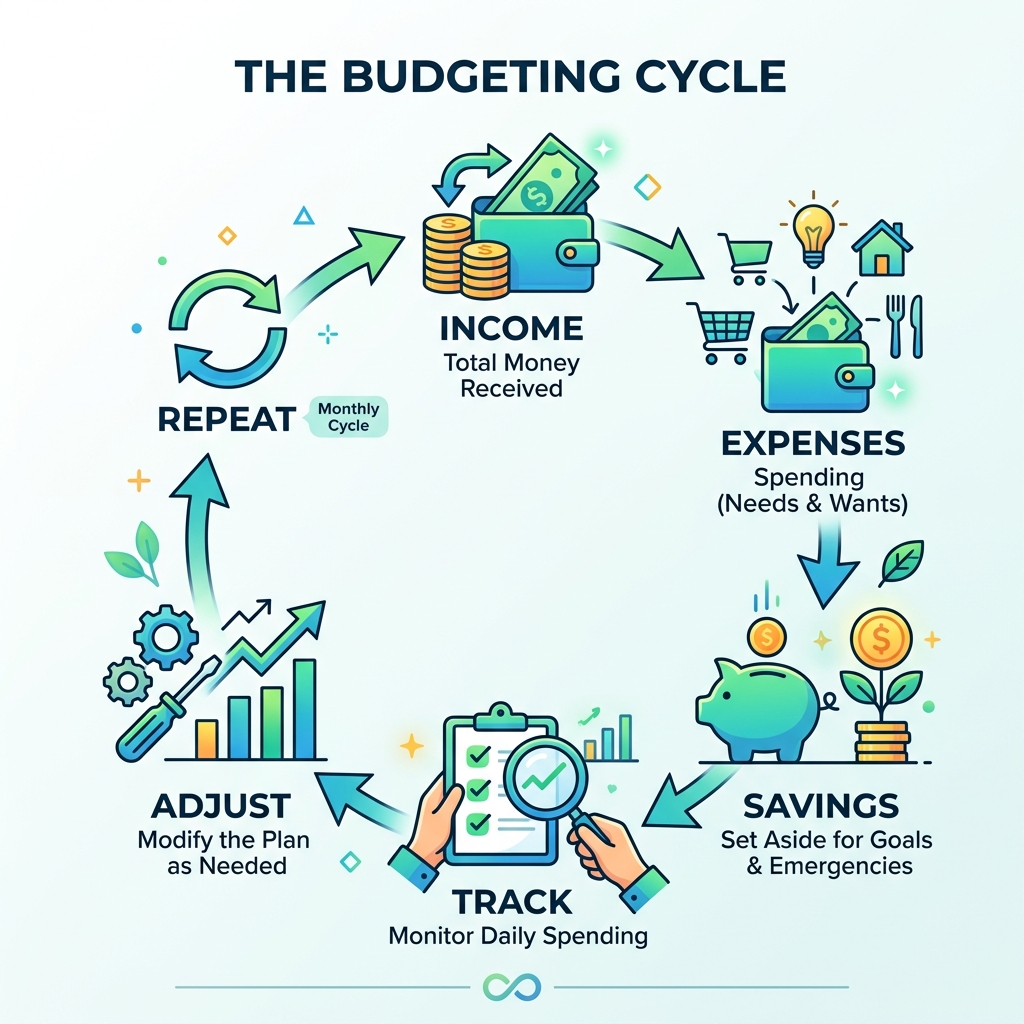
A beginners guide to budgeting gives you a simple, step-by-step way to take control of your money — no finance degree required. Here’s the quick version:
- Calculate your monthly take-home income from all sources
- List your expenses — split into needs (rent, groceries) and wants (streaming, dining out)
- Pick a budgeting method that fits your life, like the 50/30/20 rule
- Track your spending weekly so nothing sneaks up on you
- Build savings and tackle debt as part of your regular budget
That’s the core of it. The sections below walk you through each step in detail.
Here’s something worth sitting with: 78% of Americans live paycheck to paycheck. Not because they don’t earn enough, but because most people never have a clear plan for where their money goes.
Sound familiar? You get paid, cover a few bills, spend a little here and there — and somehow, by the end of the month, the money’s just gone.
That’s not a willpower problem. It’s a visibility problem.
A budget is simply a written plan for your money. It shows you what’s coming in, what’s going out, and what’s left over. Once you can see the full picture, you’re in control — not the other way around.
The good news? Building that plan is a lot simpler than most people think.
Why You Need a Beginners Guide to Budgeting
Think of a budget as a financial roadmap. You wouldn’t set off on a cross-country road trip without a GPS or at least a map, right? You’d end up lost, out of gas, and probably frustrated in a town you didn’t mean to visit. Budgeting is the GPS for your financial life. It tells you exactly how much “fuel” (money) you have and how far it can take you.
We often hear from young adults that budgeting feels restrictive. There’s this myth that having a budget means you can never buy a latte or go out with friends again. In reality, the opposite is true. A budget gives you permission to spend. When you know your rent is covered and your savings are tucked away, you can spend that remaining “fun money” without the nagging guilt that usually follows a late-night online shopping spree.
Beyond just “permission to spend,” a beginners guide to budgeting helps identify “spending leaks.” These are the small, almost invisible costs that drain your bank account. Did you know the average cost of cable is more than $1,700 a year? Or that something as small as $10 a week adds up to over $520 in a year? When we don’t track our money, these leaks stay hidden.
For those just starting out, check out our simple-budgeting-tips-for-students to see how these concepts apply even on a smaller scale. Whether you’re navigating your first job or managing a student loan, our personal-finance-budgeting-tips-for-young-adults can help you align your spending with your actual life goals.
How to Create Your First Budget in 5 Steps
Ready to get started? We’ve broken this down into five manageable steps. Grab a coffee, pull up your banking app, and let’s get to work.

Before we dive in, it’s helpful to have a template. You can use this FTC Budgeting Guidance as a physical worksheet to follow along.
To build an effective budget, you need to understand the difference between fixed and variable expenses.
| Expense Type | Description | Examples |
|---|---|---|
| Fixed Expenses | Costs that stay the same every month. | Rent, car payments, insurance, gym membership. |
| Variable Expenses | Costs that change based on usage or choice. | Groceries, gas, dining out, entertainment. |
Step 1: Calculate Your Total Monthly Income
The first step in any beginners guide to budgeting is knowing exactly how much money you have to work with. We are looking for your net income, also known as your “take-home pay.” This is the amount that actually hits your bank account after taxes, 401(k) contributions, and health insurance are taken out.
If you have a side gig, like driving for a ride-share service or freelancing, include that too. However, be conservative. It’s better to underestimate your income and end up with a surplus than to overestimate and fall short. If your income is inconsistent, we have specific strategies in our guide on budgeting-on-a-low-income to help you manage those fluctuations.
Step 2: List and Categorize Your Expenses
Now comes the part that scares most people: looking at where the money goes. We recommend reviewing your last three months of bank statements. This reveals the “real you,” not the “idealized you” who only eats home-cooked meals.
Categorize everything into two main buckets: Needs and Wants.
- Needs (Mandatory Bills): These are non-negotiable. Rent, utilities, groceries, transportation, and minimum debt payments.
- Wants (Discretionary): These are things you could live without if you had to. Streaming services, dining out, hobbies, and that third pair of sneakers.
This is the perfect time for a “subscription audit.” Are you still paying for that fitness app you haven’t opened since 2023? Cancel it. Small wins here add up fast. For more ideas on trimming the fat, see our easy-ways-to-reduce-monthly-expenses.
Step 3: Choosing the Right Beginners Guide to Budgeting Method
There is no “one size fits all” in budgeting. The best method is the one you will actually stick to. Here are three popular frameworks for beginners:
- The 50/30/20 Rule: This is a fan favorite for its simplicity. You allocate 50% of your income to Needs, 30% to Wants, and 20% to Savings and Debt Repayment. It’s flexible and doesn’t require tracking every single cent.
- Zero-Based Budgeting: In this method, every single dollar is assigned a “job” before the month begins. Income minus expenses should equal zero. This is great for those who want total control. Learn more at zero-based-budgeting-for-beginners.
- The Envelope System: This is a cash-based system. You put a set amount of cash into physical envelopes for categories like “Groceries” or “Entertainment.” Once the envelope is empty, you stop spending in that category for the month. It’s a great way to build discipline.
Step 4: Track Your Spending and Adjust
A budget isn’t a “set it and forget it” tool. It’s a living document. You need to track your actual spending to see if it matches your plan. Many people find that they spend way more on “nights out” or “convenience food” than they realized.
We suggest a quick daily log (it takes 30 seconds!) and a weekly review. If you see you’ve already spent your entire “Wants” budget by the 15th of the month, you know you need to tighten the belt for the next two weeks. For practical tips on how to do this without losing your mind, check out our guides on how-to-track-expenses-at-home and tracking-daily-spending-effectively.
Step 5: Prioritize Savings and Debt Repayment
The final step is making sure your future self is taken care of. Financial experts suggest saving 10-15% of your income for retirement, but if you’re a beginner, start where you can. Even $10 a week is a win.
Your priorities should generally look like this:
- Starter Emergency Fund: Aim for at least $500 to $1,000. This stops you from using a credit card when your tire blows out.
- High-Interest Debt: Use the Debt Snowball (paying smallest balances first for motivation) or the Debt Avalanche (paying highest interest rates first to save money).
- Full Emergency Fund: Aim for 3–6 months’ worth of living expenses.
- Retirement/Long-term Goals: Aim for that 15% mark over time.
For a deeper dive into how to balance these, read budgeting-for-savings-where-to-begin.
Overcoming Common Budgeting Obstacles
Even with a perfect plan, life happens. An unexpected car repair or a sudden medical bill can feel like a punch to the gut. According to a 2024 report, 40% of American adults would struggle to cover an unexpected $400 expense. This is why we budget—to turn a “crisis” into a mere “inconvenience.”
One of the biggest obstacles is failing to account for irregular expenses. These are costs that don’t happen every month but are definitely coming—like car registration, holiday gifts, or annual insurance premiums. To handle these, use sinking funds. Take the annual cost, divide it by 12, and save that amount every month.
Staying motivated is another hurdle. Your first budget will probably “suck.” It takes about 2-3 months to get the hang of it. If you slip up, don’t quit! Just get back on track the next day. Avoid these beginner-budgeting-mistakes-to-avoid and learn how to handle budgeting-for-unexpected-expenses to keep your momentum going.
What to Do if Your Expenses Exceed Your Income
If you do the math and your expenses are higher than your income, you have a deficit. You have two levers to pull: Spend Less or Earn More.
- Spend Less: Look at your “Wants” first. Can you cut one streaming service? Can you shop around for car insurance? (Drivers who shop around can save $1,025 per year or more!).
- Earn More: Consider a side hustle, asking for a raise, or selling items you no longer use.
The goal is to create a “sustainable” plan. If your budget is too strict and allows for zero fun, you will quit. It’s like a crash diet; it works for a week, and then you binge. Build in a small “blow money” category for guilt-free fun. See creating-a-sustainable-budget-plan for more on finding that balance.
Essential Tools for Your Beginners Guide to Budgeting
You don’t need to be a spreadsheet wizard to succeed. Use the tool that feels most natural to you:
- Budgeting Apps: Apps like YNAB, PocketGuard, or EveryDollar can automate much of the tracking for you. Check out our list of budgeting-apps-for-beginners.
- Spreadsheets: Google Sheets or Excel offer great templates if you like seeing the raw data.
- Pen and Paper: Never underestimate the power of a simple notebook. Writing things down manually can actually help you process your spending habits more deeply.
Find what works for you in our guide on simple-tools-for-budget-management.
Frequently Asked Questions about Budgeting
How much should a beginner save each month?
We recommend aiming for 10-20% of your net income. However, if you are living paycheck to paycheck (like 78% of Americans), that might feel impossible. Start small. As we mentioned, even $10 a week adds up to over $520 in a year. Consistency is far more important than the initial amount. Once you get a raise or cut an expense, redirect that “new” money straight to savings before you have a chance to spend it. For more encouragement, look at the CFPB Savings Advice.
How often should I review my budget?
You should check your “daily limit” or log expenses daily (it takes seconds). We recommend a weekly check-in (about 15 minutes) to see if you’re on track for the month. Finally, do a monthly review to see where you overspent and adjust the categories for the following month. Every month is a “test run” for the next one. Get more tips at weekly-budgeting-tips-for-beginners.
What is the best way to handle irregular income?
If you’re a freelancer or gig worker, budgeting can feel like a roller coaster. The trick is to budget based on your baseline income—the lowest amount you’ve earned in a single month over the last six months. Anything you earn above that baseline should be put into a “holding account” (a separate savings account) to help cover the months when income is lower. This creates a “buffer” that smooths out your lifestyle. For more details on managing complex household finances, see creating-a-family-budget-plan.
Conclusion
At QuickFinHub, we believe that financial freedom isn’t about how much you make; it’s about how well you manage what you have. Budgeting isn’t a chore—it’s the foundation of a life with less stress and more choices.
By following this beginners guide to budgeting, you are joining the small percentage of people who take an active role in their financial destiny. Fewer than 25% of Americans stick to a budget consistently. By just starting today, you are already ahead of the curve.
Start small, stay consistent, and don’t be afraid to adjust your plan as your life changes. Your future self will thank you for the work you’re doing right now. For more tailored advice and resources, visit our full library of budgeting services. You’ve got this!
