
Why a Monthly Expenses Calculator Is the First Step to Financial Control
A monthly expenses calculator is a simple tool that helps you add up everything you spend in a month, compare it to your income, and see exactly where your money is going.
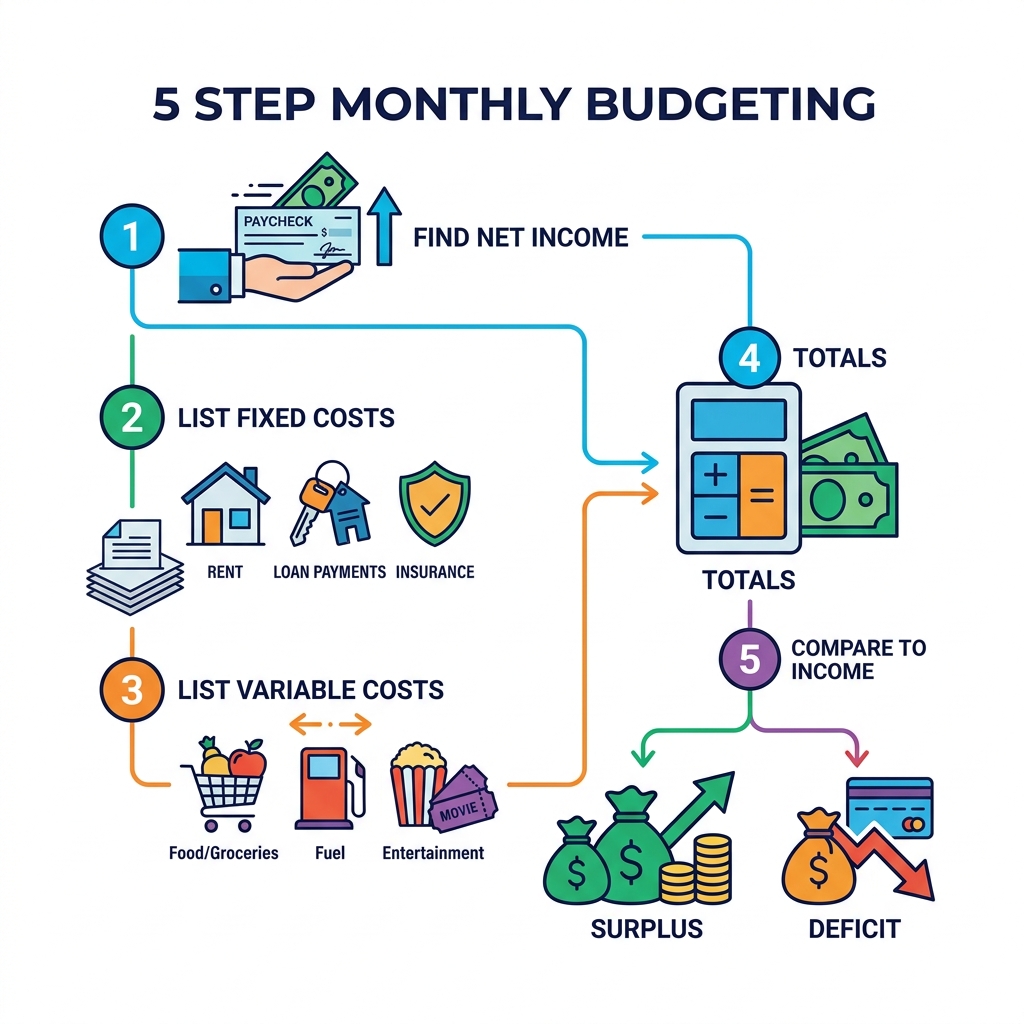
Here’s how to use one in five steps:
- Find your net income – Your take-home pay after taxes
- List fixed expenses – Rent, loan payments, insurance (costs that don’t change)
- List variable expenses – Food, gas, entertainment (costs that fluctuate)
- Add everything up – Get your total monthly spending
- Compare to income – See if you have a surplus or a deficit
Here’s a sobering fact: nearly 65% of Americans don’t know how much they spent last month. If you’re in your early 20s and just starting to manage your own money, you’re not alone – and you’re in the right place.
Not knowing where your money goes is how people quietly slide into debt. Eight out of ten Americans carry some form of debt. A simple monthly expenses calculator can break that cycle before it starts.
You don’t need a finance degree. You just need a clear picture of money in vs. money out.
The Mechanics of a Monthly Expenses Calculator
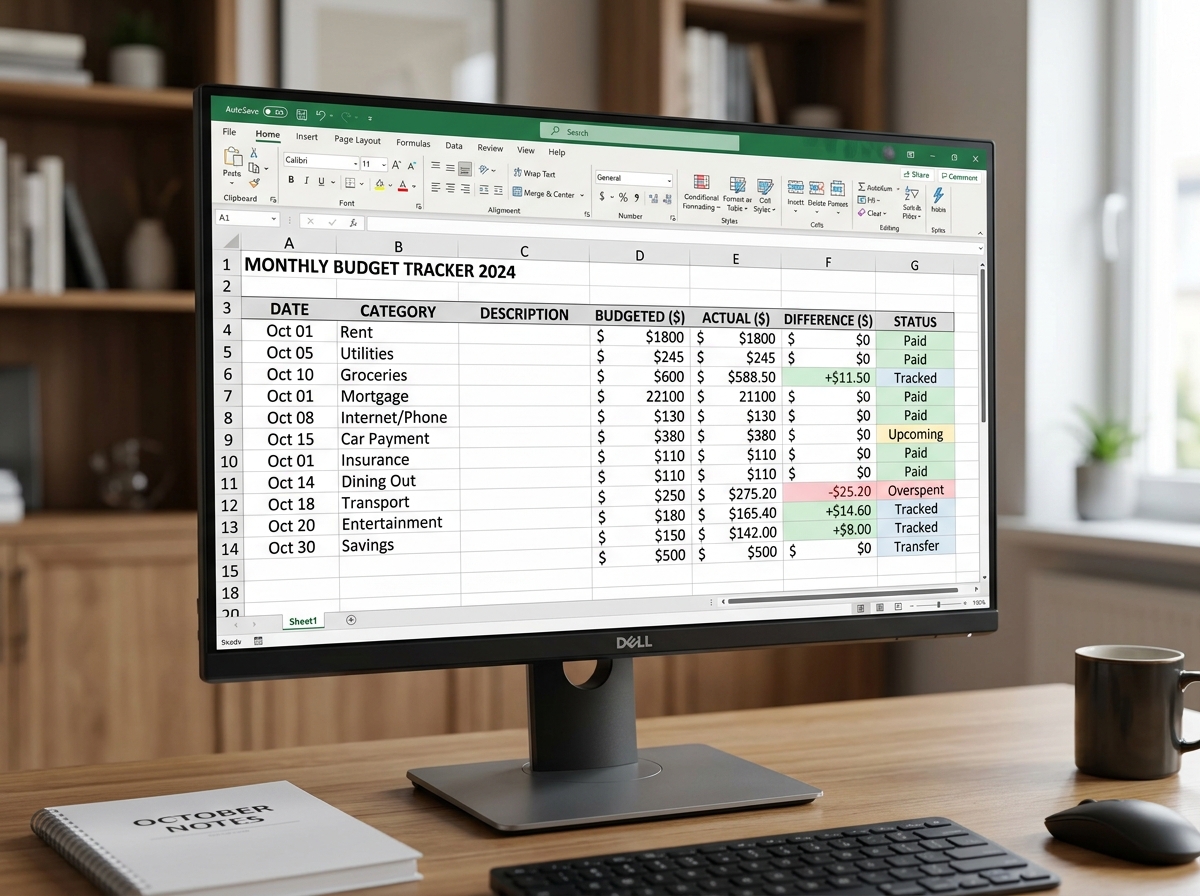
To get the most out of a monthly expenses calculator, we need to understand the “gears” turning behind the scenes. It isn’t just about adding up receipts; it’s about categorizing your financial life so you can make smarter decisions. At its core, the calculator takes your total monthly income and subtracts your total monthly expenses to reveal your “bottom line.”
The first number you need is your net income. This is your actual take-home pay—the amount that hits your bank account after Uncle Sam takes his cut and after any deductions for health insurance or 401(k) contributions. Using your gross income (the big number on your offer letter) is a common mistake that leads to overspending because you’re budgeting money you never actually see.
Next, we look at fixed costs. These are the “predictable” bills. Think of your rent, your car payment, or that flat-rate internet bill. They stay the same every month, making them the easiest part of the calculator to fill out. These are the foundation of your Beginner Guide to Financial Planning.
Then come the variable expenses. These are the wildcards. Your grocery bill might be $300 one month and $450 the next because you decided to host a dinner party or discovered a new obsession with fancy cheeses. Utilities also fall here, as heating and cooling costs fluctuate with the seasons. A good calculator helps you find an average for these so they don’t catch you off guard.
Why Tracking Monthly Spending is Vital for Financial Health
We often hear that “knowledge is power,” and in personal finance, that couldn’t be truer. 65% statistic? That lack of awareness is the primary reason people feel “broke” even when they have a decent salary. When we don’t track our spending, we lose the ability to spot “leaks” in our budget.
Tracking is the ultimate debt prevention tool. With eight out of ten Americans in debt, staying in the “two out of ten” group requires a proactive approach. By using a monthly expenses calculator, you can see a debt spiral starting before it becomes a crisis. For example, if you see that your credit card balance is creeping up because your “miscellaneous” spending is higher than your surplus, you can pivot immediately.
Beyond just avoiding trouble, tracking helps you reach your big dreams. Whether you want to travel to Tokyo, buy your first home, or finally pay off those pesky loans, you need a map to get there. You can’t save for a down payment if you don’t know how much “extra” money you actually have. Learning these basics is part of Learning the Ropes of Personal Finance: A Beginner’s Guide.
If you’re wondering where to start, we recommend checking out our guide on How to Track Expenses at Home to build that daily habit of awareness.
Essential Categories for Your Monthly Expenses Calculator
When you sit down with a monthly expenses calculator, it helps to have a checklist of categories. If you miss a category, your results won’t be accurate, and you might think you have more money than you really do.
We like to use the “Rule of Thumb” percentages as a benchmark. While everyone’s situation is unique, these national averages provide a great reality check:
| Category | Recommended % of Income | What’s Included |
|---|---|---|
| Housing | 25% – 30% | Rent/Mortgage, Insurance, Property Taxes |
| Transportation | 10% – 15% | Car Payment, Gas, Public Transit, Insurance |
| Food | 10% – 15% | Groceries and Dining Out |
| Utilities | 5% – 10% | Electricity, Water, Internet, Phone |
| Healthcare | 5% – 10% | Premiums, Copays, Medications |
| Savings/Debt | 10% – 20% | Emergency Fund, Retirement, Student Loans |
| Personal | 5% – 10% | Clothing, Entertainment, Hobbies |
Housing is usually the biggest slice of the pie. In 2021, about 23% of U.S. households were considered “cost burdened,” meaning they spent more than 30% of their income on housing. If your calculator shows you’re at 40% or 50%, it’s a sign that you might need a roommate or a more affordable neighborhood to stay financially healthy.
Transportation is another heavy hitter. The average household spent over $12,000 on transportation in 2022. Between car insurance, maintenance, and gas, the costs add up quickly. If you’re a student or young professional, we have tips on Creating a Sustainable Budget Plan that keeps these costs in check.
Don’t forget Food. This is the easiest place to overspend but also the easiest place to save. If your monthly expenses calculator shows your “Dining Out” category is larger than your “Groceries” category, you’ve found a major savings opportunity. For those looking to trim the fat, try our Save More on Groceries: A Novice’s Approach.
Using a Monthly Expenses Calculator to Identify Overspending
One of the most eye-opening moments of using a calculator is seeing the difference between “needs” and “wants.” Discretionary spending—the money we spend on things we enjoy but don’t strictly need to survive—is where most budget-busting happens.
We suggest performing a “Subscription Audit” as part of your monthly check-in. The average American spends about $273 a month on subscriptions! That’s over $3,000 a year. Are you still paying for that streaming service you haven’t opened in three months? Is that gym membership actually getting used?
By plugging these into your monthly expenses calculator, you can see the cumulative effect. Cutting just $50 a month in unused subscriptions is $600 a year back in your pocket. For more ideas, explore Easy Ways to Reduce Monthly Expenses.
Integrating a Monthly Expenses Calculator with the 50/30/20 Rule
Once you have your numbers, you need a framework to judge them. We are big fans of the 50/30/20 Rule. It’s a simple, balanced way to allocate your take-home pay:
- 50% for Needs: This covers your absolute essentials like housing, groceries, utilities, and minimum debt payments.
- 30% for Wants: This is your “fun” money. Dining out, hobbies, and that new pair of sneakers.
- 20% for Savings and Debt Repayment: This goes toward your emergency fund, retirement, and paying down debt faster than the minimum.
If your monthly expenses calculator shows that your “needs” are taking up 70% of your income, you know you have to cut back on “wants” or find ways to lower your fixed costs.
For those who want to be even more precise, you might consider Zero-Based Budgeting for Beginners. This method involves giving every single dollar a “job” until your income minus your expenses equals exactly zero. It’s the ultimate way to ensure no money is “wasted.”
Managing Hidden Costs and Irregular Income
Life isn’t always a neat series of monthly bills. There are “hidden” costs that don’t happen every month but can wreck your budget when they do. Think of annual car registration fees, Amazon Prime renewals, or holiday gift-giving.
A pro tip for your monthly expenses calculator is to take these annual costs, divide them by 12, and include that amount as a monthly “expense” that goes into a dedicated savings account. This way, when the $600 car insurance premium arrives, you already have the money sitting there.
Home maintenance is another big one. Experts suggest budgeting about 1% of your home’s value annually for repairs. If you’re renting, you might still have “hidden” costs like laundry quarters or renter’s insurance.
If you have irregular income—maybe you’re a freelancer, a server, or you work on commission—budgeting is even more critical. We recommend calculating your lowest expected monthly income and using that as your baseline in the calculator. Anything you earn above that goes into a “buffer account” to help cover months when income is lower.
Staying prepared is key. Make sure you’re Budgeting for Unexpected Expenses and looking into Simple Ways to Build an Emergency Fund to handle these surprises without stress.
Frequently Asked Questions about Monthly Expenses
What is the average monthly expense for a single person?
The average monthly expense for a single person in the U.S. typically ranges between $3,400 and $4,200. However, this varies wildly depending on your location. A single person in New York City or San Francisco will face much higher housing and grocery costs than someone in a smaller town in the Midwest.
For young adults and students, these numbers might look a bit different. You can find more tailored advice in our Simple Budgeting Tips for Students. To get a more specific idea of costs in your area, you can use a Living Expenses Calculator | New York Life to see how your spending compares to local averages.
What should I do if my expenses exceed my income?
If your monthly expenses calculator shows a “red” number at the bottom, don’t panic—but do take action. You have two levers to pull: decrease expenses or increase income.
First, look at your “wants.” This is usually the quickest way to find extra cash. Next, look for “big wins” like refinancing a high-interest loan or finding a cheaper insurance provider. If you’re still in the red, it might be time for a side hustle or a career move.
Managing a deficit is the first step in a Beginner’s Guide to Navigating Debt Management. The goal is to stop the bleeding so you can start building.
How do I account for variable expenses like utilities?
The best way to handle utilities is through annual averaging. Look back at your bills from the last 12 months. Add them all up and divide by 12. This gives you a “level” monthly amount to put into your monthly expenses calculator.
In the summer, your actual bill might be higher due to AC, but in the spring, it will be lower. By saving the “average” amount every month, you create your own internal “budget billing” system. This is a great example of Tracking Daily Spending Effectively to ensure you’re never surprised by a seasonal spike.
Conclusion
Taking control of your finances doesn’t happen overnight, but it does start with a single tool. A monthly expenses calculator gives you the clarity you need to stop guessing and start growing. By understanding your net income, identifying your fixed and variable costs, and applying smart frameworks like the 50/30/20 rule, you’re setting yourself up for long-term success.
At QuickFinHub, we know that navigating life’s transitions—from college to your first job, or from renting to buying—can be overwhelming. But with a solid budget in place, you gain the freedom to make choices based on your goals, not just your bank balance.
Ready to take the next step? Start your journey to financial freedom today and explore more of our tailored advice for young adults. Your future self will thank you for crunching the numbers today!
