
Your First Paycheck Is Just the Beginning
First job financial tips are something most people wish they had learned before their first paycheck hit their bank account — not after.
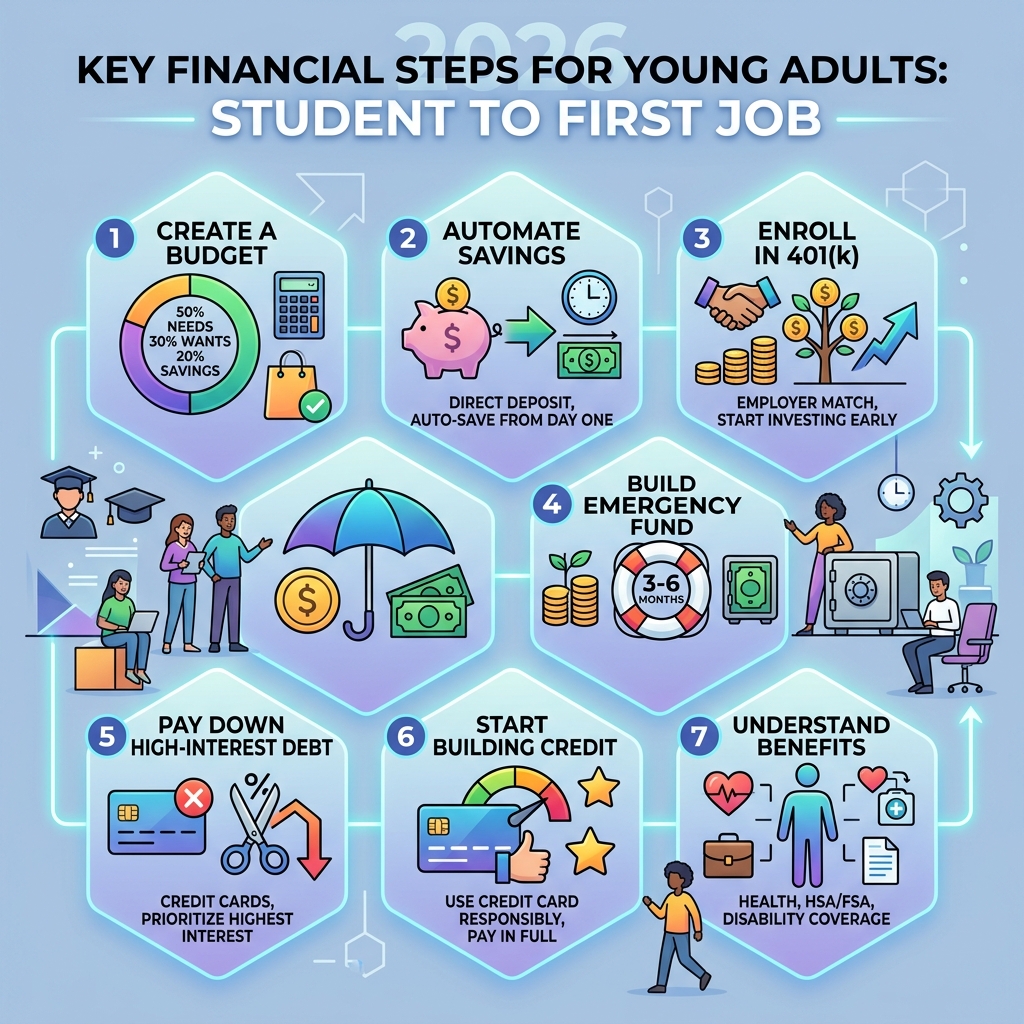
Here are the most important financial moves to make when starting your first job:
- Create a budget using the 50/30/20 rule (50% needs, 30% wants, 20% savings)
- Set up direct deposit and automate savings from day one
- Enroll in your employer’s 401(k) — especially if they offer a matching contribution
- Build an emergency fund covering 3-6 months of living expenses
- Pay down high-interest debt like credit cards before it compounds
- Start building credit by using a credit card responsibly and paying it off in full monthly
- Understand your employee benefits — health insurance, HSA/FSA, and disability coverage
Landing your first job is a huge milestone. Suddenly you have real income, real bills, and real financial decisions to make — often all at once.
The problem? Most schools don’t teach this stuff.
You might know your gross salary. But do you know what your take-home pay actually looks like after taxes, insurance, and retirement deductions? Many new earners are caught off guard by how much smaller that first paycheck looks compared to what they expected.
And that’s just the start. There’s rent, student loans, credit card debt, emergency funds, and retirement savings — all competing for the same dollars.
The good news: the financial habits you build right now will compound over time, just like a good investment. Starting early, even with small amounts, puts you dramatically ahead of people who wait.
This guide walks you through every major financial area — from budgeting and benefits to credit and investing — so you can make smart moves from day one.
Master Your Cash Flow with a First Job Budget
Congratulations! You’ve survived the interviews and landed the role. Now comes the part where you actually have to manage the money. Many young professionals fall into the trap of “lifestyle inflation”—the phenomenon where, as soon as your income goes up, your spending mysteriously rises to meet it. Suddenly, that morning latte becomes a daily requirement, and one streaming service turns into five.
To keep your bank account smiling, we recommend the 50/30/20 rule. This is a simple, flexible framework that ensures you’re covering your responsibilities while still having a life.
- 50% for Needs: This covers your “must-haves” like rent, groceries, utilities, and insurance.
- 30% for Wants: This is your “fun money” for dining out, hobbies, and that weekend trip with friends.
- 20% for Savings and Debt Repayment: This goes toward your emergency fund, retirement accounts, and extra payments on student loans or credit cards.

Budgeting isn’t about deprivation; it’s about spending with intention. When you know where your money is going, you actually enjoy it more because the guilt is gone. For more tailored advice, check out our personal finance budgeting tips for young adults or learn about budgeting on a low income if your starting salary is tighter than you’d like.
Tracking your income and expenses
Before you can allocate your 50/30/20, you need to know your net pay. This is your “take-home” pay—the amount that actually lands in your bank account after Uncle Sam takes his cut and your benefits are deducted. Taxes often throw new grads for a loop, so use a paycheck calculator to estimate your actual cash flow.
Once you have that number, use tools like Excel, Google Sheets, or budgeting apps to track every dollar. We’ve found that simple budgeting tips for students often apply perfectly to your first few months on the job as you transition into “real world” spending.
Prioritizing needs over wants
It’s tempting to buy a new car or a 75-inch TV with your first “big” check, but financial intentionality is key. Distinguish between fixed costs (rent) and flexible spending (brunch). If you’re struggling to find room for savings, start by budgeting for savings—where to begin helps you identify small leaks in your spending that can be redirected toward your future.
Essential First Job Financial Tips for Employee Benefits
When you start a new job, you’ll likely be handed a mountain of paperwork. While it’s tempting to just sign everything and get to work, these benefits are a massive part of your total compensation.
One of the most critical first job financial tips is to understand your retirement plan. Roughly 52% of private-sector workers earn retirement benefits at work, but many don’t fully utilize them. Additionally, don’t overlook disability insurance. According to the Social Security Administration, one in four 20-year-olds will become disabled before reaching retirement age. Having coverage through your employer is a vital safety net. For a broader look at these choices, see our beginner guide to financial planning.
Maximizing your 401(k) and retirement first job financial tips
If your employer offers a 401(k) match, grab it. This is literally “free money.” If they match 6%, and you only contribute 3%, you are leaving thousands of dollars on the table.
The power of compound interest is your best friend right now. An investment of $1,000 at 7% annually from age 20 to 30 can yield nearly $200,000 by age 67—even if you never add another cent after age 30! Waiting until age 35 to start means you have to work much harder to catch up. Dive deeper into these strategies with our investing tips for young adults.
Understanding health and disability coverage
You generally have a choice between an HMO (usually lower premiums, less flexibility) and a PPO (higher premiums, more doctor choice). If you are young and healthy, a High-Deductible Health Plan (HDHP) paired with a Health Savings Account (HSA) can be a smart move. HSAs are portable and the money stays with you even if you change jobs—which is likely, considering the Bureau of Labor Statistics notes that the median tenure for workers ages 25 to 34 is only 2.8 years.
Building a Safety Net and Managing Debt
Life happens. Cars break down, laptops die, and sometimes jobs disappear. This is why an emergency fund is non-negotiable. Most experts suggest saving three to six months’ worth of living expenses. If that feels overwhelming, start small. Saving just $25 a week adds up to $1,300 in a year.
At the same time, you may be staring down student loans or credit card debt. The average 2018 graduate walked away with nearly $30,000 in debt. Balancing these is a common challenge. We offer many saving tips for college students that still apply here, along with personal-finance-101-stress-free-saving-tips to help you breathe easier.
Strategic debt repayment as part of your first job financial tips
Not all debt is created equal. Prioritize high-interest debt, like credit cards, which can often have APRs over 20%. If you have student loans, understand your grace period (usually six months after graduation) and look into refinancing if you can secure a lower interest rate. If you’re unsure where to put your first extra $100, making your first steps into the world of savings can help you decide between debt and growth.
Creating an emergency fund that lasts
Keep your emergency fund in a separate, high-yield savings account so you aren’t tempted to spend it on “wants.” Automate the transfer so the money leaves your checking account before you even see it. This “out of sight, out of mind” approach is the most effective way to build a cushion.
Establishing Credit and Banking Basics
Your credit score is your financial reputation. A good score makes it easier to rent an apartment, get a car loan, and eventually secure a mortgage at the best interest rates.
Start by setting up a no-fee checking account with direct deposit. This ensures you get paid quickly and securely. Also, look for accounts with overdraft protection to avoid those pesky $35 fees while you’re still learning the ropes. Our guide on learning the ropes of personal finance—a beginner’s guide covers these essentials in detail.
Building a strong credit history
Payment history accounts for 35% of your credit score. The simplest rule? Pay your bills on time, every time. If you don’t have a credit history, consider a secured credit card or becoming an authorized user on a parent’s account. Keep your “credit utilization”—the amount you owe compared to your limit—below 30% to keep your score healthy.
Protecting your financial information
Cybersecurity is financial security. Set up two-factor authentication (2FA) on all banking and investment accounts. Monitor your statements monthly for any unauthorized charges. If something looks weird, report it immediately. Protecting your information is just as important as earning the money in the first place.
Frequently Asked Questions about Starting a Career
How much should I save from my first paycheck?
A common rule of thumb is the 10% rule: save at least 10% of every paycheck. Some prefer the Rule of Thirds: 1/3 for fun, 1/3 for savings, and 1/3 for your future (donations or long-term goals). The most important thing is to “pay yourself first” by automating your savings.
Should I pay off student loans or save for retirement first?
If your employer offers a 401(k) match, prioritize that first—it’s a 100% return on your money. After that, look at the interest rates. If your credit card debt is at 22% interest and your student loans are at 4%, pay off the credit card aggressively while making the minimum payments on the loans.
How do I avoid lifestyle inflation after my first raise?
When you get a raise or a bonus, try the 50% rule: save half of the increase and use the other half to improve your lifestyle. This allows you to enjoy your success while also accelerating your journey toward financial freedom.
Conclusion
At QuickFinHub, we believe that your first job is about more than just a paycheck—it’s the foundation of your entire financial future. By mastering your budget, maximizing your benefits, and building a safety net early, you aren’t just surviving; you’re setting the stage for massive wealth building.
Financial independence doesn’t happen by accident. It happens through consistent, small actions taken day after day. Take these first job financial tips and put them into practice today. Your future self (and your bank account) will thank you.
Ready to take control? Take the first step toward financial freedom with QuickFinHub.
