
Why So Many People Search for the Best Ways to Budget Money
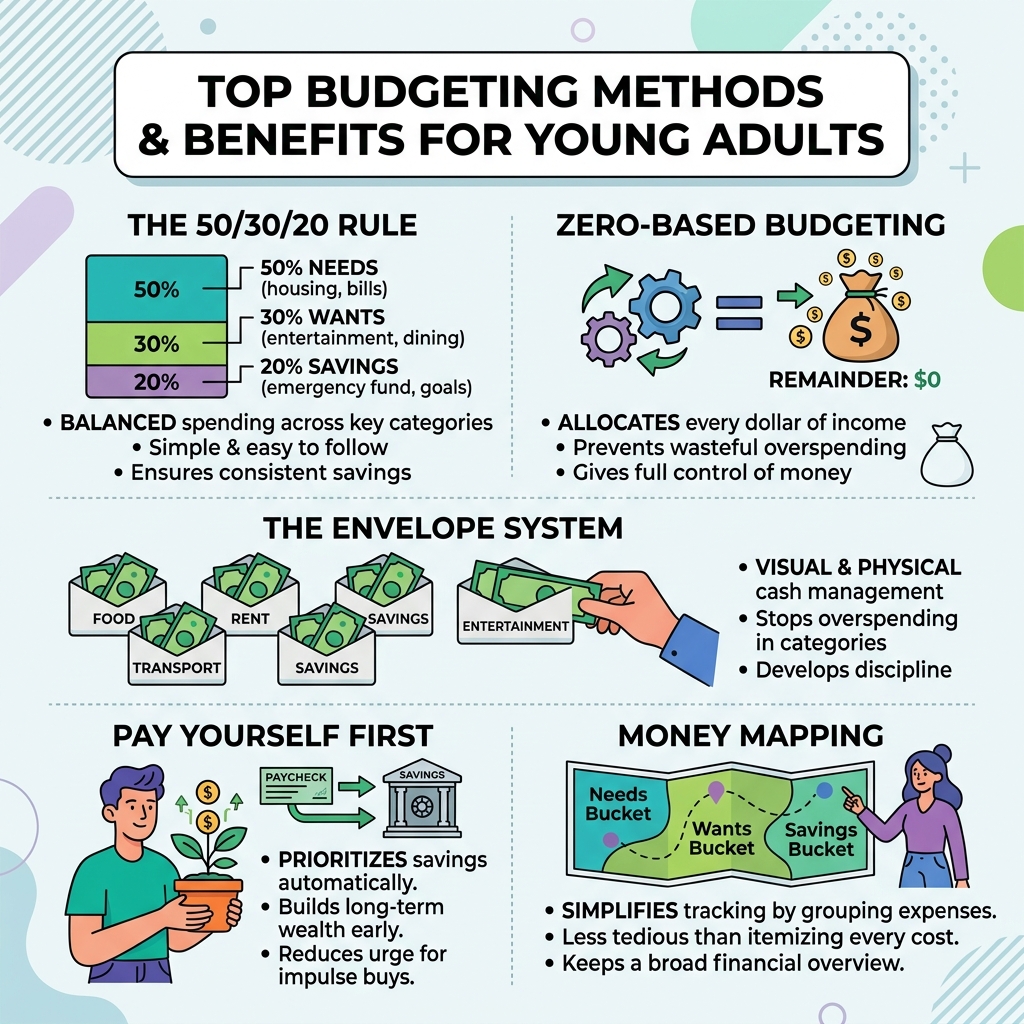
The best ways to budget money come down to a few proven methods that consistently work for real people:
- The 50/30/20 Rule – Spend 50% on needs, 30% on wants, and save 20%
- Zero-Based Budgeting – Assign every dollar a job until your income minus expenses equals zero
- The Envelope System – Divide cash into spending categories and stop when each envelope is empty
- Pay Yourself First – Move money to savings before spending anything else
- Money Mapping – Group spending into broad buckets (needs, wants, savings) instead of tracking every penny
Here’s something surprising: nearly 9 in 10 Americans say they budget in some form. Yet almost 69% still live paycheck to paycheck.
That gap tells the real story. Having a budget and having one that actually works are two very different things.
If you’re in your 20s and just starting to manage money on your own, the pressure is real. Rent. Student loans. Groceries. A social life. It all competes for the same limited paycheck. And most budgeting advice feels either too rigid or too vague to actually help.
The good news? Over 84% of people who budget report it helped them either avoid debt or pay it off. A budget isn’t about restriction. It’s about giving your money direction – so it goes where you want it to go, not where it accidentally ends up.
This guide breaks down the strategies that actually stick.
The Foundation: How to Start Budgeting for Success
Before we dive into the specific “bespoke” strategies, we need to build the foundation. Think of a budget as a financial map. You wouldn’t start a road trip without knowing your starting point and your fuel level, right?
Budgeting is essentially a plan for how you use your money. No matter how much you earn, it helps you stay on top of bills and goals while reducing that nagging “where did my money go?” stress.
The first step is understanding your net income. This is your actual take-home pay—the amount that hits your bank account after taxes, insurance, and retirement contributions are taken out. Interestingly, some experts suggest adding back your pre-tax deductions (like 401k contributions) when you calculate your budget to get a full picture of your financial power.
Once you know what’s coming in, you have to see what’s going out. This requires expense tracking. We recommend looking at the last two to three months of bank statements to get an honest average. It’s easy to guess that we spend $400 on groceries, but the data might show it’s actually $600 once those “quick trips” for snacks are added up.
We break expenses into two main types:
- Fixed costs: These stay the same every month, like rent, car insurance, or your internet bill.
- Variable spending: These fluctuate, like groceries, gas, and dining out.
For a deeper dive into the mechanics of this, check out our guide on Tracking Daily Spending Effectively or learn How to Track Expenses at Home to find a system that isn’t a chore.
Categorizing Your Needs vs. Wants
This is where the “bespoke” part begins. One of the best ways to budget money is to be brutally honest about what is a “need” and what is a “want.”
Needs are your essential bills—things you must pay to keep your life running. This includes housing, basic utilities, transportation, groceries, and minimum debt payments.
Wants are discretionary spending. This is the “fun stuff”: streaming services, dining out, hobbies, and that new outfit.
The “gray area” is where most budgets fail. A cell phone is a need; the latest iPhone Pro Max with an unlimited data plan is a want. Organic groceries might be a priority for you, but they are technically a want if conventional groceries would suffice during a tight month. By ranking your priorities, you can find Easy Ways to Reduce Monthly Expenses without feeling like you’re living in total deprivation.
Calculating Your Real Monthly Income
If you have a steady salary, this is easy. But for many young adults, income is a moving target. You might have a side hustle, freelance gigs, or a job with varying hours.
When calculating your income, we suggest being conservative. If your monthly take-home varies between $2,800 and $3,400, build your budget based on $2,800. Any extra becomes a “bonus” you can put toward your goals.
Don’t forget to include all sources, such as:
- Primary paycheck stubs.
- Tips or bonuses.
- Side hustle earnings (after setting aside money for taxes!).
- Occasional income like tax refunds or birthday cash.
According to Scientific research on household spending trends, housing remains the largest expense for most households, often taking up over 30% of total spending. Knowing your real income helps ensure that these “big rocks” don’t crush the rest of your financial life.

The Best Ways to Budget Money: 4 Proven Strategies
There is no “one size fits all” in finance. The best system is the one you will actually use. Whether you are a “set it and forget it” person or someone who loves micro-managing every cent, one of these four strategies will fit your life.
| Strategy | Best For | Level of Effort |
|---|---|---|
| 50/30/20 Rule | Beginners who want simplicity | Low |
| Zero-Based | People who want total control | High |
| Envelope System | Overspenders who need physical limits | Medium |
| Pay Yourself First | Goal-oriented people who hate tracking | Low |
Choosing the right path is about building a Creating a Sustainable Budget Plan that doesn’t make you want to quit after two weeks.
Why the 50/30/20 Rule is One of the Best Ways to Budget Money
The 50/30/20 rule is perhaps the most famous budgeting framework, and for good reason. It’s simple and flexible.
- 50% for Needs: Half of your income goes to the essentials we discussed earlier.
- 30% for Wants: This is your “lifestyle” money. It gives you permission to spend without guilt.
- 20% for Savings and Debt Repayment: This goes toward your emergency fund, retirement, or paying down credit card balances.
This method is one of the best ways to budget money because it doesn’t require you to track whether you spent $15 on “entertainment” vs. $15 on “hobbies.” You just need to keep your total “wants” bucket under that 30% mark. For more tailored advice, see our Personal Finance Budgeting Tips for Young Adults.
Zero-Based Budgeting for Maximum Control
If the 50/30/20 rule is a broad brush, Zero-Based Budgeting (ZBB) is a fine-tipped pen. In this system, every single dollar you earn is assigned a “job.”
Income – Expenses = $0.
This doesn’t mean you have zero dollars in your bank account. It means that if you earn $3,000, you decide exactly where all $3,000 goes—whether it’s $1,200 for rent, $200 for savings, or $50 for “random stuff.”
ZBB is incredibly effective for people with specific goals, like crushing debt or saving for a house, because it forces you to be intentional with every cent. It’s the most popular method overall, used by about 33% of budgeters. Ready to try it? Check out Zero-Based Budgeting for Beginners.
The Envelope System and Pay-Yourself-First
For those who find digital numbers abstract and easy to ignore, the Envelope System is a game-changer. You take your discretionary categories (like dining out or clothing), withdraw that amount in cash at the start of the month, and put it in physical envelopes. When the cash is gone, the spending stops. It’s a tactile way to build financial discipline.
On the flip side, Pay-Yourself-First (also known as “Reverse Budgeting”) focuses entirely on your goals. Instead of seeing what’s left over at the end of the month to save, you move your savings and debt payments out of your account the moment you get paid. You then live on whatever is left. This relies heavily on Automatic Savings: Making Your Money Work for You, removing the need for willpower.
Setting and Integrating Your Financial Goals
A budget without a goal is just a math project. To stay motivated, you need to know why you are tracking your spending.
We recommend prioritizing your goals in this order:
- Starter Emergency Fund: Aim for at least $500 to $1,000 to cover a surprise car repair or medical bill.
- Employer Match: If your job offers a 401k match, contribute enough to get it. It’s literally free money.
- High-Interest Debt: Attack credit cards or payday loans with everything you’ve got.
- Full Emergency Fund: Eventually, aim for 3 to 6 months of bare-bones living expenses.
Integrating these into your budget means making them “line items” just like your rent. If you want to save for a “Dream Vacation,” create an envelope or a digital sub-account for it. You can learn more about Simple Ways to Build an Emergency Fund and Budgeting for Savings: Where to Begin to get started.
Finding the Best Ways to Budget Money for Your Lifestyle
Your budget should reflect your actual life, not someone else’s “ideal” life. This means using tools like sinking funds.
A sinking fund is a way to save for irregular expenses. For example, if your car registration is $240 a year, you budget $20 a month for it. This prevents “surprises” from blowing up your budget.
Whether you are looking for Short-Term vs. Long-Term Savings Tips, the key is flexibility. A budget is a living document. It should change when you get a raise, move to a new city, or finish paying off a loan.
Staying on Track: Tools, Adjustments, and Overcoming Failure
Even the best-laid plans hit snags. Fewer than 25% of Americans stick to a budget consistently, often because they try to be too perfect.
To stay on track, we recommend:
- Weekly Check-ins: Spend 10 minutes every Sunday reviewing your transactions.
- Monthly Reviews: At the end of the month, compare what you planned to spend with what you actually spent. Use this data to adjust next month’s numbers.
- Use Technology: There are fantastic Budgeting Apps for Beginners that sync with your bank and categorize spending automatically. If you prefer a manual touch, Simple Tools for Budget Management like spreadsheets can be just as effective.
Why Budgets Fail and How to Fix Them
Why do budgets fail? It’s rarely a lack of math skills. Usually, it’s one of these three things:
- Unrealistic Expectations: If you currently spend $800 on food, trying to budget $200 next month is a recipe for failure. Make gradual cuts instead.
- Rising Costs: 74% of people say inflation is their biggest challenge. If prices go up, your budget must adjust. You might need to trim a “want” to cover a “need.”
- The “All or Nothing” Mentality: If you overspend one day, don’t throw away the whole month. Just reset the next day.
Avoid these common Beginner Budgeting Mistakes to Avoid by giving yourself some “fun money” or a small buffer for mistakes.
Adjusting for Unexpected Expenses
Life happens. Tires pop, laptops break, and friends get married (which is surprisingly expensive!).
A resilient budget includes a buffer fund—a small amount of money (maybe $50-$100) that isn’t assigned to any category. This handles the little things. For the big things, that’s what your emergency fund is for.
Don’t forget to account for annual subscriptions that auto-renew. We recommend averaging these out monthly so they don’t catch you off guard. For more on building financial resilience, read the Expert guide on creating a resilient budget or our tips on Budgeting for Unexpected Expenses.
Frequently Asked Questions about Budgeting
How often should I review my budget?
We recommend a quick weekly check-in to ensure no “spending leaks” are happening. A full review should happen once a month to adjust categories for the upcoming month. You should also do a major overhaul whenever a life change occurs, like a new job or a change in rent.
What is the best budgeting method for beginners?
The 50/30/20 rule is generally the best starting point because it requires the least amount of “math” and tracking. It helps you understand the broad strokes of your finances before you decide if you need the granular control of a Zero-Based budget.
How do I budget with an irregular income?
Budget based on your “floor”—the minimum amount you know you’ll earn in a bad month. Use any income above that floor to build a larger-than-normal emergency fund (aim for 6-9 months) to cushion the lean months.
Conclusion
At QuickFinHub, we believe that budgeting isn’t about saying “no” to yourself—it’s about saying “yes” to your future self. It’s an empowering process that puts you in the driver’s seat of your life.
Whether you choose the 50/30/20 rule, the discipline of Zero-Based budgeting, or the simplicity of Paying Yourself First, the most important step is just to start. Be patient with yourself, stay consistent, and remember that every small habit adds up to massive financial freedom over time.
Ready to take control? Start your journey with our expert Budgeting Tips and turn your financial dreams into a bespoke reality.
