
Why Starting Retirement Savings as a Young Adult Changes Everything
Retirement savings for young adults is one of the highest-leverage financial moves you can make right now — even if you’re only saving a little.
Here’s the quick answer if you need it fast:
- Start as early as possible — even $50–$200/month in your 20s can outgrow larger contributions started in your 30s
- Use tax-advantaged accounts — 401(k), Roth IRA, and HSA are your three best tools
- Capture your employer match — it’s literally free money added to your salary
- Aim for 15% of income — including any employer contributions
- Automate everything — set it, forget it, and let compound interest do the heavy lifting
Let’s be honest. When you’re in your 20s, retirement feels about as relevant as buying a cemetery plot. You’ve got rent, student loans, maybe a side hustle, and approximately zero mental bandwidth for thinking about age 65.
But here’s the thing: time is the one financial advantage you have right now that you can never get back.
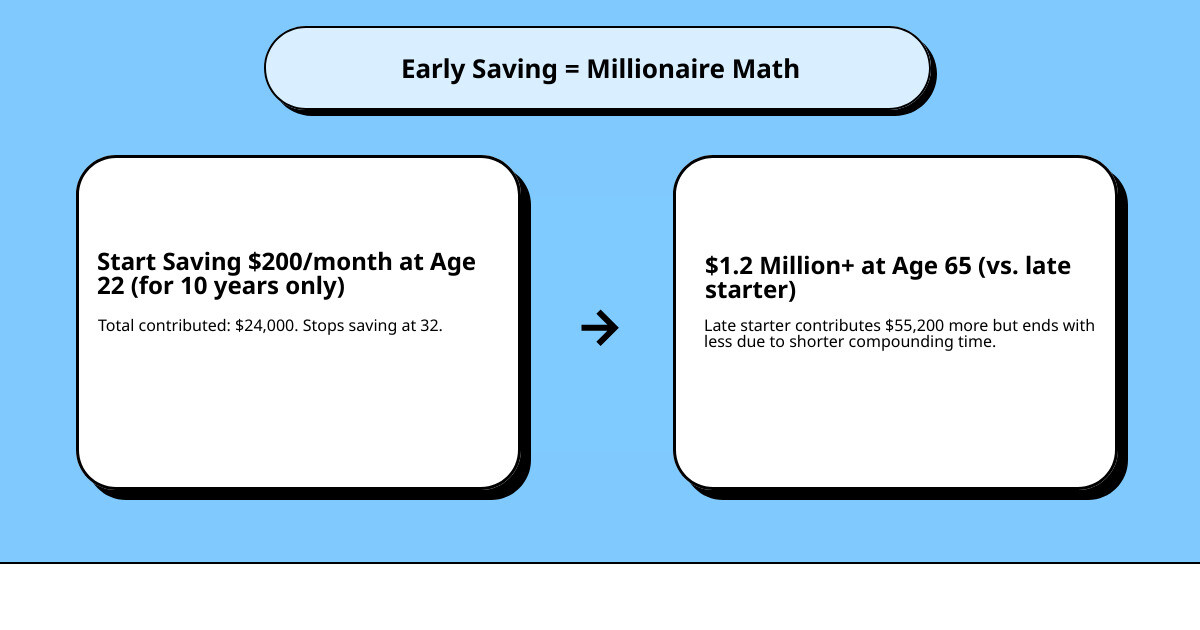
Consider this real comparison from the research: Emma saves $200 a month starting at age 22 — for just 10 years. She stops completely at 32. Liam starts at 32 and saves the same $200 a month all the way to age 65. Emma ends up with more money. Despite contributing $55,200 less than Liam over her lifetime.
That’s not magic. That’s compound interest — and it works hardest for people who start young.
This guide will show you exactly how to build retirement savings without turning your life into a budget horror story. No ramen required.
Why Retirement Savings for Young Adults is a Math Miracle
If we told you that you could become a millionaire by skipping one fancy dinner a month, you’d probably think we were selling a pyramid scheme. But when it comes to retirement savings young adults, the math actually backs it up. The secret sauce isn’t how much you earn; it’s how much time your money has to invite its friends over and multiply.
The Power of the Time Horizon
When you start in your early 20s, you have a 40-plus-year time horizon. This allows for exponential growth. In the beginning, your balance grows slowly. But after a few decades, the interest starts earning interest on the interest. Eventually, the growth of your investments starts to outpace your actual contributions.
Emma vs. Liam: The $74,000 Lesson
Let’s look closer at the “Math Miracle” using the Emma and Liam case study.
- Emma starts at age 22. She saves $200 a month for just 10 years ($24,000 total) and then never touches it again. By age 65, assuming a 7% return, she has roughly $350,000.
- Liam waits until age 32. He saves $200 a month every single month until he is 65 ($79,200 total). By age 65, he has roughly $276,000.
Even though Liam contributed nearly $55,000 more out of his own pocket, Emma ends up with $74,000 more than him. Why? Because her money had a 10-year head start to compound. If you’re wondering how to start a retirement fund, the answer is “immediately.”
The Million-Dollar Difference
Starting at age 22 versus 32 can literally be the difference between a comfortable retirement and a stressful one. Statistics show that a 22-year-old contributing $8,400 annually to a 401(k) and $7,000 to an IRA (at a 7% return) could see a balance of over $2.1 million by age 67. If that same person waits until 32 to start, their balance drops to about $1 million. Waiting just one decade costs you over $1.1 million in potential wealth.

Navigating the Best Retirement Accounts for Your Career Stage
Not all savings accounts are created equal. If you put your retirement money in a standard savings account at a big bank, inflation will eat it for breakfast. You need tax-advantaged accounts designed specifically for retirement savings young adults.
Choosing the Best Retirement Savings for Young Adults Accounts
The 401(k): Your Workplace Powerhouse
If you work for a company that offers a 401(k), this is usually your first stop. The money is taken directly out of your paycheck before you even see it (and before the taxman takes a bite).
The real “killer feature” here is the employer match. Many companies will match your contributions up to a certain percentage (e.g., they put in $1 for every $1 you put in, up to 4% of your salary). This is free money. If you aren’t contributing enough to get the full match, you are essentially turning down a part of your salary.
The Roth IRA: The Young Adult’s Best Friend
A Roth IRA is slightly different. You put in money that has already been taxed, but then it grows tax-free forever. When you pull the money out at age 60, Uncle Sam doesn’t get a penny. For young adults currently in a lower tax bracket than they expect to be in later, this is a massive win. Plus, Roth IRAs offer “withdrawal flexibility”—you can actually withdraw your contributions (not the earnings) at any time without penalty if you’re in a real bind.
| Feature | Traditional 401(k) | Roth IRA |
|---|---|---|
| Tax Benefit | Pre-tax (Pay less tax now) | After-tax (Pay no tax later) |
| Employer Match | Often available | Not available |
| 2025 Contribution Limit | $23,500 | $7,000 |
| Withdrawal Rules | Taxed as income | Tax-free (Qualified) |
Even if you are investing with small amounts, getting these accounts open is the most important step.
The “Secret” Retirement Weapon: The HSA
If you have a High-Deductible Health Plan (HDHP), you likely have access to a Health Savings Account (HSA). Most people think of this as a way to pay for braces or stitches, but it’s actually a “stealth” retirement account.
It has a triple tax advantage:
- Contributions are tax-deductible (or pre-tax via payroll).
- The money grows tax-free.
- Withdrawals for qualified medical expenses are tax-free.
For 2025, the HSA contribution limits are $4,350 for individuals and $8,550 for families. The trick for young adults is to pay for current medical bills out of pocket and let the HSA money stay invested in the market. After age 65, you can withdraw the money for anything (though you’ll pay income tax on non-medical withdrawals, just like a traditional IRA). Check out some simple investment options for a low budget to see how to put that HSA money to work.
Specialized Plans for Different Careers
Not everyone works a 9-to-5 at a big corporation. Depending on your path, you might have other options:
- 403(b): Basically a 401(k) but for teachers, nurses, and non-profit employees.
- Solo 401(k): If you are a freelancer or side-hustle king/queen with no employees, this allows you to contribute as both the employer and the employee, leading to very high contribution limits.
- Thrift Savings Plan (TSP): If you are in the military or work for the federal government, you have access to the TSP. It has some of the lowest fees in the entire industry.
No matter your job title, there are investing tips for young adults that apply to your specific situation.
Balancing Debt, Emergencies, and Future Wealth
We know what you’re thinking: “I’d love to save 15%, but I have $40,000 in student loans and my car just made a sound like a dying walrus.”
We hear you. Retirement savings young adults doesn’t happen in a vacuum. You have to balance it with real life.
The 36% Debt-to-Income Rule
A good rule of thumb is to keep your total debt payments (including student loans, car payments, and housing) below 36% of your gross income. If your debt is higher than that, you might need to prioritize aggressive debt payoff before maxing out retirement accounts.
The Emergency Fund: Your Financial Insurance
Before you go “all-in” on the stock market, you need an emergency fund. Aim for 3 to 6 months of basic living expenses in a high-yield savings account. This is what keeps you from raiding your retirement fund when life happens. Whether it’s a flat tire or an unexpected medical bill, having this cash cushion is non-negotiable.
Prioritizing High-Interest Debt
If you have credit card debt with a 22% interest rate, pay that off first! No retirement investment is going to consistently return 22%. However, for student loans with lower interest rates (usually under 6%), it often makes sense to pay the minimums while simultaneously contributing to your retirement. This allows you to benefit from compounding while still chipping away at debt.
For more on this balance, read our personal finance and budgeting tips for young adults and our guide on short-term vs long-term savings tips.
Proven Strategies to Maximize Retirement Savings for Young Adults
Building wealth isn’t about being a genius; it’s about building habits that make it impossible not to succeed.
The 15% Goal and Paying Yourself First
Most experts recommend saving 10-15% of your gross income for retirement. If that feels impossible right now, start with 1% or 5%. The key is to “pay yourself first.” This means your retirement contribution should leave your paycheck before you have a chance to spend it on a weekend trip or a new gadget.
Automate and Escalate
The most successful savers are the ones who don’t have to think.
- Automate: Set up your 401(k) or IRA to pull money automatically every payday.
- The 1% Bump: Every year (or every time you get a raise), increase your contribution by 1%. You won’t notice the difference in your take-home pay, but your 65-year-old self will see a massive difference. A 35-year-old earning $60,000 who adds just 1% more to their savings could end up with an extra $110,000 by age 67.
Invest Aggressively (While You’re Young)
Since you have decades until retirement, you can afford to ride the ups and downs of the stock market. Most young adults should have a portfolio heavily weighted toward stocks (equities) rather than bonds. Stocks have higher growth potential over the long term, which is exactly what you need to beat inflation. You can learn more about these basic investing strategies for beginners to get your asset allocation right.
Avoiding Common Pitfalls and Managing Job Changes
The road to retirement is full of potholes. Here is how to avoid the biggest ones.
The “Cash-Out” Trap
When you leave a job, you’ll be given the option to “cash out” your 401(k). Don’t do it. If you cash out, you’ll likely pay:
- A 10% early withdrawal penalty to the IRS.
- Federal and state income taxes on the full amount.
- The “opportunity cost” of all that lost future growth.
Rollover Options
Instead of cashing out, you have three better options:
- Leave it there: If your former employer allows it and the fees are low.
- Rollover to your new 401(k): Move the money to your new employer’s plan.
- Rollover to an IRA: Move the money into your own personal IRA account. This often gives you more investment choices and lower fees.
Diversification and Intentional Splurging
Don’t put all your eggs in one basket (like buying only your company’s stock). Use low-cost index funds or target-date funds to spread your risk. These are among the safe investing options for beginners.
And remember: saving for retirement doesn’t mean you can’t have fun. Practice “intentional splurging.” If you’ve hit your 15% savings goal and your bills are paid, enjoy your money! Financial freedom is about peace of mind, not deprivation.
Frequently Asked Questions about Early Saving
Is Social Security enough to live on?
Short answer: No. Social Security was designed to be a “safety net,” not a full retirement plan. According to Social Security income statistics, it currently represents only about 30% of the average senior’s income. The average monthly benefit is around $1,782 (roughly $21,000 a year). Unless you plan on living a very minimalist lifestyle, you will need supplemental retirement savings young adults to maintain your standard of living.
Should I prioritize student loans or retirement?
This is the classic debate. We recommend a “balanced” approach:
- Always get the employer match first. It’s a 100% return on your money. No student loan interest rate is that high.
- Check the interest rate. If your loans are above 6-7%, prioritize paying them down. If they are lower (3-4%), focus more on retirement.
- Do both. Even if it’s just $25 a month toward retirement while you crush your loans, you are building the habit. For more tips, see our guide on saving tips for college students.
How do I protect my savings from inflation?
Inflation is the “silent killer” of purchasing power. Historically, inflation averages around 3% per year. This means your money needs to grow by more than 3% just to stay even. The best way to protect yourself is to invest in assets that historically outpace inflation, like stocks and real estate. Cash under a mattress (or in a 0.01% savings account) loses value every day. Check out long-term vs short-term investing tips for a deeper dive into inflation protection.
Conclusion
At QuickFinHub, we believe that retirement savings young adults isn’t about being rich; it’s about being free. It’s about making sure that the “future you” has the same choices and opportunities that you have today.
You don’t need a six-figure salary or a finance degree to get started. You just need to start. Open that account, grab that employer match, and let time do the hard work for you. Your future self is already thanking you.
Ready to take control? Start your financial journey today with QuickFinHub.
