
The Smartest Way to Automate Savings and Debt Pay (Without Thinking About It)
To automate savings and debt pay means setting up your money to move itself — into savings accounts and toward debt balances — without you lifting a finger each month. Here’s the quick version of how it works:
- Split your paycheck so a set amount or percentage goes straight to savings before you can spend it
- Schedule recurring transfers from checking to savings on payday
- Set up automatic debt payments for at least the minimum (and ideally more) on all accounts
- Prioritize high-interest debt by automating extra payments there first
- Use round-up tools or AI apps to save spare change in the background
That’s the core of it. Read on for the full setup guide.
Picture this: it’s the end of the month, you check your bank account, and there’s nothing left to save. Sound familiar?
You started with good intentions. But then rent hit. Then groceries. Then that thing on Amazon you definitely needed. And savings? “Next month,” you told yourself.
Here’s the uncomfortable truth — this isn’t a willpower problem. It’s a system problem.
Research backs this up hard. People who automate their savings save 2 to 3 times more than people who try to save whatever’s left at month’s end. And a staggering 56% of Americans still can’t cover a $1,000 emergency from savings — not because they earn too little, but because money gets spent before it gets saved.
The fix is simple: stop relying on yourself to remember, and let the system do it for you.
That’s exactly what automating savings and debt payments does. It takes the decision out of your hands — before you even see the money — so saving and paying down debt just… happens.

Why You Should Automate Savings and Debt Pay Today
At QuickFinHub, we talk a lot about behavioral psychology because, let’s face it, humans are wired to spend what we see. This is known as status quo bias—we tend to stick with the current state of affairs. If the money is in your checking account, the “status quo” is that it’s available for pizza or a new pair of shoes.
By choosing to automate savings and debt pay, you leverage a principle called loss aversion. We hate losing things more than we like gaining them. When you manually move money to savings, it feels like a “loss” from your spending power. But when that money never hits your main account, you never feel the “loss.” You simply adjust your life to the balance you see.
The statistics are eye-opening, and Scientific research on automatic savings tools highlights why automation works so well:
- People who use “pay yourself first” transfers save an average of 30% more annually than manual savers.
- Automatic 401(k) enrollees contribute nearly twice as much as those who sign up voluntarily.
- About 40% of our daily actions are habits, not conscious decisions. Automation turns financial health into a subconscious habit.
When you make your money work for you, you aren’t just saving cash; you’re buying time and peace of mind. Consistent, automated contributions allow you to benefit from compound interest—where your interest earns interest—without you having to monitor the markets every day.
How to Set Up Your Automation Architecture
Building a financial “architecture” sounds fancy, but it’s really just about creating a path of least resistance for your cash. Your goal is to make it harder to spend and easier to save.
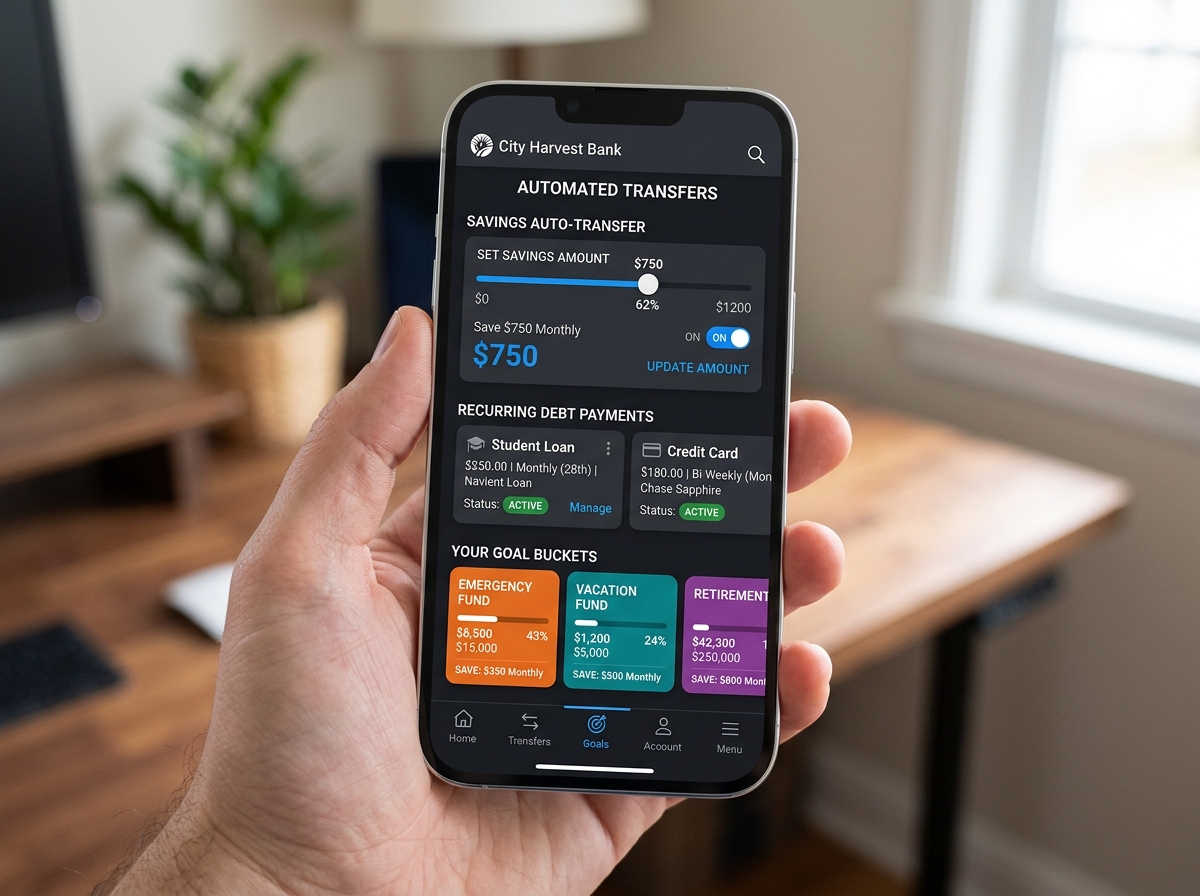
The most effective way to start is through direct deposit. Most employers allow you to split your paycheck between multiple accounts. Instead of sending 100% to your checking, send 10-15% directly to a high-yield savings account (HYSA). This makes the money “invisible.”
If your employer doesn’t offer splitting, you can set up recurring transfers through your bank. The key here is timing: schedule the transfer for the same day your paycheck hits. This ensures the “pay yourself first” philosophy is executed before you have a chance to spend a dime. For those just starting out, check out these strategies for beginners to find a rhythm that works for your budget.
Step-by-Step: How to Automate Savings and Debt Pay via Your Bank
Ready to get your hands dirty? Here is how we recommend setting up the plumbing:
- Identify Your Paydays: Look at your calendar. If you get paid on the 1st and 15th, your automations should trigger on the 2nd and 16th.
- Set Up Standing Orders: Use your bank’s “Transfer” or “Bill Pay” feature. Create a recurring transfer to your savings account.
- Automate Debt Minimums: Log into your credit card or loan portals. Set up an auto-pay for at least the minimum amount due. This protects your credit score from accidental late fees.
- Target High-Interest Debt: If you have a credit card with a 24% APR, that is a financial emergency. Set up an additional recurring “Bill Pay” from your bank to that specific creditor. When you tackle credit card debt, try to ensure extra payments are applied to the principal balance rather than just “paying ahead” on future interest.
- Align Due Dates: Many creditors allow you to change your bill due date. Try to move all your debt payments to a window shortly after your payday to keep your cash flow predictable.
Using AI to Automate Savings and Debt Pay Smarter
We live in the future, and your bank account should too. Advanced apps and AI tools can now analyze your spending habits to find “hidden” savings.
Some tools use predictive budgeting to look at your upcoming bills and your current balance. If the AI sees you have an extra $20 that you likely won’t need before the next paycheck, it “whispers” it away into a savings account. This is often called Surprise Savings. It’s a great way to master quick loan repayment because those tiny $5 or $10 “micro-payments” can add up to hundreds of dollars in extra debt principal paid off each year without you ever feeling the pinch.
Advanced Tools for Effortless Growth
Once the basics are in place, you can use “micro-savings” tools to accelerate your progress.
| Feature | How it Works | Best For |
|---|---|---|
| Round-ups | Rounds a $3.50 coffee to $4.00; saves the $0.50. | Passive, “invisible” saving. |
| Percentage-based | Moves a fixed % of every deposit to savings. | People with irregular income. |
| Spending Buckets | Sub-accounts for specific goals (e.g., “Car” or “Vacation”). | Visualizing progress and organizing. |
| Sinking Funds | Automating small amounts for annual bills (like car insurance). | Avoiding “emergency” expenses. |
Round-up apps are fantastic for young adults because they turn everyday spending into a wealth-building tool. If you buy groceries for $87.45, the system rounds it to $88.00 and puts $0.55 in your savings. While it seems small, these tools can help you navigate debt management by creating a “buffer” you didn’t know you had.
Balancing the Two: Should You Save or Pay Debt First?
This is the million-dollar question: should you automate savings and debt pay equally, or pick one to crush first?
At QuickFinHub, we believe in a balanced approach to avoid “financial fragility.” If you put every extra penny toward debt but have $0 in savings, the next flat tire will go straight back onto your credit card, breaking your momentum.
Here is our suggested priority list:
- The Starter Emergency Fund: Automate a small amount until you have $1,000 to $2,000. This is your “financial runway.”
- The 401(k) Match: If your employer offers a match, automate enough to get the full amount. This is a 100% return on your money—don’t leave it on the table!
- High-Interest Debt: Use the Debt Avalanche (paying highest interest first) or Debt Snowball (paying smallest balance first) method. You can explore debt consolidation to lower your rates and make automation even easier.
- Full Emergency Fund: Once high-interest debt (anything over 7-8%) is gone, automate your savings until you have 3-6 months of expenses.
Understanding the basics of debt management means knowing that math usually favors paying off high-interest debt, but psychology favors small wins. Choose the path that keeps you motivated.
Avoiding Pitfalls and Scaling Your System
Automation is powerful, but it isn’t “set it and forget it” forever. You need to be the pilot of your autopilot system.
Watch Out for Overdrafts: The biggest risk of automation is a “low balance” alert turning into a $35 fee. We recommend keeping a “buffer guardrail”—a small cushion of cash (perhaps $200-$500) that always stays in your checking account to cover timing mismatches between deposits and transfers.
Combat Lifestyle Creep: When you get a raise, your first instinct might be to upgrade your car. Instead, apply the 1% Rule. Every three months, increase your automated savings or debt payment by just 1%. You won’t notice the difference in your daily life, but your future self will thank you. If you get a 5% raise, automate 3% of it immediately. This is one of the smartest tips for paying off loans faster.
Quarterly Reviews: Every three months, sit down for 15 minutes. Are your goals still the same? Did a debt get paid off? If so, don’t just spend that extra cash—redirect that automation to the next goal on your list. This is how you demystify debt reduction and turn it into a game you can win.
Frequently Asked Questions about Automation
How do I automate savings and debt pay with an irregular income?
If you’re a freelancer or gig worker, fixed dollar amounts can be scary. Instead, use percentage-based transfers. Many modern banking tools allow you to set a rule: “Every time I receive a deposit, move 15% to my ‘Tax’ bucket and 10% to my ‘Savings’ bucket.” This way, you save more when you earn more and less when things are lean.
Is it safe to automate my debt payments?
Yes, provided you monitor it. Always set up payment confirmation alerts via email or text. Also, verify that your extra payments are being applied correctly. For some student loans or mortgages, you may need to specify that extra funds should go toward the principal balance, not the next month’s interest.
How much should I start automating each month?
If you’re feeling overwhelmed, start small. Even $25 per paycheck builds the habit of saving. As you get comfortable and realize you don’t miss that $25, bump it to $50. The goal is to reach a 15-20% savings/debt-pay rate, but the habit of starting is more important than the initial amount.
Conclusion
Automating your finances is the single most effective thing you can do to change your financial future. It moves you from a place of “hoping” to save to a place of “guaranteed” growth. By taking the decision-making out of your day-to-day life, you reduce stress and free up your brain to focus on things that actually matter—like your career, your hobbies, and your friends.
At QuickFinHub, we want to help you navigate these transitions with confidence. Don’t wait for the “perfect” time to start. Open your banking app today, set up a $20 recurring transfer, and watch how quickly those small wins stack up.
Start your journey to a debt-free life and put your growth on autopilot today!
