
Your Emergency Fund Is Probably Losing Money Right Now
A high yield emergency fund is simply your financial safety net — cash set aside for unexpected expenses — stored in an account that pays a competitive interest rate instead of letting it sit idle.
Here are the best types of accounts for a high yield emergency fund:
| Account Type | Typical APY | Liquidity | Best For |
|---|---|---|---|
| High-Yield Savings Account | 3.50% – 5.00% | High | Most people |
| Money Market Account | 0.59% avg | High | Check-writing needs |
| No-Penalty CD | Fixed, often 4%+ | Medium | Larger, stable funds |
| Traditional Savings | 0.39% avg | High | Not recommended |
Here’s an uncomfortable truth: most people’s emergency fund is quietly losing ground.
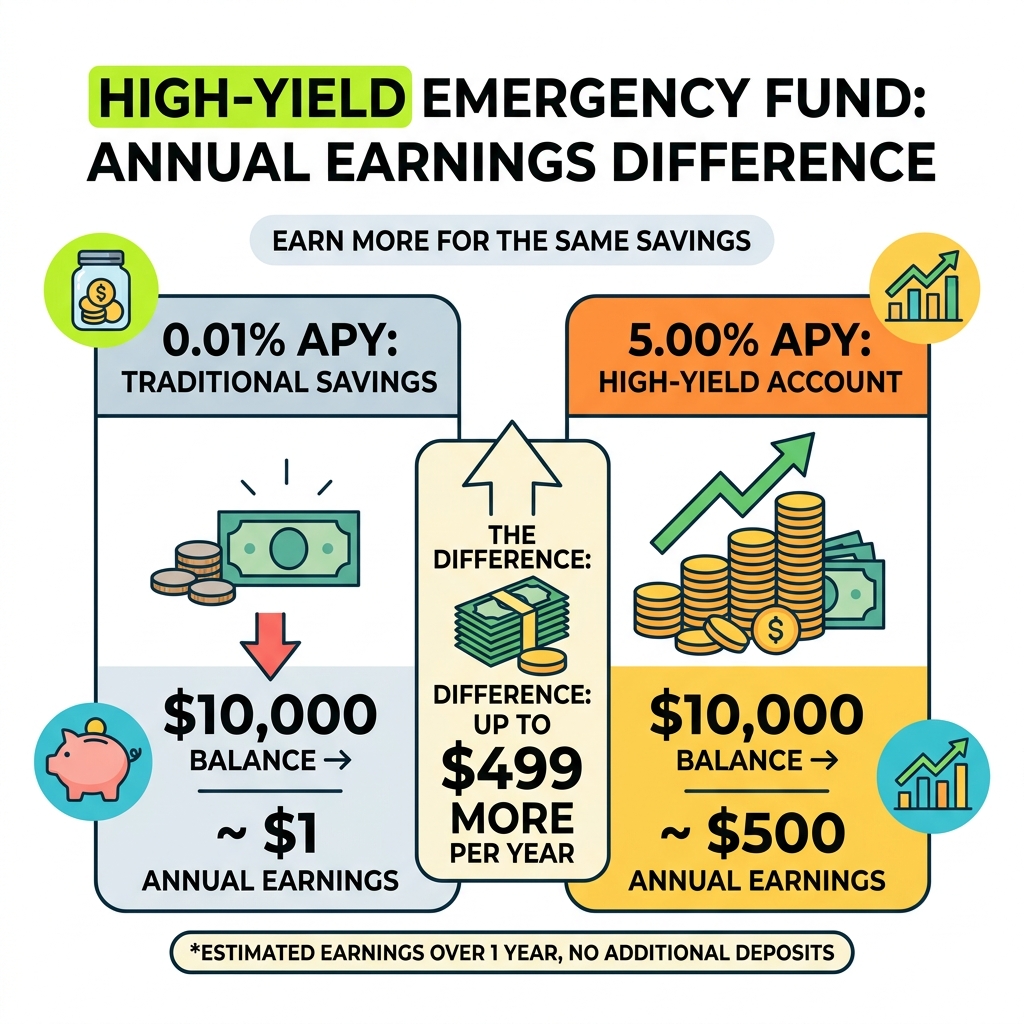
The average traditional savings account pays around 0.39% APY. Top high-yield savings accounts currently pay up to 5.00% APY. That gap isn’t small. On a $10,000 emergency fund, that’s the difference between earning roughly $1 per year and $500 per year — for doing nothing differently except choosing the right account.
And most of us aren’t even close to comfortable with our savings. According to recent data, 60% of U.S. adults feel uncomfortable with their level of emergency savings. Meanwhile, 1 in 3 Americans carry more credit card debt than emergency savings — meaning a single unexpected bill could send them deeper into high-interest debt.
If you’re in your 20s and just starting to figure out money, this matters a lot. Life throws curveballs — a car repair, a surprise medical bill, a gap between jobs. Without a properly funded emergency fund in the right account, those curveballs become debt.
This guide compares the top high-yield savings accounts so you can pick the one that actually works for your situation.
Why You Need a High Yield Emergency Fund in 2026
Think of your high yield emergency fund as a personalized insurance policy that actually pays you to hold it. In 2026, the financial landscape for young adults is tricky. Between fluctuating inflation and the high cost of living, having a “buffer” isn’t just a good idea—it’s essential for survival.
The statistics are sobering. Research shows that 34% of Gen Zers and 28% of Millennials have absolutely no emergency savings. When an unexpected car repair bill hits, many are forced to turn to credit cards. With average credit card APRs hovering between 20% and 28%, a $1,000 repair can quickly snowball into a multi-year debt trap.
By keeping your safety net in a high-yield account, you aren’t just avoiding debt; you’re protecting your purchasing power. Inflation acts like a slow leak in a tire; if your money earns 0.01% while prices rise by 3%, you are effectively losing money every day. A high-yield account helps you keep pace, ensuring that the $5,000 you save today still has the same “buying power” for a medical bill a year from now.

Beyond the math, there is the “Sleep Well at Night” factor. Financial stress is a leading cause of anxiety for Americans. Knowing you have three to six months of expenses tucked away provides a level of psychological freedom that allows you to take risks in your career or personal life without fear of a single “spending shock” ruining your future. To get started on managing these surprises, check out our guide on Budgeting for Unexpected Expenses.
Calculating Potential Earnings in Your High Yield Emergency Fund
Many people underestimate how quickly compounding interest adds up in a high-yield environment. Unlike traditional banks that offer “pennies on the dollar,” a high yield emergency fund utilizes a much higher Annual Percentage Yield (APY).
Let’s look at the numbers. If you have a $10,000 balance:
- In a standard savings account (0.10% APY): You earn about $10 a year. That’s barely enough for a burrito.
- In a high-yield account (5.00% APY): You earn $500 a year. That’s a car insurance payment or a weekend getaway.
To calculate your monthly earnings, you can use a simple formula: (Balance × APY) ÷ 12 = Monthly Interest.
For a $5,000 balance at 4.50% APY, you’re looking at roughly $18.75 per month. Compare that to the $0.21 you’d get at a big-name traditional bank offering 0.05%. Over five years, that gap represents thousands of dollars in “free money” that you’re currently leaving on the table.
The Pros and Cons of a High Yield Emergency Fund
While we clearly love high-yield accounts, we want to give you the full picture.
The Pros:
- High Returns: You earn significantly more than at traditional “brick-and-mortar” banks.
- Safety: Most are FDIC or NCUA insured up to $250,000, meaning your principal is safe even if the bank fails.
- Liquidity: Your money isn’t locked away; you can usually transfer it to your checking account within 1–3 business days.
- Low Barriers: Many online high-yield accounts have no monthly maintenance fees or minimum balance requirements.
The Cons:
- Variable Rates: Unlike a CD, the APY on a savings account can change. If the Federal Reserve lowers interest rates, your bank will likely follow suit.
- Transfer Lag: Because many of these banks are online-only, it might take a couple of days for the money to hit your local checking account. This is why we recommend keeping a small “buffer” in your primary checking.
- Withdrawal Limits: While federal “Regulation D” (which limited savings withdrawals to six per month) was suspended, many banks still enforce their own limits or charge fees for excessive transfers.
For more tips on how to balance growth with accessibility, explore our various Saving Strategies.
Sizing and Comparing Your Savings Options
How much do you actually need in your high yield emergency fund? The “standard” advice is three to six months of essential expenses, but that can feel overwhelming when you’re just starting out.
We find it helpful to distinguish between two types of financial hits:
- Spending Shocks: These are one-time, unexpected costs like a broken HVAC, a dental emergency, or a “fender bender.” Experts suggest having at least half a month’s expenses saved specifically for these.
- Income Shocks: This is the big one—losing your job or being unable to work. This is where the 3–6 month rule applies.
| Expense Category | Monthly Cost (Example) | 3-Month Target | 6-Month Target |
|---|---|---|---|
| Housing (Rent/Mortgage) | $1,200 | $3,600 | $7,200 |
| Utilities & Phone | $250 | $750 | $1,500 |
| Groceries & Essentials | $400 | $1,200 | $2,400 |
| Insurance & Transport | $350 | $1,050 | $2,100 |
| Total Essentials | $2,200 | $6,600 | $13,200 |
We say essential expenses. In an emergency, you’ll likely cut out Netflix, dining out, and new clothes. Your target should be based on what you need to keep the lights on and food on the table.
High-Yield Savings vs. Money Market Accounts
When shopping for a home for your fund, you’ll likely see two main contenders: High-Yield Savings Accounts (HYSAs) and Money Market Accounts (MMAs).
- HYSAs are straightforward. They usually offer the highest rates but fewer “bells and whistles.” They are great if you want to move the money and forget about it until you need it.
- MMAs are a hybrid. They often offer competitive interest rates similar to HYSAs but come with check-writing abilities or a debit card. This can be a double-edged sword: it’s easier to access your money in a pinch, but it also makes it easier to spend it on “non-emergencies.”
For a deeper dive into making these choices without the headache, see our Personal Finance 101: Stress-Free Saving Tips.
Why CDs and Stocks Fail the Emergency Test
It might be tempting to put your emergency fund in the stock market or a high-interest Certificate of Deposit (CD), but we strongly advise against this for your primary safety net.
The Stock Market is for Growth, Not Safety. If you need $2,000 for a medical bill but the market just dipped 10%, you’re forced to sell at a loss. An emergency fund’s job is to be there, in full, exactly when you need it.
CDs Lack Liquidity. A CD “locks” your money for a set term (like 12 months). If you withdraw early, you usually have to pay a penalty that could eat into your interest or even your original deposit. While “no-penalty CDs” exist, they often offer lower rates than the best HYSAs.
Your emergency fund should prioritize the return of your principal over the return on your principal. If you’re wondering where to start your savings journey, visit Budgeting for Savings: Where to Begin.
A Step-by-Step Guide to Building Your Safety Net
Building a high yield emergency fund doesn’t happen overnight. It’s a marathon, not a sprint. We recommend using the “Emergency Fund Ladder” approach:
- Stage 1: The $500 Buffer. This is your first milestone. $500 covers the vast majority of small-scale emergencies—a flat tire, a broken phone, or a surprise bill.
- Stage 2: The $2,000 Threshold. Research from Vanguard shows that financial stress drops significantly once a household hits $2,000 in savings. This is your “catastrophe” barrier.
- Stage 3: One Month of Essentials. Now you have real breathing room.
- Stage 4: The Full 3–6 Month Goal. This is the ultimate destination for total financial independence.
Starting small is the key. Even $25 a week adds up to $1,300 in a year. For more tactical advice, check out Simple Ways to Build an Emergency Fund.
Automation and Windfalls
The secret to successful saving isn’t willpower; it’s automation. If you have to remember to move money every month, you eventually won’t.
- Set up a split direct deposit: Most employers allow you to send a portion of your paycheck (say, $50) directly to your high-yield account and the rest to your checking. You won’t even miss the money because you never “saw” it in your main account.
- Use your windfalls: Did you get a tax refund? A birthday check from Grandma? A work bonus? Instead of spending it, move at least 50% of it into your high yield emergency fund. The average US tax refund is over $3,000—that could jumpstart your fund instantly.
Discover more about Automatic Savings Strategies for Beginners to make your money work for you without the effort.
Managing and Replenishing Your Fund
One of the hardest parts of having an emergency fund is knowing when to use it. A “flash sale” on a new gaming console is not an emergency. A “true emergency” is:
- Unplanned (you didn’t know it was coming).
- Necessary (you can’t live/work without it).
- Urgent (it needs to be handled now).
Common examples include job loss, medical/dental bills, or a car repair required for your commute. Once you use the fund, your top financial priority becomes replenishing it. Treat the “repayment” to your savings account like a non-negotiable bill until you’re back at your target balance. For ongoing maintenance tips, see How to Save Money Every Month.
Frequently Asked Questions about High Yield Emergency Funds
How does FDIC and NCUA insurance protect my savings?
This is the most important safety feature of a high yield emergency fund.
- FDIC (Federal Deposit Insurance Corporation): Protects deposits at banks.
- NCUA (National Credit Union Administration): Protects deposits at credit unions.
Both cover up to $250,000 per depositor, per institution. This means even if your bank goes out of business, the US government guarantees you will get your money back. Since its inception in 1933, no depositor has lost a single cent of insured funds. Just make sure the account you choose explicitly states it is FDIC or NCUA insured.
What features should I look for in a high-yield account?
Don’t just chase the highest APY. Look for the “Total Package”:
- No Monthly Fees: Many online banks have zero maintenance fees. Don’t pay $10 a month to earn $15 in interest.
- No Minimum Balance: You want an account that stays open even if you have to drain it for an emergency.
- User-Friendly App: You should be able to move money and check balances easily from your phone.
- Savings Buckets: Some banks allow you to organize your savings into “buckets” (e.g., “Car Repair,” “Job Loss,” “Pet Emergency”), which helps with the psychology of saving.
Are there limits on how often I can withdraw money?
Historically, a federal rule called Regulation D limited savings account withdrawals to six per month. While the government has relaxed this rule, many banks still enforce it.
If you go over the limit, the bank might charge you an “excessive withdrawal fee” (often $10–$15 per transaction) or even convert your savings account into a checking account. Since an emergency fund is for emergencies, six withdrawals a month should be plenty, but it’s something to keep in mind if you plan on using the account frequently.
Conclusion
Your emergency fund is the foundation of your entire financial life. By moving it into a high yield emergency fund, you stop letting your money “slack off” and start making it work as hard as you do.
Whether you’re starting with $5 or $5,000, the best time to optimize your savings is today. The peace of mind that comes from knowing you can handle whatever life throws at you is priceless—and the extra interest you’ll earn is just the icing on the cake.
At QuickFinHub, we are dedicated to helping young adults navigate these transitions with confidence. For more tailored advice and tools to help you master your money, visit More info about QuickFinHub services.
