
Your First Job Salary Negotiation Could Be Worth $1.5 Million
First job salary negotiation is the process of asking your employer for better pay or benefits after receiving your first job offer — and it’s one of the most important financial moves you’ll ever make.
Here’s how to do it in 5 steps:
- Research your market value using tools like Glassdoor, LinkedIn Salary, or the Bureau of Labor Statistics
- Wait for the written offer before starting any negotiation conversation
- Make your ask clearly and confidently, anchored to market data — not personal need
- Negotiate beyond base salary if the number is fixed (signing bonus, extra PTO, remote work, etc.)
- Get everything in writing before you sign
Most people skip this conversation entirely. In fact, 55% of workers don’t negotiate when they receive a new job offer. That’s an expensive habit — candidates who do negotiate earn an average of $5,000 more in their first job alone.
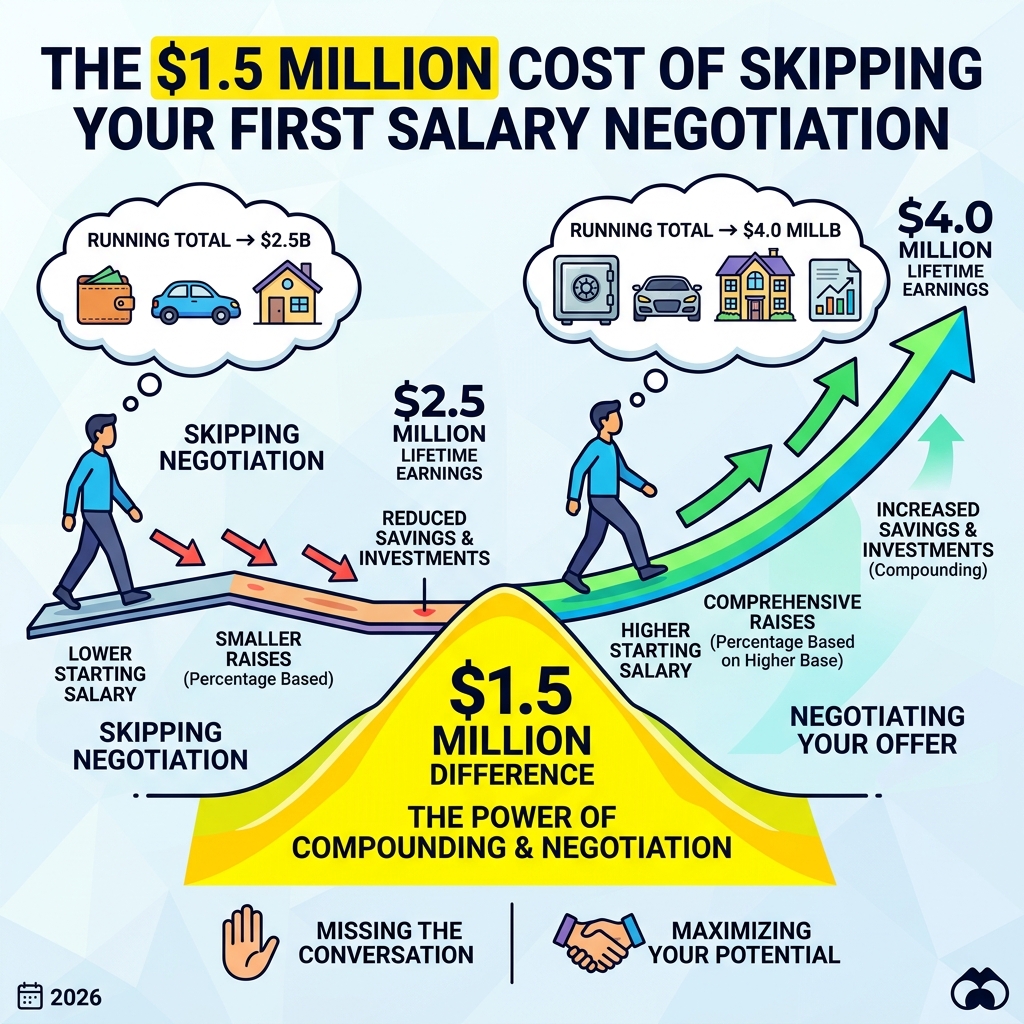
But the real cost isn’t just $5,000. Because your starting salary becomes the baseline for every raise, every counter-offer, and every future job you take, failing to negotiate early could cost you between $1 million and $1.5 million in lost earnings over your career.
Here’s the part that might surprise you: 73% of employers actually expect you to negotiate. You’re not being pushy. You’re playing the game the way it’s meant to be played.
This guide walks you through everything — from researching your worth to the exact words to use — so you can walk into that conversation with confidence.
Why First Job Salary Negotiation is a Lifetime Investment
When we land that first post-college offer, the adrenaline is real. We’re often so relieved to have a paycheck that we forget that this number isn’t just for today’s rent—it’s the foundation for our entire financial future. At QuickFinHub, we see this as one of the most critical “compounding” moments in a young adult’s life.
Think of your starting salary as a financial anchor. Most future raises are calculated as a percentage of what you’re currently making. If you start $5,000 higher today, a 5% raise next year is bigger. When you move to your next job, that company will likely ask about your current compensation to “anchor” their offer. Over 30 or 40 years, that initial $5,000 gap—when combined with percentage-based raises and the power of investing—balloons into that staggering $1.5 million figure mentioned above.
Beyond the immediate cash, successful Entry Level Salary Negotiation: Boost Your Starting Pay teaches you a skill you’ll use forever. It’s about self-advocacy. If you don’t stand up for your value now, it becomes harder to do it five or ten years down the line. Plus, a higher starting salary allows you to follow personal-finance-budgeting-tips-for-young-adults more effectively, giving you more “wiggle room” to save for retirement or pay down student loans faster.
Debunking Common Myths and Fears
The biggest thing holding us back is usually fear. We’ve heard the horror stories, but the data tells a different story. Let’s bust the top myths:
- Myth: They’ll rescind the offer. This almost never happens. If you are professional and polite, 70% of managers say negotiating won’t hurt your reputation. In fact, 84% of employers expect candidates to negotiate, including entry-level ones. If a company pulls an offer just because you asked a respectful question about compensation, that’s a massive red flag about their culture.
- Myth: I have no leverage. You might think, “I’m just a grad, I have no experience.” Untrue! You have the latest training, you’re tech-savvy, and most importantly, the company has already spent weeks and thousands of dollars choosing you. They want to close the deal.
- Myth: Negotiating is greedy. Negotiation is business. Employers actually try to hire you as “cheaply as they can” because it’s their job to manage a budget. It’s your job to manage your budget.

For more on this, check out these 10 Myths About Negotiating Your First Salary to clear your head before the big call.
How to Research and Determine Your Market Value
You can’t negotiate based on what you want; you have to negotiate based on what the market pays. This turns the conversation from an emotional plea into a factual business discussion.
Start by gathering 3-5 data points. Use resources like:
- Glassdoor and Payscale: Great for company-specific and role-specific ranges.
- Bureau of Labor Statistics (BLS): The gold standard for national averages.
- LinkedIn Salary: Helpful for seeing how geography impacts pay.
- NACE Salary Surveys: Specifically tailored for new college graduates.
Don’t forget to account for the “Cost of Living.” A $60,000 salary in Des Moines feels like wealth; in San Francisco, it might mean having four roommates and eating ramen for every meal.
When building your case, look for your “receipts.” These are specific examples of your value:
- Internship wins: Did you increase social media engagement by 20%?
- Specialized skills: Do you know a specific coding language or software that’s hard to find?
- Advanced degrees: Does your Master’s degree put you in a higher bracket?
Here is a general look at how entry-level salaries can vary by industry:
| Industry | Typical Entry-Level Range | Key Leverage Factors |
|---|---|---|
| Technology | $70,000 – $110,000 | Portfolio, Coding Skills, Internships |
| Marketing/PR | $45,000 – $60,000 | Certifications, Writing Samples |
| Finance/Banking | $65,000 – $85,000 | GPA, Networking, Quantitative Skills |
| Non-Profit | $35,000 – $48,000 | Mission Alignment, Volunteer History |
Once you have your data, use our beginner-guide-to-financial-planning to see how these numbers fit into your long-term goals.
Strategies for a Successful First Job Salary Negotiation
The “how” is just as important as the “how much.” We recommend a collaborative approach. You aren’t fighting the recruiter; you’re working with them to find a solution that makes sense for both of you.
Step 1: Get it in writing. Never negotiate a verbal offer on the spot. When they call to give you the good news, say: “Thank you so much! I’m thrilled about the offer. Could you send over the full details in writing so I can review the complete package?”
Step 2: The 48-hour rule. Take at least a day or two to look over the benefits, 401k match, and health insurance. This gives you time to calm the nerves and prep your script.
Step 3: The Ask. Use the “Value Sandwich.” Start with enthusiasm, state your researched number, and end with a question.
- The Script: “I’m very excited about the opportunity to join the team. Based on my research for similar roles in [City] and my experience with [Specific Skill], I was hoping we could look at a base salary closer to $[Your Target]. Is there any flexibility there?”
Then—and this is the hardest part—stop talking. Let the silence do the work. The next person to speak often loses their leverage.
If you’re still feeling nervous, our guide on learning-the-ropes-of-personal-finance-a-beginners-guide can help you build the confidence needed to handle these professional milestones.
Negotiating Beyond Base Salary in Your First Job Salary Negotiation
Sometimes, the base salary truly is fixed. This is common in large “rotational” programs or government roles. If they say “no” to the salary, don’t give up! There are many other “buckets” of money and benefits to explore:
- Signing Bonus: This is a one-time payment. It’s easier for companies to approve because it doesn’t affect their long-term payroll budget.
- Relocation Assistance: If you’re moving for the job, ask for a stipend to cover moving trucks and security deposits.
- Professional Development: Ask for a guaranteed budget for certifications, conferences, or specialized training.
- Paid Time Off (PTO): An extra 3-5 days of vacation is a form of compensation.
- Remote Work Flexibility: Saving on a commute is essentially a raise for your wallet and your time.
By looking at the “total package,” you can create a creating-a-sustainable-budget-plan that works for your lifestyle even if the base pay isn’t exactly where you wanted it.
Handling Pushback During Your First Job Salary Negotiation
What happens if they say “The budget is firm”? Don’t panic. This isn’t a rejection of you; it’s just a business constraint.
You have three moves here:
- The Six-Month Review: “I understand the budget is fixed for now. Would you be open to a performance review in six months with the potential for a salary adjustment based on my contributions?”
- The Pivot: Switch to negotiating the non-salary items mentioned above (like PTO or a signing bonus).
- The Walk-Away: Know your “walk-away number.” This is the lowest salary you can accept while still covering your basic needs. If the offer is 20% below market and they won’t budge, it might be a sign to keep looking.
Learning to manage your expectations when things are tight is a key part of budgeting-on-a-low-income.
Best Practices and Mistakes to Avoid
To ensure your first job salary negotiation goes smoothly, keep these “Golden Rules” in mind:
- Don’t make it personal. Never say “I need more money because my rent is high” or “I have student loans.” The company doesn’t pay you based on your bills; they pay you based on your value.
- Don’t lie about other offers. The world is small. If you claim to have a $70k offer from a competitor and you don’t, and the recruiter calls your bluff, you’ll lose the job and your reputation.
- Keep it professional, not emotional. Avoid using “I feel” or “I think.” Use “The data shows” or “Market averages suggest.”
- Get it in writing (Again!). We cannot stress this enough. A verbal promise of a “bonus later this year” is worth nothing if it isn’t in the final contract.
Avoid these beginner-budgeting-mistakes-to-avoid by staying organized and keeping a paper trail of every conversation.
Frequently Asked Questions about First Job Salary Negotiation
What if the employer asks for my salary requirements first?
This often happens during the first phone screen. Try to defer. You can say: “I’m still learning about the full scope of the role. I’d love to hear what the company has budgeted for this position.” If they insist, give a wide range based on your research, but emphasize that it’s negotiable depending on the full benefits package.
Can I negotiate if I have no prior professional experience?
Yes! Your leverage isn’t just “years worked.” It’s your GPA, your specialized projects, your internships, and the fact that they chose you over hundreds of other applicants. You are a “product” they want to buy; don’t be afraid to set a fair price.
Why is it crucial to get the final negotiated terms in writing?
Verbal agreements are not legally binding. People leave companies, managers change, and memories fade. If your signing bonus or extra vacation days aren’t in that final PDF offer letter, they don’t exist. Always wait for the updated letter before you officially resign from another job or stop your search.
Conclusion
At QuickFinHub, we believe that financial empowerment starts on day one of your career. Negotiating your first salary isn’t about being “difficult”—it’s about being a professional who understands their worth and is planning for a stable future.
By doing your research, staying calm, and focusing on the long-term compounding effects of that first paycheck, you are setting yourself up for decades of financial success. The worst they can say is “no,” and even a “no” leaves you with the original offer you already had.
Start your financial journey with QuickFinHub today for more tips on how to manage your new income, build a budget, and grow your wealth from your very first paycheck!
