
When Every Dollar Is Stretched Thin: The Reality of Paying Off Debt on a Low Income
How to pay off debt fast with low income is one of the most searched financial questions — and for good reason. Over 60% of households earning under $40,000 a year carry debt, and with average credit card interest rates sitting around 24%, that debt grows fast.
Here are the core steps to get started right now:
- List every debt — write down the balance, interest rate, and minimum payment for each
- Build a bare-bones budget — cover food, shelter, utilities, and transportation first
- Stop adding new debt — use cash or debit only while you pay down what you owe
- Pick a repayment method — either smallest balance first (snowball) or highest interest first (avalanche)
- Find extra dollars — cut one or two expenses and add a small income stream
- Negotiate with creditors — many will lower your rate or offer a hardship plan if you just ask
The average American adult carries $66,772 in total debt. If you’re in your 20s and living paycheck to paycheck, that number can feel crushing.
But here’s the truth: you don’t need a high salary to get out of debt. You need a plan that actually fits your life.
Many people fall into debt not because they’re irresponsible — but because their income simply can’t keep up with rising costs, unexpected bills, or one bad month. A car repair. A medical bill. A job gap. Any of these can start a cycle that’s hard to break.
This guide is built specifically for that reality. No generic advice like “just stop buying coffee.” Real steps you can take this week, even on a tight income.
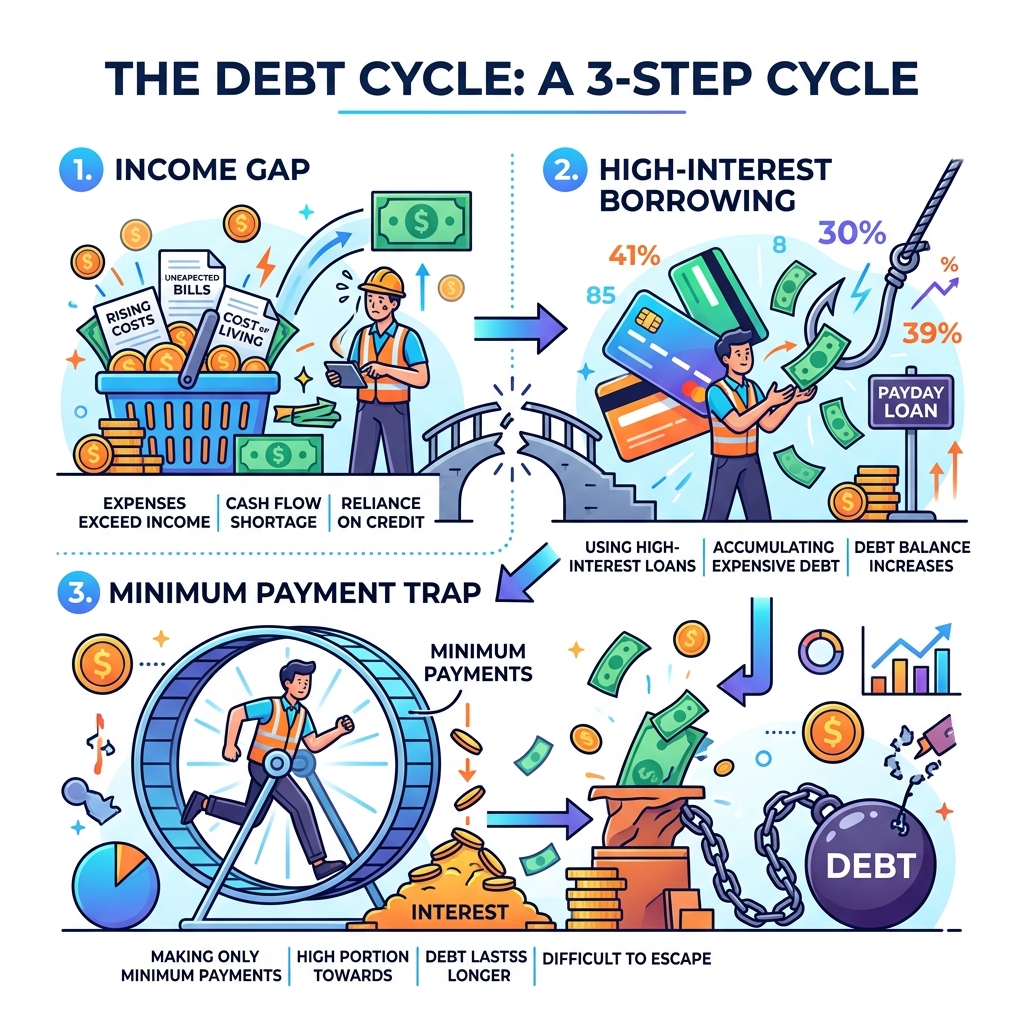
First Steps: How to Pay Off Debt Fast with Low Income
When you’re staring at a mountain of bills, the hardest part is often just looking at the numbers. But we can’t fix what we don’t measure. The very first step is to perform a “Debt Inventory.”
Grab a piece of paper or open a spreadsheet and list every single person or company you owe money to. You need to know four things for each: the total balance, the interest rate (APR), the minimum monthly payment, and the due date. This might feel scary, but understanding the basics of debt management starts with total honesty. Seeing it all in one place takes away the “monster under the bed” effect.
Next, we need to talk about the “Mini Emergency Fund.” You might hear experts say you need six months of expenses saved up. On a low income, that feels like a joke. Instead, aim for a “starter” fund of $500 to $1,000. Why? Because if your tire blows out while you’re paying off debt and you don’t have $500, you’ll just put it on a credit card, and the cycle continues. This small cushion protects your progress.
Finally, check out the FTC advice on managing debt. They emphasize that you have rights. If you’re being hounded by collectors, you can verify the debt and stop the harassment. Knowing the rules of the game makes you a much more effective player.

Budgeting on a Limited Income
Budgeting isn’t about restriction; it’s about permission. It gives your money “marching orders.” For low-income earners, we recommend the Zero-Based Budgeting method. This means every single dollar you earn is assigned a job until there is $0 left at the end of the calculation.
We also suggest the “Four Walls” approach. Before you pay a cent toward extra debt, you must ensure your Four Walls are covered:
- Food (Groceries, not dining out)
- Utilities (Electricity, water, heat)
- Shelter (Rent or mortgage)
- Transportation (Gas, bus pass, basic car maintenance)
Once these are safe, every remaining penny goes toward your debt. Budgeting on a low income requires looking for “leaks.” Are you paying for a streaming service you don’t watch? Is your phone bill higher than it needs to be? Even $15 saved is $15 that can kill a high-interest balance.
Comparing Budgeting Methods
| Feature | 50/30/20 Rule | Zero-Based Budgeting |
|---|---|---|
| Best For | General stability | Fast debt payoff |
| Flexibility | High (30% for “wants”) | Low (Every dollar has a job) |
| Focus | Balanced lifestyle | Aggressive goal-setting |
| Low-Income Fit | Difficult (margins are too tight) | Excellent (finds every hidden cent) |
By demystifying debt reduction strategies, we see that tracking expenses is the only way to find “margin.” Use a free app or a simple notebook to track every cent for 30 days. You’ll be surprised how much “ghost spending” happens on autopilot.
Proven Debt Repayment Strategies
Once the budget is set, you need a battle plan. You can’t just throw money randomly at different bills; you need to be strategic. The key to how to pay off debt fast with low income is consistency. Even an extra $20 a month above the minimum payment can shave months off a loan’s life.
Using the Debt Snowball to Pay Off Debt Fast with Low Income
The Debt Snowball method is all about psychology. You list your debts from the smallest balance to the largest balance, regardless of interest rates. You pay the minimum on everything except the smallest debt, which you attack with every extra dollar you have.
When that smallest debt is gone, you take the money you were paying on it and “roll” it into the next smallest debt. This creates “quick wins.” On a low income, motivation is your most valuable resource. Seeing a balance hit zero in just two or three months gives you the “I can do this!” energy needed to keep going. It truly is your first step to freedom when paying off credit cards.
The Debt Avalanche Method
If you are a “numbers person,” the Debt Avalanche might be for you. Here, you list debts from the highest interest rate to the lowest. Mathematically, this saves you the most money because you’re killing the most expensive debt first.
Average credit card rates are currently around 24.04%, while some personal loans might be 10%. The Avalanche says: “Kill the 24% monster first!” This is swift and smart for paying off loans faster if you have the discipline to stay the course without the frequent “wins” of the snowball method.
Side Hustles to Pay Off Debt Fast with Low Income
Let’s be real: sometimes the math just doesn’t add up. If your expenses are $2,000 and your income is $2,000, you can’t pay off debt. You need more “shovels” to dig out.
The gig economy has made it easier than ever to earn an extra $50–$100 a week without a second full-time job. Consider:
- Pet Sitting/Dog Walking: Use apps to find local neighbors who need help.
- Selling Unused Items: Check your closet or garage. Most of us are sitting on $200–$500 worth of stuff we don’t use.
- Freelancing: If you have a skill like data entry, graphic design, or writing, use platforms to find quick tasks.
- Online Surveys: While they don’t pay much, they can fill the “dead time” during a commute or while watching TV.
Every dollar from these hustles should go 100% toward your debt. This is especially helpful for managing student loans the effective way, as those balances can often feel too large to tackle with a base salary alone.
Professional Help and Scam Prevention
As you navigate this journey, you’ll likely see ads for “debt settlement” or “debt relief.” Be careful. Many of these are for-profit companies that charge massive fees (often 15-25% of your debt) and can actually ruin your credit further.
Instead, look for Non-Profit Credit Counseling. Organizations like the NFCC provide free or low-cost budget reviews and can set up a Debt Management Plan (DMP). A DMP can often lower your interest rates and combine your payments into one monthly bill without the risks of “settlement” scams.
Mastering debt management also means sidestepping common pitfalls. Never pay an upfront fee for “credit repair” or “debt forgiveness.” If it sounds too good to be true, it probably is.
If you are truly struggling to cover the basics, don’t be afraid to use government or community assistance. Programs like SNAP (food stamps) or utility assistance (LIHEAP) are there for a reason. Using these programs frees up cash that you can then use to pay off your debt. You can also call 211 in many areas to find local food banks or rent assistance programs.
For those considering debt consolidation, it can be a great tool—but only if you’ve stopped the spending habits that caused the debt in the first place. Otherwise, you’ll just end up with a consolidation loan and new credit card balances. Always avoid these debt traps by keeping your old accounts open but “frozen” (literally, put the card in a bowl of water in the freezer!) so you don’t use them.
Frequently Asked Questions about Low-Income Debt Payoff
Should I use a balance transfer card on a low income?
A balance transfer card can be a powerful tool because it offers 0% interest for a set period (usually 12–18 months). However, it requires a decent credit score to qualify. If you do use one, be aware of the 3–5% transfer fee and make sure you have a plan to pay off the balance before the 0% period ends. If you don’t, the interest rate will jump back up, often to 20% or higher.
How do I negotiate lower interest rates with creditors?
It sounds intimidating, but it’s actually quite simple. Call the number on the back of your card and say: “I’ve been a loyal customer, but my current interest rate is making it hard to make progress. I’m looking at other options, but I’d like to stay with you. Is there any way you can lower my APR or put me on a hardship plan?” You’d be surprised how often they say yes just to keep you from defaulting.
What if I can’t afford my minimum payments?
If you genuinely can’t make the minimums, don’t hide. Contact your creditors immediately. Ask about “hardship programs.” These are internal programs that can temporarily lower your payments or pause interest while you get back on your feet. If that’s not enough, talk to a non-profit credit counselor about a Debt Management Plan or, as a last resort, consult a bankruptcy attorney to understand your legal options.
Conclusion
Paying off debt on a low income is a marathon, not a sprint. It requires a shift in mindset — moving from “I’ll never get out of this” to “I am taking control of my future.” By using a zero-based budget, choosing a strategy like the snowball or avalanche, and staying alert for scams, you are already ahead of the curve.
At QuickFinHub, we believe that young adults shouldn’t be held back by the mistakes of their past or the limitations of their current paycheck. Every small payment you make is a brick in the wall of your future financial house. Keep tracking, keep hustling, and keep believing that freedom is possible.
For more tips on navigating your financial journey, explore our debt category for deep dives into specific loan types and repayment hacks. You’ve got this!
