
Why Most Young Adults Struggle With Money (And What Actually Helps)
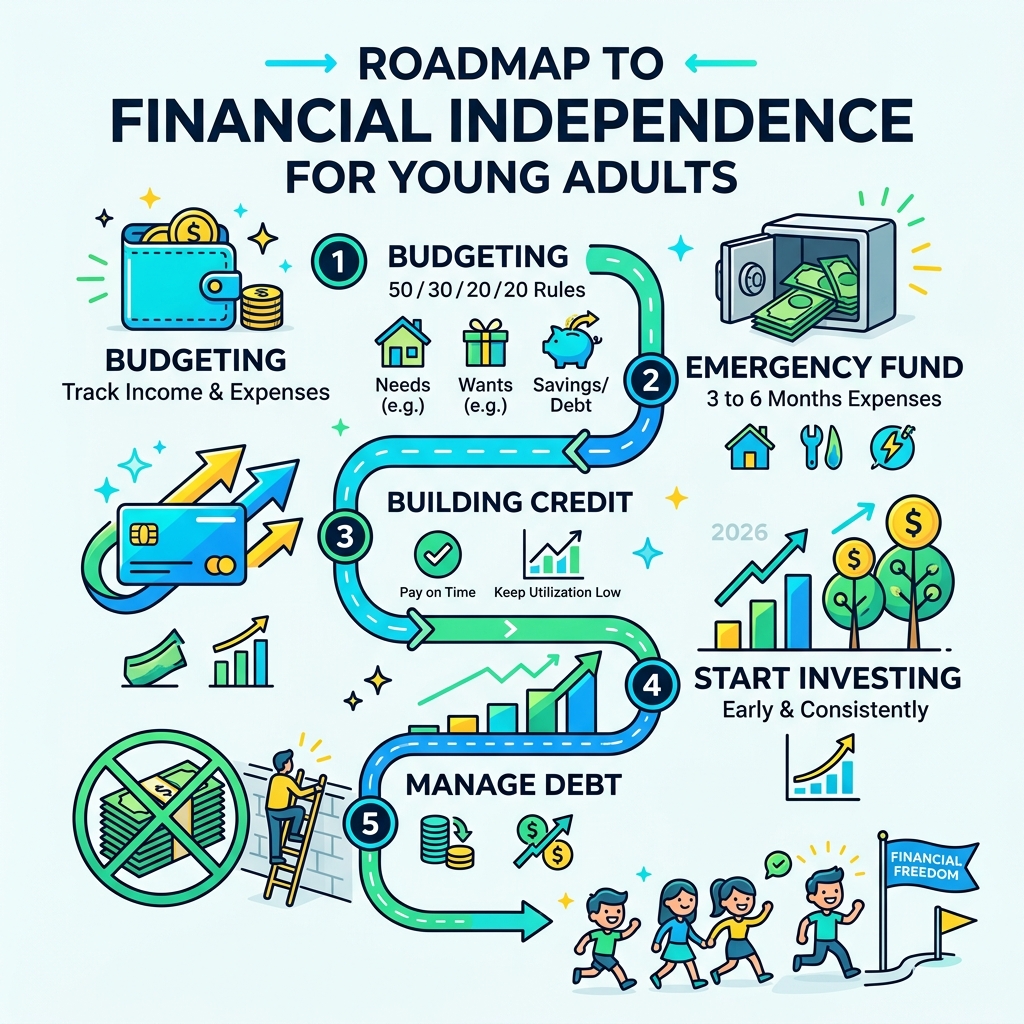
Financial tips for young adults are more important than ever — and here’s a quick snapshot of what actually moves the needle:
- Budget first — use the 50/30/20 rule: 50% needs, 30% wants, 20% savings/debt
- Build an emergency fund — aim for 3 to 6 months of living expenses in a high-yield savings account
- Start investing early — even $50–$100 a month grows dramatically thanks to compound interest
- Build credit responsibly — pay on time, keep utilization under 30%
- Avoid lifestyle inflation — when your income rises, save the difference before spending it
- Understand your taxes — know your take-home pay before building any budget
- Get insured — health and renters insurance protect everything you’re building
Here’s a sobering fact: only 49% of U.S. adults can answer basic money questions correctly. That’s not because people are bad with money — it’s because most schools never teach it. Personal finance is still not a required subject in most high schools or colleges, which leaves a lot of people guessing.
And guessing gets expensive fast.
The good news? You don’t need a finance degree. You just need a few solid habits, started early. Time is genuinely your biggest advantage here — and this guide will show you exactly how to use it.
Master the Art of Budgeting with Financial Tips for Young Adults

Budgeting often gets a bad rap. Many people view it as a financial “diet” that forbids fun. At QuickFinHub, we like to think of a budget as a compass rather than a cage. It’s simply a plan for where your money goes so you don’t end up wondering where it went.
One of the most effective financial tips for young adults starting out is the 50/30/20 rule. It’s a simple ratio that helps you balance your current needs with your future goals:
- 50% for Needs: This covers the non-negotiables. Rent, groceries, utilities, transportation, and minimum debt payments. If your “needs” are eating up 70% of your income, it might be time to look for a roommate or a cheaper cell phone plan.
- 30% for Wants: This is your “fun” money. Dining out, Netflix subscriptions, hobbies, and that weekend trip. This category is the most flexible and usually where you find the most “leakage.”
- 20% for Savings and Debt Repayment: This is the most important slice for your future self. This goes toward your emergency fund, retirement accounts, and extra payments on high-interest debt.
To make this work, you must first track your income. Your “gross” salary (the big number on your offer letter) isn’t what hits your bank account. Between federal income tax (ranging from 10% to 37%), FICA taxes (Social Security at 6.2% and Medicare at 1.45%), and potentially state taxes, your take-home pay might be 25% to 30% less than you expect. For example, a $35,000 salary in a place like New York might only net you about $2,290 per month.
For more detailed guidance, check out our personal finance budgeting tips for young adults or use an easy budget planner for beginners to get started.
Choosing Your Budgeting Style
Not everyone likes spreadsheets. Here is a comparison of two popular methods to see which fits your personality:
| Feature | 50/30/20 Rule | Envelope System |
|---|---|---|
| Best For | Generalists who want a simple ratio. | People who struggle with overspending. |
| How it Works | Divide income into three percentage buckets. | Put physical cash into envelopes for each category. |
| Pros | Flexible and easy to track digitally. | Impossible to overspend; once the cash is gone, it’s gone. |
| Cons | Requires discipline to keep “wants” in check. | Carrying cash can be inconvenient in a digital world. |
Build a Bulletproof Safety Net and Credit Score
Life has a funny way of throwing curveballs. Whether it’s a $700 car repair, an unexpected ER visit, or a sudden job loss, financial emergencies are a matter of “when,” not “if.”
We recommend establishing an emergency fund as your very first financial priority. While the ultimate goal is to save 3 to 6 months of living expenses, don’t let that number intimidate you. Start small. Aim for an initial goal of $1,000. This “starter” fund can handle most minor crises without you having to reach for a high-interest credit card.
Keep this money in a High-Yield Savings Account (HYSA). Unlike a traditional brick-and-mortar bank account that pays pennies in interest, an HYSA can help your money grow at a rate that at least keeps pace with inflation while remaining completely liquid. If you are still in school, these saving tips for college students can help you find extra cash to seed this fund.
Managing Your Credit Score
Your credit score is essentially your “financial GPA.” It affects your ability to rent an apartment, get a car loan, and even secure certain jobs. A good score leads to lower interest rates, which can save you tens of thousands of dollars over your lifetime.
To build and maintain a top-tier score, focus on these two heavy hitters:
- Payment History (35% of your score): Never, ever miss a payment. Set up autopay for the minimum amount at the very least.
- Credit Utilization (30% of your score): This is the ratio of how much credit you’re using compared to your total limit. Experts recommend keeping this under 30%. If you have a $1,000 limit, try not to carry a balance higher than $300. Keeping it under 10% is even better.
For those looking for a structured educational approach, the FDIC guide on Money Smart for Young Adults offers excellent modular resources to help you master these basics.
Leverage Compound Interest: Why Investing Early is Your Superpower
If there is one thing we want you to take away from these financial tips for young adults, it’s this: Time is more valuable than money.
This is due to compound interest—the process where the interest you earn on your money begins to earn interest on itself. It creates a snowball effect that turns small, consistent contributions into massive wealth over decades.
Consider this: If you start investing $150 per paycheck at age 25 and earn an average 8% return, you could have approximately $1.1 million by age 65. If you wait until age 35 to start, you would end up with only about $490,000, even if you invested the exact same amount per month. That ten-year delay literally costs you over half a million dollars.
You don’t need a lot of money to start. Many modern platforms allow you to invest with as little as $5. You can explore easy ways to start investing or look into investing apps for beginners to find a user-friendly entry point.
Essential Investing Financial Tips for Young Adults
When you’re ready to move beyond savings, you’ll need to open a brokerage account. This is your gateway to the stock market. For most young professionals, the best strategy isn’t trying to “pick the next Apple” or “day trade.” Instead, focus on:
- Index Funds and ETFs: These allow you to buy a tiny piece of hundreds of different companies at once. It’s instant diversification, which lowers your risk.
- Long-Term Growth: The market will go up and down. As a young adult, you can afford to be more “aggressive” with your portfolio because you have decades to recover from market dips.
- Consistency: “Time in the market” beats “timing the market” every single time.
Learn more about these strategies in our investing tips for young adults and our guide on investing in stocks for beginners.
Retirement Accounts and Financial Tips for Young Adults
The best place to start investing is often right at your job. Many employers offer a 401(k) match. This is literally free money. If your employer matches up to 3% of your salary, and you don’t contribute that 3%, you are essentially taking a 3% pay cut.
Beyond the 401(k), consider a Roth IRA. With a Roth, you contribute “after-tax” money (money that has already been taxed). The magic happens later: all the growth and all your withdrawals in retirement are 100% tax-free. Since young adults are often in their lowest-earning years (and thus their lowest tax brackets), paying the tax now is a brilliant move.
For more on these “boring but beautiful” accounts, check out safe investing options for beginners. If you need more convincing, scientific research on the benefits of early retirement saving highlights how early habits lead to significantly better outcomes in later life.
Crushing Debt and Protecting Your Wealth
Debt can feel like a heavy backpack you can’t take off. Whether it’s student loans or a credit card balance from a “treat yo’ self” phase, you need a plan to shed the weight.
There are two primary ways to attack debt:
- The Debt Snowball: Pay off your smallest balance first while making minimum payments on the others. Once the smallest is gone, roll that payment into the next smallest. This provides a psychological “win” that keeps you motivated.
- The Debt Avalanche: Pay off the debt with the highest interest rate first. This is mathematically superior because it saves you the most money in interest over time.
While tackling debt, don’t forget the basics of student life if you’re still transitioning; these simple budgeting tips for students can help keep new debt from forming.
Avoiding the “Silent Killers” of Wealth
As your career progresses and your salary increases, you will face a phenomenon called lifestyle inflation. This is when your spending rises to match your income. You get a $5,000 raise, and suddenly you “need” a more expensive apartment and a luxury gym membership. If you can keep your expenses steady while your income grows, you can reach financial independence years earlier.
Finally, protect what you have. Insurance isn’t a luxury; it’s a foundation.
- Health Insurance: A single major accident can cost tens of thousands of dollars. Even a “catastrophic” plan is better than nothing.
- Renters Insurance: This is incredibly cheap (often $15–$20 a month) and protects your belongings from fire, theft, or water damage.
Frequently Asked Questions about Money Management
How much should a young adult have in an emergency fund?
Ideally, you want 3 to 6 months of living expenses. However, if you are just starting, aim for a starter fund of $1,000. Once you have that, you can slowly build toward the full 3-6 month cushion. If your job is unstable or you work in the gig economy, aiming for 9 months might provide better peace of mind.
What is the difference between a Roth IRA and a 401(k)?
A 401(k) is an employer-sponsored plan. It often comes with a “match” (free money) and higher contribution limits. A Roth IRA is an individual account you open yourself. The 401(k) usually provides a tax break now, while the Roth IRA provides a massive tax break later when you retire.
How can I build credit if I have no history?
Start with a secured credit card. You provide a small deposit (e.g., $200), which becomes your credit limit. Use it for one small, predictable expense—like your Netflix bill—and pay it off in full every month. Alternatively, you can ask a parent with good credit to add you as an authorized user on their oldest credit card.
Conclusion
At QuickFinHub, we believe that financial independence isn’t about how much you earn; it’s about how much you keep and how early you start. By mastering a simple budget, building a safety net, and letting compound interest do the heavy lifting, you’re setting yourself up for a life of choices rather than a life of chores.
The secret weapon to all of this is automation. Set up your savings, your retirement contributions, and your bill payments to happen automatically on payday. When you remove the need for “willpower,” you make success inevitable.
Ready to take the next step? Explore our reviews of budgeting apps for beginners to find the tool that fits your life.
The best time to start was ten years ago. The second best time is today. Start your journey at QuickFinHub and take control of your future!
