
Your First Paycheck Is a Turning Point — Here’s What to Do With It
First job budgeting tips can mean the difference between building real financial freedom and spending your paycheck before the next one arrives.
Here’s a quick overview of the most important steps:
- Calculate your real take-home pay — your paycheck is smaller than your salary after taxes and deductions
- Use the 50/30/20 rule — 50% on needs, 30% on wants, 20% on savings and debt
- Separate needs from wants — rent is a need; daily takeout is a want
- Build an emergency fund — aim for 3-6 months of living expenses
- Automate your savings — split your direct deposit so saving happens before you can spend
- Start retirement contributions early — even small amounts compound significantly over time
- Handle debt strategically — know your student loan grace periods and prioritize high-interest debt
- Review your budget regularly — at least once a month as your expenses shift
Getting your first real paycheck feels incredible. After the interviews, the waiting, and the hard work — money is finally hitting your account.
But that excitement can work against you fast.
A morning coffee becomes a daily ritual. One streaming service turns into five. A “treat yourself” moment becomes a monthly habit. Before you know it, you’re wondering where your money went — and your next payday feels very far away.
This is called lifestyle inflation, and it sneaks up on almost every first-time earner.
The good news? A simple, realistic budget built now — before bad habits take hold — sets the tone for your entire financial future. You don’t need to be a finance expert. You just need a starting point.
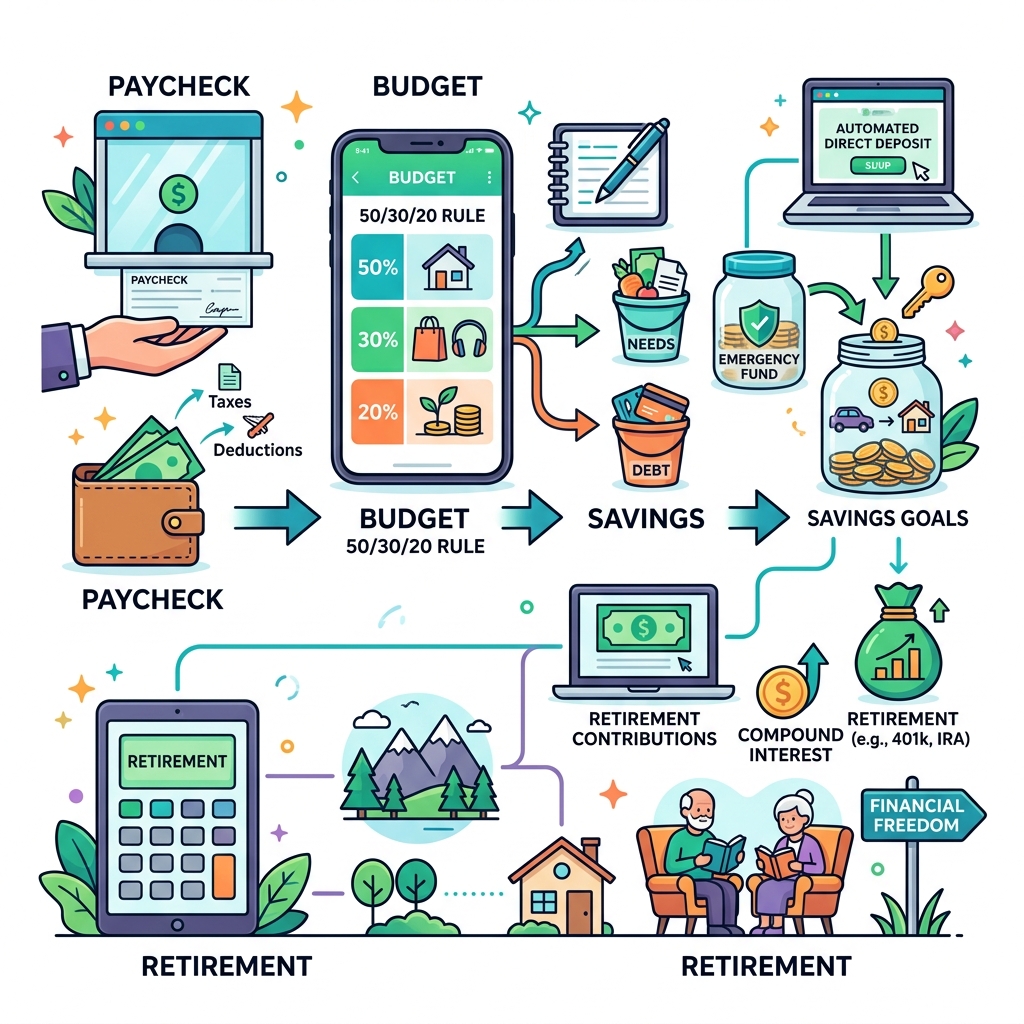
Calculating Your Real Take-Home Pay
The most common shock for new employees is looking at their first pay stub and seeing a number much smaller than their agreed-upon salary. This is the difference between your gross pay (the total amount you earned) and your net pay (what actually hits your bank account).
To build a budget that works, we must base everything on that net pay. If you try to budget based on your gross salary, you’ll find yourself short every single month.
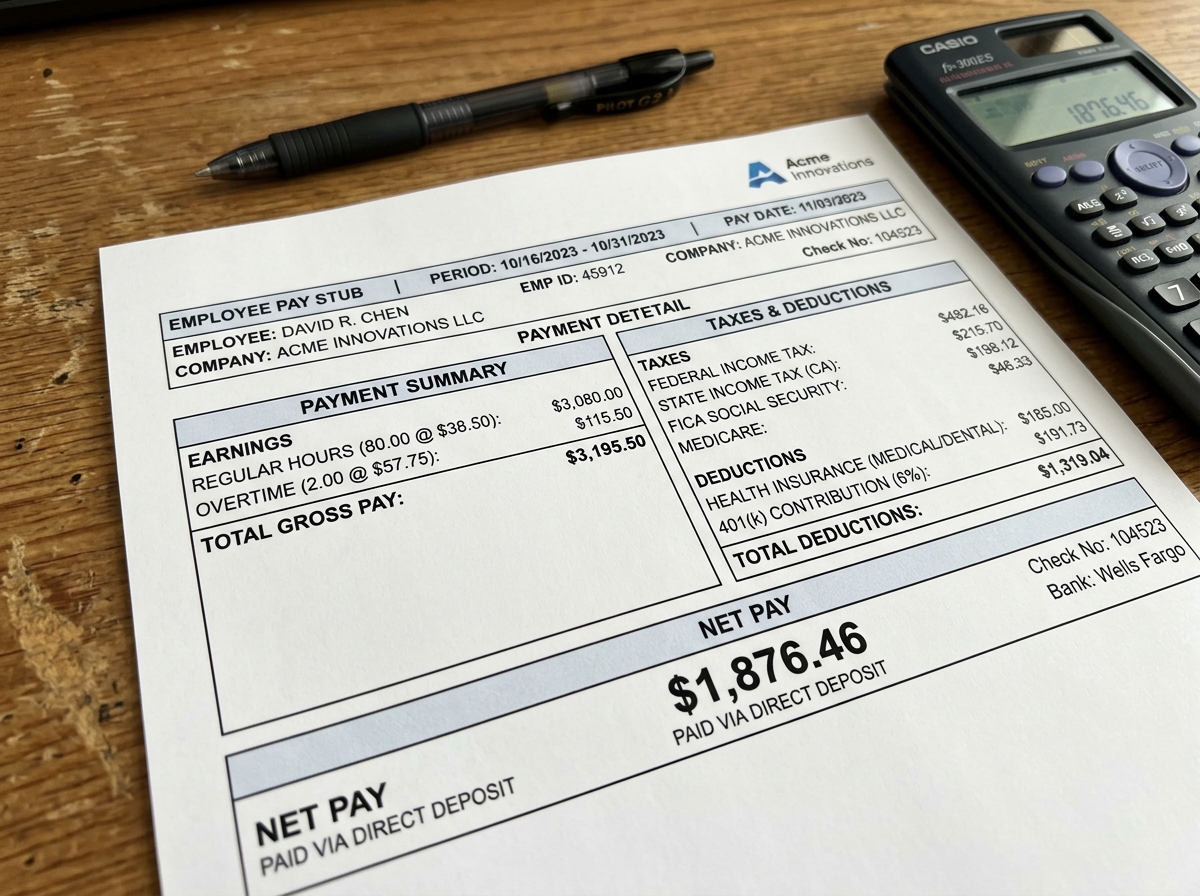
The Deductions Breakdown
Where does that money go? Usually, it’s a mix of four main categories:
- Federal and State Taxes: These are mandatory withholdings that the government takes to fund public services.
- FICA (Social Security and Medicare): These are also mandatory and go toward federal insurance programs.
- Health Insurance: If you’ve signed up for your employer’s health, dental, or vision plans, these premiums are often deducted before you get paid.
- Retirement Contributions: If you’ve enrolled in a 401(k) or 403(b), that money is moved directly into your investment account.
Gross vs. Net Income Comparison
To help you visualize this, look at how a typical monthly salary might break down:
| Category | Amount (Example) |
|---|---|
| Gross Monthly Salary | $4,000 |
| Federal/State Income Tax | -$600 |
| FICA (Social Security/Medicare) | -$306 |
| Health Insurance Premium | -$150 |
| 401(k) Contribution (5%) | -$200 |
| Net Take-Home Pay | $2,744 |
Understanding these numbers is the first step toward financial independence. If you need a hand setting this up, check out our easy-budget-planner-for-beginners/ to map out your specific numbers.
Essential First Job Budgeting Tips for Success
Once we know exactly how much cash is coming in, we need to look at where it’s going. We like to group expenses into two categories: fixed and variable.
Fixed expenses are the bills that stay the same every month. Think of your rent, your car payment, your internet bill, and your insurance. These are easy to plan for because they are predictable.
Variable expenses are the “sneaky” ones. These include groceries, gas, dining out, and entertainment. They change based on your behavior. One month you might spend $200 on groceries; the next, you might spend $400 because you hosted a dinner party.
The best way to get a handle on these is by tracking-daily-spending-effectively/. We recommend looking back at your last 30 days of bank transactions. It can be eye-opening to see how many “small” $10 purchases add up to a massive monthly total.
To make this easier, you can use budgeting-apps-for-beginners/ like YNAB (You Need A Budget) or Mint to categorize your spending automatically.
Mastering the 50/30/20 Rule
If you aren’t sure how much you should be spending in each category, the 50/30/20 rule is a fantastic framework for your first job budgeting tips. Here is how it breaks down:
- 50% for Needs: This covers your absolute essentials. Rent, utilities, basic groceries, transportation, and minimum debt payments.
- 30% for Wants: This is your “fun” money. Dining out, streaming services, hobbies, and that new outfit you’ve been eyeing.
- 20% for Savings and Extra Debt Repayment: This goes toward your emergency fund, retirement, and paying down loans faster than the minimum requirement.
Using this method ensures you are taking care of your future self while still enjoying your life today. If you want to get even more precise, you might consider zero-based-budgeting-for-beginners/, where every single dollar is assigned a specific job.
Distinguishing Needs vs. Wants in Your First Job Budgeting Tips
The hardest part of budgeting is being honest about what is a “need” versus a “want.”
- Need: A reliable way to get to work (bus pass or gas).
- Want: A brand-new car with a $500 monthly payment.
- Need: Nutritious food to eat.
- Want: Ordering Uber Eats three times a week.
Small changes in your “wants” can lead to massive savings. For example, Americans who make coffee at home rather than buying it at a shop save around $427 per year on average! That’s nearly enough to cover a major car repair or a new phone.
We suggest performing a “subscription audit.” Are you still paying for that gym you never visit or three different movie streaming services? Cutting these out is one of many easy-ways-to-reduce-monthly-expenses/ that can free up cash for your goals. For more ideas on living well without overspending, dive into our budget-friendly-lifestyle-tips/.
Building Your Financial Safety Net
Life is unpredictable. Statistically, 5,671 phone screens are broken every hour—that’s nearly 2 per second! Beyond broken phones, you might face a flat tire, a sudden medical bill, or even an unexpected job loss.
This is why an emergency fund is non-negotiable.
Most experts recommend saving enough to cover 3 to 6 months of living expenses. However, some financial institutions suggest aiming for 6 to 9 months if you work in a volatile industry.
If that number feels overwhelming, start small. Aim to save $500 or $1,000 first. Even saving $100 a month builds to $1,200 in a year, which can cover most common emergencies. Keep this money in a separate, liquid savings account—somewhere you can reach it quickly, but not so easily that you’ll spend it on a weekend trip.
Not sure how to find that extra cash? Start with our guide on budgeting-for-savings-where-to-begin/. You can also check out the Consumer Financial Protection Bureau’s guide to building emergency savings for more scientific insights into why this safety net is so vital.
Automating Your Savings and Retirement
The most effective way to save is to “pay yourself first.” This means moving money into your savings or investment accounts before you have a chance to spend it on anything else.
We highly recommend setting up direct deposit splits. Most employers allow you to send a percentage of your check (say, 10-20%) directly to a savings account and the rest to your checking. If you never see the money in your spending account, you won’t miss it.
The Power of Compound Interest
When it comes to retirement, time is your greatest ally. If you start contributing to a 401(k) or IRA early, your money has decades to grow through compound interest.
Consider this: If you invest $200 a month in a 401(k) beginning at age 25, you’ll have approximately $398,298 at age 65 (assuming a 6% annual return). If you wait until age 45 to start, you’d only have about $92,408.
Always contribute enough to your 401(k) to get the full employer match—it’s essentially a 100% return on your investment and “free money” for your future.
Managing Debt and Upfront Career Costs
Starting a first job often comes with “start-up costs” that hit before your first paycheck even arrives. You might need to pay a security deposit for a new apartment, buy professional work attire, or cover moving expenses.
These costs can easily run into the thousands. Avoid the temptation to put these on a credit card and carry a balance. With average credit card interest rates now over 20%, that debt can snowball quickly. Instead, try to find budget-friendly alternatives, like thrifted work clothes or asking friends for spare furniture. For more pitfalls to avoid, see our list of beginner-budgeting-mistakes-to-avoid/.
Smart Debt Management and First Job Budgeting Tips
For many of us, a first job also means the end of the student loan grace period. The average class of 2018 grad had nearly $30,000 in student loans.
When managing debt, remember:
- Know your dates: Most student loans give you a six-month grace period after graduation. Use this time to build your emergency fund.
- Prioritize high interest: If you have credit card debt, pay that off aggressively before putting extra money toward low-interest student loans.
- Protect your credit score: 35% of your credit score comes from your payment history. Even if you can only afford the minimum, always pay on time.
Building a solid credit history now will save you thousands of dollars in interest when you eventually want to buy a car or a home. Learn more about managing these early-career hurdles in our guide on personal-finance-budgeting-tips-for-young-adults/.
Frequently Asked Questions about First Job Budgeting
What is the difference between gross and net pay?
Gross pay is the total amount your employer pays you (your “salary”). Net pay is what you actually receive in your bank account after taxes, Social Security, health insurance, and retirement contributions are deducted. Always budget using your net pay!
How much should I realistically save for emergencies?
While the ultimate goal is 3-6 months of living expenses, don’t let that number scare you. Start by aiming for $500 or $1,000. Once you hit that, keep going until you feel secure. Nearly 61% of millennials have less than $500 in emergency savings—getting past that first milestone puts you ahead of the curve.
How often should I review and adjust my budget?
We recommend a quick check-in every week and a deep dive once a month. Your first few months at a new job will be full of “one-time” expenses. Regular reviews help you see if your 50/30/20 proportions are actually working or if you need to cut back on “wants.”
Conclusion
Managing your first paycheck wisely isn’t about depriving yourself of fun; it’s about giving yourself the freedom to enjoy your money without stress. By understanding your take-home pay, sticking to a simple 50/30/20 plan, and automating your savings, you are building a foundation that will support you for decades.
The habits you form today—like paying yourself first and avoiding lifestyle inflation—are the most valuable tools you own.
Ready to take control of your financial future? Start your financial journey with QuickFinHub for more tailored advice on navigating life’s big transitions. We’re here to help you turn that first paycheck into lasting wealth.
