
How Much Can Nurses Get in Student Loan Repayment?
Nurse student loan repayment programs are one of the most powerful tools available to nurses who are drowning in education debt.
Here’s a quick look at the top options:
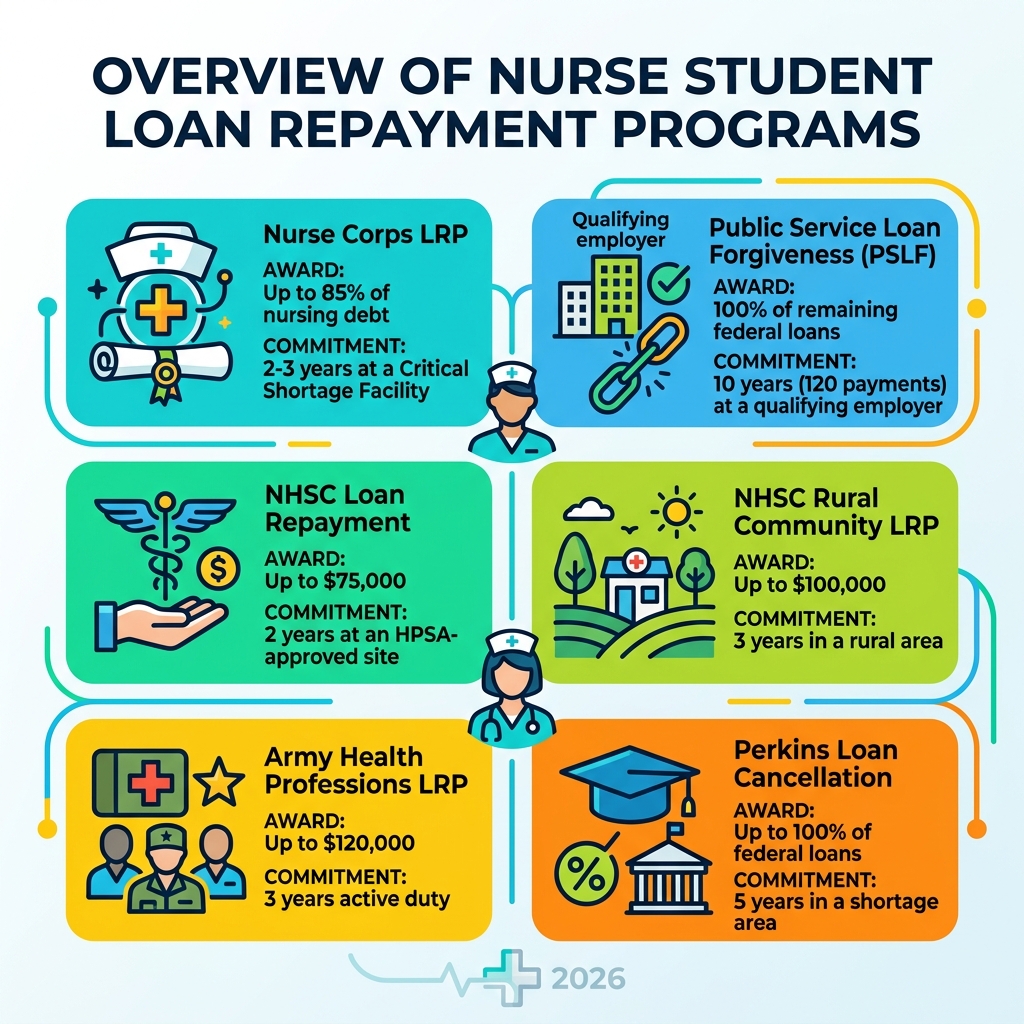
| Program | Max Award | Service Commitment |
|---|---|---|
| Nurse Corps LRP | Up to 85% of nursing debt | 2-3 years at a Critical Shortage Facility |
| Public Service Loan Forgiveness (PSLF) | 100% of remaining federal loans | 10 years (120 payments) at a qualifying employer |
| NHSC Loan Repayment | Up to $75,000 | 2 years at an HPSA-approved site |
| NHSC Rural Community LRP | Up to $100,000 | 3 years in a rural area |
| Army Health Professions LRP | Up to $120,000 | 3 years active duty |
| Perkins Loan Cancellation | Up to 100% of federal loans | 5 years in a shortage area |
Nursing is one of the most in-demand careers in the U.S. — but it doesn’t come cheap to get there.
ADN graduates carry an average of nearly $20,000 in student debt. BSN graduates average $23,711. And if you went for your MSN? You’re looking at over $47,000.
That’s a heavy load to carry when you’re just starting out in your career and your life.
The good news? There are dozens of federal, state, and specialized programs designed specifically to help nurses like you pay off that debt — sometimes completely — in exchange for serving in communities that need you most.
This guide breaks all of them down in plain language, so you can find the right fit for your situation fast.
Top Federal Nurse Student Loan Repayment Programs
When we talk about the “big hitters” in debt relief, we’re usually looking at federal programs. These are funded by the U.S. government and are designed to steer talented healthcare professionals toward areas that are struggling with staffing shortages.
Public Service Loan Forgiveness (PSLF)
The PSLF is perhaps the most famous program, but it requires patience. To qualify, you must work full-time for a qualifying employer—typically a government organization or a 501(c)(3) non-profit. After you make 120 qualifying monthly payments (which takes about 10 years), the government forgives the entire remaining balance of your federal Direct Loans.
It is important to note that you must be on an Income-Driven Repayment (IDR) plan for this to make financial sense. If you stay on a standard 10-year plan, your balance will be zero by the time you reach the finish line! If you’re feeling overwhelmed by the paperwork, check out our guide on Managing Student Loans the Effective Way to stay organized.
Perkins Loan Cancellation
If you have older federal loans, specifically Federal Perkins Loans, you might be sitting on a goldmine of forgiveness. Nurses can have 100% of their Perkins loans canceled over five years of full-time service. The cancellation happens in stages: 15% for years one and two, 20% for years three and four, and the final 30% in year five. This is a fantastic deal if you meet the 5-year service requirement in a designated shortage area.
For a deeper dive into the technicalities of these federal options, the Nurse Corps Fact Sheet is an excellent resource to keep on hand.
Nurse Corps: A Premier Nurse Student Loan Repayment Program
If you want to see a massive dent in your debt quickly, the Nurse Corps Loan Repayment Program (NCLRP) is the gold standard. This program is specifically for Registered Nurses (RNs), Advanced Practice Registered Nurses (APRNs), and nurse faculty.
Here is how the math works:
- Initial 2 Years: The program pays off 60% of your total qualifying nursing education debt.
- Optional 3rd Year: If you stay for a third year, they pay off an additional 25% of your original balance.
- Total: That is a whopping 85% of your nursing debt gone in just three years.
In exchange, you must work full-time at an eligible Critical Shortage Facility (CSF) or an accredited school of nursing. For the 2026 cycle, the program expects to make around 380 new awards. If this sounds like the path for you, you can Apply to the Nurse Corps Loan Repayment Program through the official portal.
NHSC and Other Federal Nurse Student Loan Repayment Programs
The National Health Service Corps (NHSC) offers several different nurse student loan repayment programs that target primary care and behavioral health.
- NHSC Loan Repayment Program: This offers up to $75,000 for primary care medical clinicians and up to $50,000 for dental or behavioral health clinicians for a two-year commitment.
- Focus on HPSA: Awards are prioritized based on Health Professional Shortage Area (HPSA) scores. The higher the score (meaning the greater the need in that community), the more likely you are to receive funding.
Learning how to navigate these applications is a skill in itself. We recommend Mastering the Art of Quick Loan Repayment to help you strategize your financial moves. You can also explore more broad funding opportunities through the Nurse Corps: Funding for Nurses and Nursing Students page.
State-Specific Nurse Student Loan Repayment Programs
Sometimes, the best help is found right in your own backyard. Many states have their own versions of nurse student loan repayment programs to keep healthcare talent within their borders.
- Georgia: The Georgia Board of Health Care Workforce offers an APRN Loan Repayment Program that provides up to $10,000 per year for a maximum of four years ($40,000 total). They also have a Nurse Faculty program offering up to $25,000 over two years. The catch? You must work in a rural county with a population of 50,000 or less.
- Mississippi: The Nurse Retention Loan Repayment Program (NULR) awards up to $6,000 per year for three years ($18,000 total). It is first-come, first-served, so you have to be quick!
- Texas: The Texas Nurse LRP is quite generous but varies by license level. LVNs can receive $4,500, RNs $6,500, and APRNs up to $13,333 annually for up to three years.
- Florida: The Nursing Student Loan Forgiveness Program (NSLFP) offers up to $4,000 per year for four years for nurses working in designated sites like public schools or state-run facilities.
If you’re looking for ways to handle the remaining balance while waiting for state funds, check out our Swift and Smart Tips for Paying Off Loans Faster.
Specialized Forgiveness for Nurse Faculty, Military, and Rural Health
Not every nurse works in a hospital. If you’ve chosen a specialized path, there are programs tailored just for you.
Nurse Faculty Programs
We need teachers to train the next generation! The Disadvantaged Faculty Loan Repayment Program offers up to $40,000 to educators from economically or environmentally disadvantaged backgrounds. There is also the Nurse Faculty Loan Program (NFLP), which can cancel up to 85% of loans for those who complete four years of post-graduation faculty service.
Military Nursing
The military offers some of the highest repayment amounts available. The Army Active Duty Health Professions Loan Repayment Program provides up to $120,000—distributed as $40,000 per year for three years—in exchange for active duty service. This is a life-changing amount of money for those willing to serve in uniform. For more on managing high-stakes debt like this, read Mastering Debt Management: A Guide for Beginners.
Rural and Substance Use Disorder (SUD) Health
The NHSC Rural Community Loan Repayment Program specifically targets the opioid epidemic. It offers up to $100,000 for full-time service in rural communities. For those in broader behavioral health roles, the Substance Use Disorder Treatment and Recovery (STAR) LRP offers a massive maximum of $250,000 for a six-year commitment. These programs are vital for addressing the mental health crisis in underserved areas.
Eligibility and Requirements for Nurse Student Loan Repayment Programs
Understanding the “fine print” is where many nurses get tripped up. Most nurse student loan repayment programs share some common requirements, but the specifics vary.
| Feature | Nurse Corps LRP | NHSC LRP | PSLF |
|---|---|---|---|
| Primary Requirement | Work at a Critical Shortage Facility | Work at an NHSC-approved HPSA site | Work for a non-profit or govt. agency |
| Citizenship | U.S. Citizen/National/Permanent Resident | U.S. Citizen/National | No specific requirement |
| Hours | Full-time (32+ hours/week) | Full-time or Half-time | Full-time (30+ hours/week) |
| License | Unencumbered RN/APRN | Unencumbered License | No license requirement |
Key Definitions to Know:
- Critical Shortage Facility (CSF): These include FQHCs, public hospitals, rural health clinics, and even some hospice programs.
- HPSA Score: This is a number assigned to an area based on its need for primary care, dental, or mental health providers.
- Direct Patient Care: For programs like Nurse Corps, you must spend at least 25% of your time (8 out of 32 hours) providing direct care to patients.
Applying for these can feel like a part-time job. If you’re just starting your financial journey, our Understanding the Basics: Simple Guide to Debt Management can help you get your bearings.
Frequently Asked Questions about Nursing Loan Repayment
Are nurse loan repayment awards taxable?
In many cases, yes. Unlike PSLF (which is currently tax-free at the federal level), programs like the Nurse Corps LRP are considered taxable income. This means the IRS expects a cut. The program will usually report the award to the IRS, and you may need to adjust your W-4 withholding to avoid a surprise bill at the end of the year. Some programs, like the Faculty LRP, may provide extra funds specifically to help cover the tax burden.
What happens if I fail to complete my service commitment?
This is the “scary” part. If you breach your contract—meaning you quit or move to an ineligible site without approval—the penalties are severe. You will likely have to pay back the funds you received, often with heavy interest and additional penalties. Most programs will pro-rate the debt if you’ve completed a significant portion, but it is always a legal obligation that should be taken seriously.
How do I determine if my workplace is an eligible service site?
You don’t have to guess! Use the Health Workforce Connector or the HPSA Find tool on the HRSA website. You can search by your facility’s address to see its HPSA score and eligibility status. If you are a nurse faculty member, check if your school is accredited by a body recognized by the U.S. Department of Education.
Conclusion
Navigating nurse student loan repayment programs can feel like trying to read a cardiac monitor in the dark, but the effort is worth it. Whether you are looking at the 85% debt relief from the Nurse Corps or the long-term total forgiveness of PSLF, there is a path out of debt for you.
At QuickFinHub, we are dedicated to helping young adults navigate these big life transitions. Nursing is a calling, and your focus should be on your patients, not your interest rates. If you’re ready to take the next step in organizing your finances, dive into our Beginner’s Guide to Navigating Debt Management or explore our full Debt Category for more tailored advice. You’ve done the hard work of getting through nursing school—now let these programs do the hard work of paying for it!
