
Your Money, Your Rules: A Student’s Starting Point
How to budget your money as a student comes down to six core steps you can start today:
- Add up your income – list every source: financial aid, part-time work, family support, scholarships
- Track every expense – rent, groceries, transport, entertainment, subscriptions
- Sort needs from wants – needs first, wants with what’s left
- Pick a budgeting method – the 50/30/20 rule is a great starting point
- Set spending limits – assign a cap to each category before the month begins
- Review weekly – adjust anything that isn’t working
College life is exciting. It’s also the first time most people are fully in charge of their own money — and that part is genuinely hard.
More than half of students run out of money before the end of term. Meanwhile, the average monthly cost of living beyond tuition sits somewhere between $1,200 and $2,000. That gap between what’s coming in and what’s going out doesn’t close itself.
The good news? You don’t need a finance degree to fix it. A simple, honest budget gives you control — over your stress, your spending, and your future.
This guide walks you through everything: how to build your first budget, which strategies actually work for students, and how to make your money stretch further without giving up your social life.
Why Learning how to budget your money as a student is a Game Changer

We’ve all heard the “broke college student” trope, but the reality is a bit more sobering. Recent data shows that 61% of Americans live paycheck to paycheck, and the average family carries nearly $8,000 in credit card debt. For a student, falling into these traps early can lead to years of financial “catch-up” after graduation.
Learning how to budget your money as a student isn’t just about saying “no” to a late-night pizza run; it’s about building a foundation for your entire adult life. When you have a plan, you stop wondering where your money went and start telling it where to go. This reduces the massive amount of financial stress that often leads to students dropping out—in fact, financial pressure is the number one reason students leave school, ahead of academic difficulty.
Furthermore, understanding your resources is vital. For instance, more than 90% of students at institutions like Tiffin University receive some form of financial aid. If you aren’t tracking how that aid is spent, you might find yourself short on rent by November. By mastering Simple Budgeting Tips for Students, you gain the freedom to enjoy campus life without the constant “can I afford this?” panic.
At QuickFinHub, we believe that How to Manage Money Without Losing Your Mind is a skill every young adult needs. A budget acts as your financial GPS—it doesn’t restrict where you go; it just shows you the best route to get there.
5 Steps to Building Your First College Budget
Creating a budget for the first time might feel like a chore, but we can break it down into five manageable steps. The goal is to create a “snapshot” of your financial life.
- Calculate Your Net Income: This is the total amount of money hitting your bank account after taxes.
- List Your Essential Expenses: These are the “non-negotiables” like rent, utilities, and basic groceries.
- Identify Your Variable Costs: Think about things that change each month, like dining out or gas.
- Compare the Two: Subtract your expenses from your income. If the number is negative, we need to trim the “wants.”
- Set Your Goals: Whether it’s an emergency fund or a spring break trip, give your extra dollars a job.
Using an Easy Budget Planner for Beginners can take the guesswork out of this process. The most important part of these steps is Tracking Daily Spending Effectively. Small $5 purchases—like that second double-double on the way to class—can add up to hundreds of dollars over a semester if you aren’t paying attention.
Identifying Your Income Sources
When we look at how to budget your money as a student, we have to categorize income into two buckets: repayable and non-repayable.
- Non-repayable Income: This is the “best” kind of money. It includes scholarships, grants, and contributions from family. It also includes earnings from a part-time job or a federal work-study position.
- Repayable Income: This includes student loans and lines of credit. Every $1,000 you borrow today could cost you $1,400 or more with interest over a 10-year repayment period.
By identifying exactly what is coming in, you can apply Saving Tips for College Students more effectively. If your income is irregular—perhaps you work more during the summer—we recommend underestimating your monthly income to ensure you don’t overspend during the leaner months.
Categorizing Expenses: Needs vs. Wants
The secret to a successful budget is being brutally honest about what is a “need” versus a “want.”
| Expense Category | Type | Example |
|---|---|---|
| Tuition & Fees | Fixed Need | Enrollment costs |
| Rent / Dorm | Fixed Need | Housing |
| Groceries | Variable Need | Basic food supplies |
| Internet / Phone | Fixed Need | Communication |
| Dining Out | Variable Want | Takeout, coffee shops |
| Subscriptions | Fixed Want | Netflix, Spotify, Gym |
| Entertainment | Variable Want | Concerts, movies, gaming |
It’s not always easy to decide. For example, are organic groceries a need or a want? Is a gym membership a need for your mental health, or a want because you could use the free campus gym? Learning How to Track Expenses at Home helps you see these patterns. We suggest looking back at three months of bank statements to see where your money actually goes versus where you think it goes.
Popular Budgeting Strategies for Campus Life
Not every budgeting style fits every student. We want you to find the one you can actually stick to.
- Zero-Based Budgeting: This is where you “give every dollar a job.” If you have $1,500 for the month, you assign all $1,500 to specific categories (including savings) until there is $0 left unassigned. This is excellent for Zero-Based Budgeting for Beginners because it prevents “accidental” spending.
- The Envelope System: A classic for a reason. You put a set amount of cash in an envelope for categories like “Groceries” or “Fun.” Once the cash is gone, that’s it for the month. This works wonders when Budgeting on a Low Income.
- Pay Yourself First: In this method, you immediately move a set amount (even just $25) into savings the moment you get paid. Then, you live off whatever is left.
For more tailored advice, check out our Personal Finance Budgeting Tips for Young Adults.
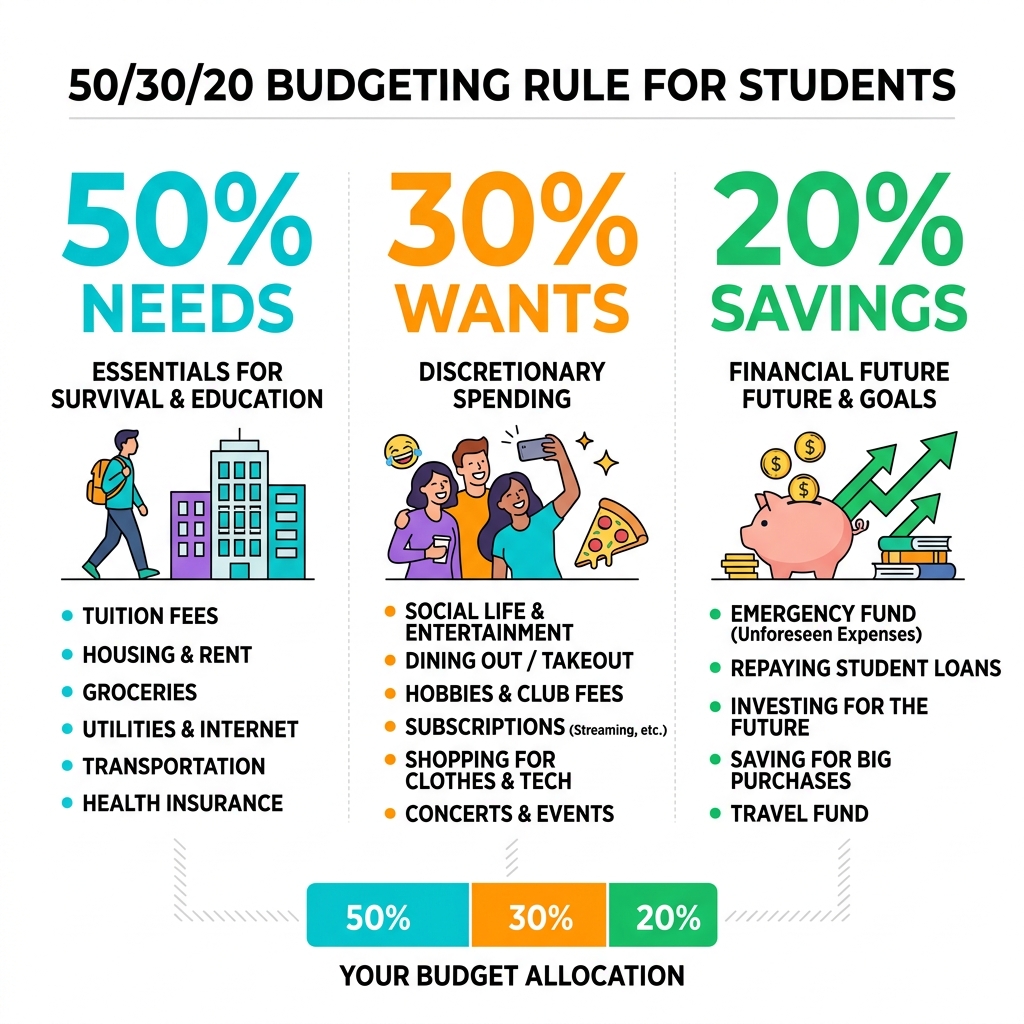
Applying the 50/30/20 Rule: how to budget your money as a student
The 50/30/20 rule is one of the most popular frameworks for a reason: it’s simple. Here is how it works for a student:
- 50% for Needs: Half of your income goes to rent, utilities, groceries, and transportation.
- 30% for Wants: This is your “fun money.” Dining out, hobbies, and that new outfit.
- 20% for Savings & Debt: This goes toward building an emergency fund or paying down credit card balances.
If you are living on a very tight budget, you might need to adjust this to 60/20/20 or even 70/20/10. The point is to have a framework. Starting this early is a great way to learn How to Start Saving Money in College.
Using Tools for how to budget your money as a student
You don’t have to do the math in your head. There are plenty of tools designed to make this easier:
- Budgeting Apps: Apps like Monarch, Rocket Money, or Splitwise (for splitting bills with roommates) can automate the tracking process. Check out our list of Budgeting Apps for Beginners.
- Spreadsheets: Google Sheets and Excel offer free budget templates that allow for total customization.
- Calculators: We recommend you Crunch the Numbers with a Personal Monthly Budget Calculator to see how small changes impact your long-term savings.
Automation is your best friend here. If you can set up an automatic transfer to your savings account, you’re much more likely to actually save.
Stretching Your Dollars: Practical Saving Hacks
When you’re learning how to budget your money as a student, the “expense” side of the equation is often where you have the most control. Here are some of our favorite “hacks” to make your budget stretch:
- The 24-Hour Rule: Before making an impulse purchase (like a new pair of shoes), wait 24 hours. Often, the urge to buy passes.
- Textbook Strategy: Never buy new if you can help it. Use sites like AbeBooks or Chegg, or better yet, check the campus library for copies on reserve. This can save you $500 to $1,000 a year.
- Cook at Home: The average student spends over $100 a month just on coffee and snacks. Cooking at home and meal prepping can save you $200–$300 a month compared to dining out. Start with Save More on Groceries: A Novice’s Approach.
- Student Discounts: Your student ID is essentially a coupon for the world. From Spotify and Amazon to local transit and clothing stores, always ask “Do you have a student discount?”
- Free Campus Resources: You’re already paying for the gym, counseling, and entertainment through your student fees. Use the campus gym instead of a commercial one ($30–$50 savings/month) and attend free campus movie nights.
For more ways to trim the fat, explore Easy Ways to Reduce Monthly Expenses and our Budget-Friendly Lifestyle Tips.
Managing Debt and Credit Responsibly
Debt is a tool, but it’s a sharp one. If you don’t handle it carefully, you’ll get cut.
The average federal student loan balance is around $39,100. While that number is large, student loans usually have much lower interest rates than credit cards. Credit cards often have rates of 20% or higher, which can lead to a debt spiral if you only pay the minimum.
Our Golden Rules for Credit:
- Treat it like a debit card: Only charge what you can pay off in full every month.
- Avoid “Interest-Only” thinking: On student loans, try to pay the monthly interest while you’re still in school. For a $10,000 loan, this might only be $27 a month, but it prevents the principal from growing.
- Don’t use loan refunds for “wants”: A $5,000 refund spent on a spring break trip could cost you $7,000+ by the time you finish paying it back.
We’ve put together guides on Managing Student Loans the Effective Way and Plastic Money Prudence: Credit Card Tips for Newbies to help you stay out of trouble. Your First Step to Freedom: Paying Off Credit Cards is easier when you never build up a massive balance in the first place. Always practice Borrowing Responsibly: Key Tips for Beginners.
Frequently Asked Questions about Student Budgeting
How much should a college student budget per month?
While every situation is different, the average college student needs between $1,200 and $2,500 per month for living expenses beyond tuition. This typically breaks down to:
- Housing: $500–$1,200
- Food: $250–$450
- Transportation: $50–$200
- Personal/Misc: $150–$300
How often should I review and adjust my budget?
We recommend a weekly check-in. It only takes 10–15 minutes. This allows you to see if you overspent on “wants” early in the month so you can adjust before you run out of money. You should also do a major “re-optimization” at the start of every semester as your schedule and income change.
What is the best way to build an emergency fund as a student?
Start small! Aim for a “starter” fund of $500 to $1,000. This covers the “life happens” moments like a flat tire, a broken laptop, or an unexpected medical bill. You can reach this by saving just $20 a week for six months.
Check out our guide on Simple Ways to Build an Emergency Fund and learn about Budgeting for Unexpected Expenses so a small crisis doesn’t become a mountain of debt.
Conclusion
Budgeting isn’t about depriving yourself; it’s about making sure you have money for the things that actually matter to you. Whether that’s a stress-free graduation, a study abroad trip, or just being able to afford a night out with friends without checking your bank balance first, a budget is the tool that gets you there.
At QuickFinHub, we are dedicated to helping you navigate these transitions with confidence. By avoiding Beginner Budgeting Mistakes to Avoid and Learning the Ropes of Personal Finance: A Beginner’s Guide, you are setting yourself up for a lifetime of financial wellness.
Ready to take the first step? Start your financial journey today by tracking your next five purchases. You might be surprised at what you find!
