
You Don’t Need a Lot of Money to Start Investing
The best app for investing small amounts of money in 2025-2026 depends on your goals, but here are the top picks to get you started fast:
| App | Best For | Minimum | Key Feature |
|---|---|---|---|
| Acorns | Spare change investing | $0 | Round-ups + IRA match |
| Stash | Beginners + fractional shares | $0.01 | Stock-Back Debit Card |
| Robinhood | Commission-free trading | $0 | 1-3% IRA match |
| M1 Finance | Hands-off custom portfolios | $100 | “Pies” portfolio builder |
| Wealthfront | Automated long-term growth | $500 | Robo-advisor + tax tools |
| Public | Diversified investing + bonds | $0 | Social + direct indexing |
Think you need thousands of dollars to start investing? You don’t.
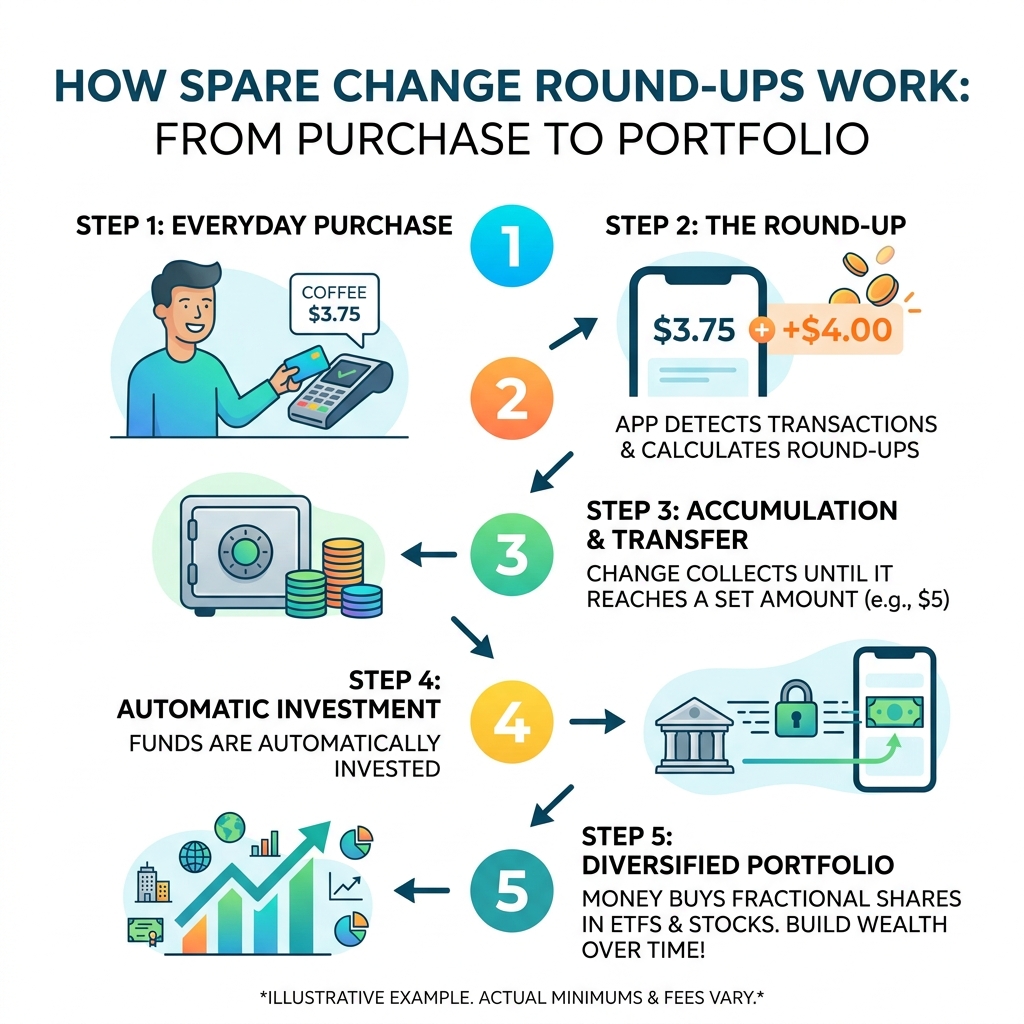
Micro-investing apps have made it possible for anyone to start building wealth — even with just a few dollars a week. Picture this: you buy a coffee for $3.75, and an app automatically invests the $0.25 change. Small? Yes. But those tiny amounts add up fast when they compound over time.
More than 14 million Americans have already put over $27 billion to work through apps like these. And Auto-Stash users set aside nine times more than people who invest manually — just because automation removes the friction.
Whether you’re trying to build an emergency cushion, save for a big goal, or just dip your toes into the stock market, there’s an app built for exactly where you are right now.
How an App for Investing Small Amounts of Money Works
At QuickFinHub, we know that the biggest barrier to investing isn’t usually a lack of interest—it’s the feeling that you don’t have enough cash to make a difference. That is where micro-investing comes in. These apps are designed to lower the barrier to entry, allowing you to participate in the global economy with the literal change in your pocket.
Micro-investing works by using technology to automate the process of saving and buying assets. Instead of needing $3,000 to open a brokerage account, you can start with as little as $1 or even $0.01. Most of these platforms utilize robo-advisors, which are automated algorithms that manage your money based on your risk tolerance. You answer a few questions about your goals, and the app builds a diversified portfolio of ETFs (Exchange-Traded Funds) for you.
The magic happens through automation. By setting up recurring contributions—say, $5 every Monday—you ensure that you are investing with small amounts consistently without having to think about it. This removes the emotional stress of “timing the market” and helps you build a habit that lasts. If you are looking for easy ways to start investing, automation is your best friend.
Choosing an App for Investing Small Amounts of Money via Round-Ups
One of the most popular ways to start is through “round-ups.” This feature links your debit or credit card to the app. Every time you make a purchase, the app rounds the transaction up to the nearest dollar and invests the difference.
Acorns is the pioneer of this model. When you buy a sandwich for $8.60, Acorns tracks that $0.40 “spare change” and moves it into your investment account once your round-ups hit a certain threshold (usually $5). It’s a “set it and forget it” strategy that turns everyday spending into a wealth-building tool. This is one of the most safe investing options for beginners because it uses money you wouldn’t otherwise miss.
Beyond just round-ups, these apps often include:
- Automatic Rebalancing: Ensuring your portfolio stays diversified even as market prices change.
- Dividends: Automatically reinvesting the small payments you get from companies back into your portfolio.
- Educational Content: Helping you learn the ropes while your money grows.
Finding an App for Investing Small Amounts of Money with Fractional Shares
In the old days, if you wanted to buy a share of a big tech company and the price was $2,500 per share, you needed $2,500. Today, an app for investing small amounts of money uses fractional shares to break those barriers down.
Fractional shares allow you to buy a “slice” of a stock. If you have $5, you can own $5 worth of that expensive tech company. Platforms like Stash and Robinhood have mastered this. Stash even offers a “Stock-Back” debit card that rewards your spending by giving you fractional shares of the companies you shop at. Buy a pair of shoes at a major retailer, and you might get 0.11% of that purchase back in the form of their stock.
This provides incredible market access. You no longer have to choose between paying rent and owning a piece of the world’s most successful corporations. If you’re interested in investing in stocks for beginners, fractional shares are the most accessible entry point.
Top Micro-Investing Platforms for 2025 and 2026
The landscape for investing apps has become highly competitive, which is great news for us! Fees are lower, and features are more robust than ever. Here is a deeper look at the top contenders for 2025 and 2026.
Wealthfront: The Hands-Off Powerhouse
Wealthfront is ideal for those who want a sophisticated robo-advisor experience. While its $500 minimum is higher than some others, it offers advanced features like tax-loss harvesting, which can help lower your tax bill by selling losing investments to offset gains. It’s a great “step up” for those who have moved past the spare-change phase.
M1 Finance: The Architect’s Choice
M1 Finance uses a unique “Pies” system. You create a “Pie” of the stocks and ETFs you want to own, and the app automatically distributes your deposits to keep your Pie in the right proportions. It’s perfect for long-term, hands-off investors who still want a say in what they own. It has a $100 minimum to get started.
Public: The Social Investor
Public has evolved into a powerhouse for diversification. You can invest in stocks, ETFs, and even corporate bonds or Treasuries. One of its standout features is “social investing,” where you can follow other investors to see their moves (though we always recommend doing your own research!).
Betterment: Goal-Based Growth
Betterment is similar to Wealthfront but often cited as even more beginner-friendly. It focuses heavily on your specific goals—like a “Safety Net” fund or a “Retirement” fund—and manages the risk level of each account separately.
If you are just starting out, checking out a dedicated list of investing apps for beginners can help you narrow down which interface feels right for you. Many of these apps focus on ETFs, so having a beginner guide to ETFs handy will help you understand exactly what you’re buying.
The Math of Micro-Investing: Turning $5 into $70,000
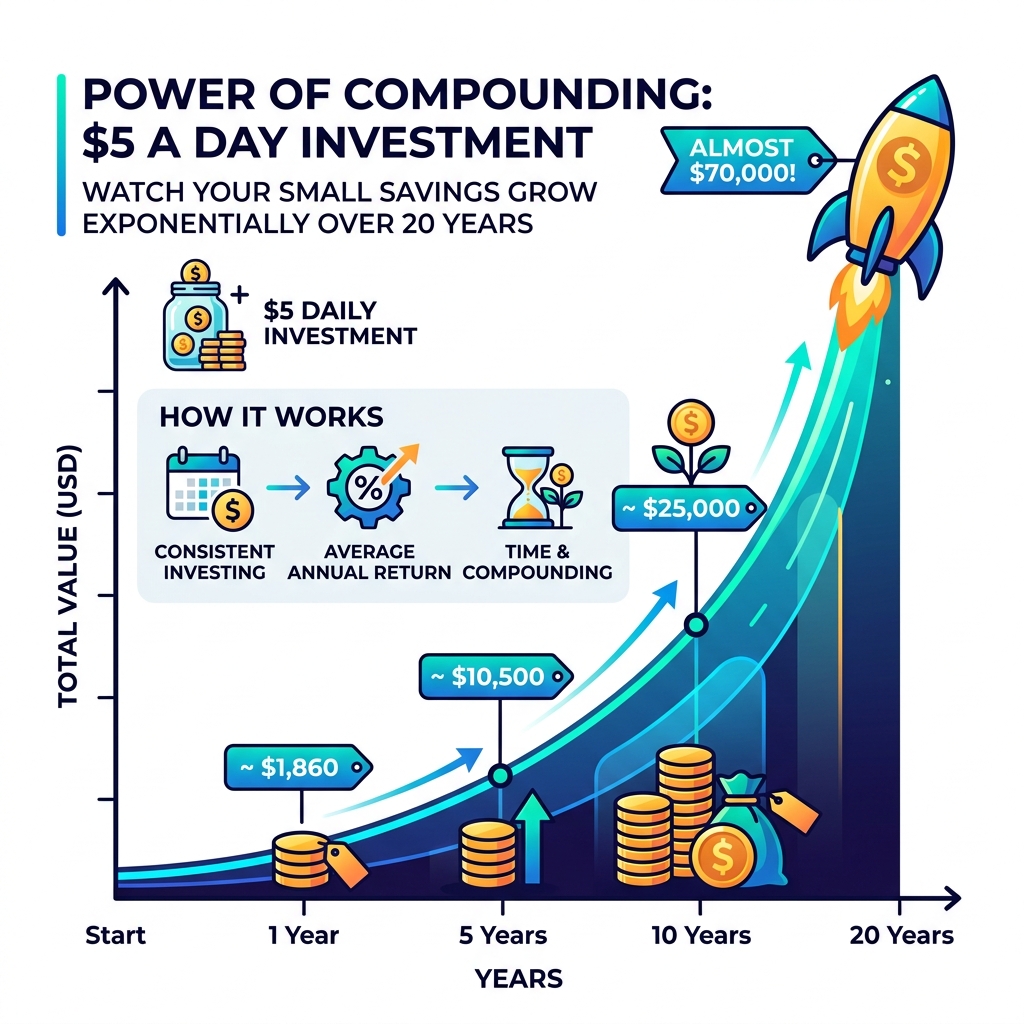
We’ve all heard that “time is money,” but in investing, time is actually more important than money. This is thanks to the power of compounding. When your investment earns a return, that return then earns its own return. Over decades, this creates an exponential curve.
Let’s look at the numbers. Imagine you skip one gourmet coffee a day and instead put $5 a day into an app for investing small amounts of money. That’s about $150 a month. If we assume a conservative 6% average annual return, here is how that small sacrifice grows:
- 1 Year: ~$1,860
- 5 Years: ~$10,500
- 10 Years: ~$25,000
- 20 Years: Almost $70,000!
Now, imagine if you increased that amount as your salary grew. That $70,000 could easily become $200,000 or more. The key is starting early. A 20-year-old who starts with $5 a day is in a much better position than a 40-year-old who starts with $50 a day. For more ways to maximize your early start, check out our investing tips for young adults.
Understanding Fees, Risks, and SIPC Protection
While we love the accessibility of these apps, we have to be realistic: no investment is without risk. Before you link your bank account, keep these three things in mind:
1. Watch the Fees
Many micro-investing apps charge a flat monthly subscription fee (e.g., $3 or $5 a month). On a $10,000 account, $3 a month is negligible. But if you only have $100 in your account, a $3 monthly fee is 3% of your balance every month. That will eat your returns faster than the market can grow them. Always check if the fee makes sense for your account size.
2. Market Volatility and Limited Control
When you use a robo-advisor, you are usually choosing a “risk level” rather than individual stocks. This means you have less control over exactly what you own. Additionally, the market goes up and down. You can lose money, especially in the short term. Micro-investing is a long-term game; don’t panic if your balance drops $10 next week.
3. SIPC Protection
The good news is that your actual assets are generally safe from the app company itself going bust. Most reputable apps are members of the SIPC (Securities Investor Protection Corporation). This protects your securities (stocks/bonds) up to $500,000 if the brokerage firm fails. You can find more SIPC protection details on their official site. This doesn’t protect you from market losses—it just means the app can’t run away with your shares.
Learning how to invest without stress involves understanding these protections and keeping a long-term perspective.
Frequently Asked Questions about Micro-Investing
Are micro-investing apps safe for beginners?
Yes, generally they are very safe. Most use bank-level encryption (256-bit) and two-factor authentication (2FA). As long as you choose an app that is SIPC-protected and has a strong reputation, your biggest “risk” is simply the normal ups and downs of the stock market.
How much money do I need to start investing?
Technically, you can start with one cent on apps like Stash. Most people find that starting with $5 to $20 is a good way to see some initial movement in their portfolio. The “minimum” is rarely a hurdle anymore.
Can I really build wealth with just spare change?
Spare change alone probably won’t make you a millionaire by next year, but it will build the habit. Most successful micro-investors start with round-ups and then eventually add a recurring “Auto-Invest” of $20 or $50 a month. It’s about the momentum.
Conclusion
At QuickFinHub, our mission is to help you navigate these transitions with confidence. Using an app for investing small amounts of money is more than just a financial move—it’s a mindset shift. It’s moving from being a “consumer” to being an “owner.”
Whether you choose Acorns for its round-ups, Stash for its fractional shares, or M1 Finance for its “Pies,” the most important step is the one you take today. Don’t wait until you have “enough” money. Start with what you have, automate the process, and let time do the heavy lifting.
Ready to dive deeper into finance? Explore our Investing Basics section to keep your momentum going. Your future self will thank you for the spare change you invested today!
